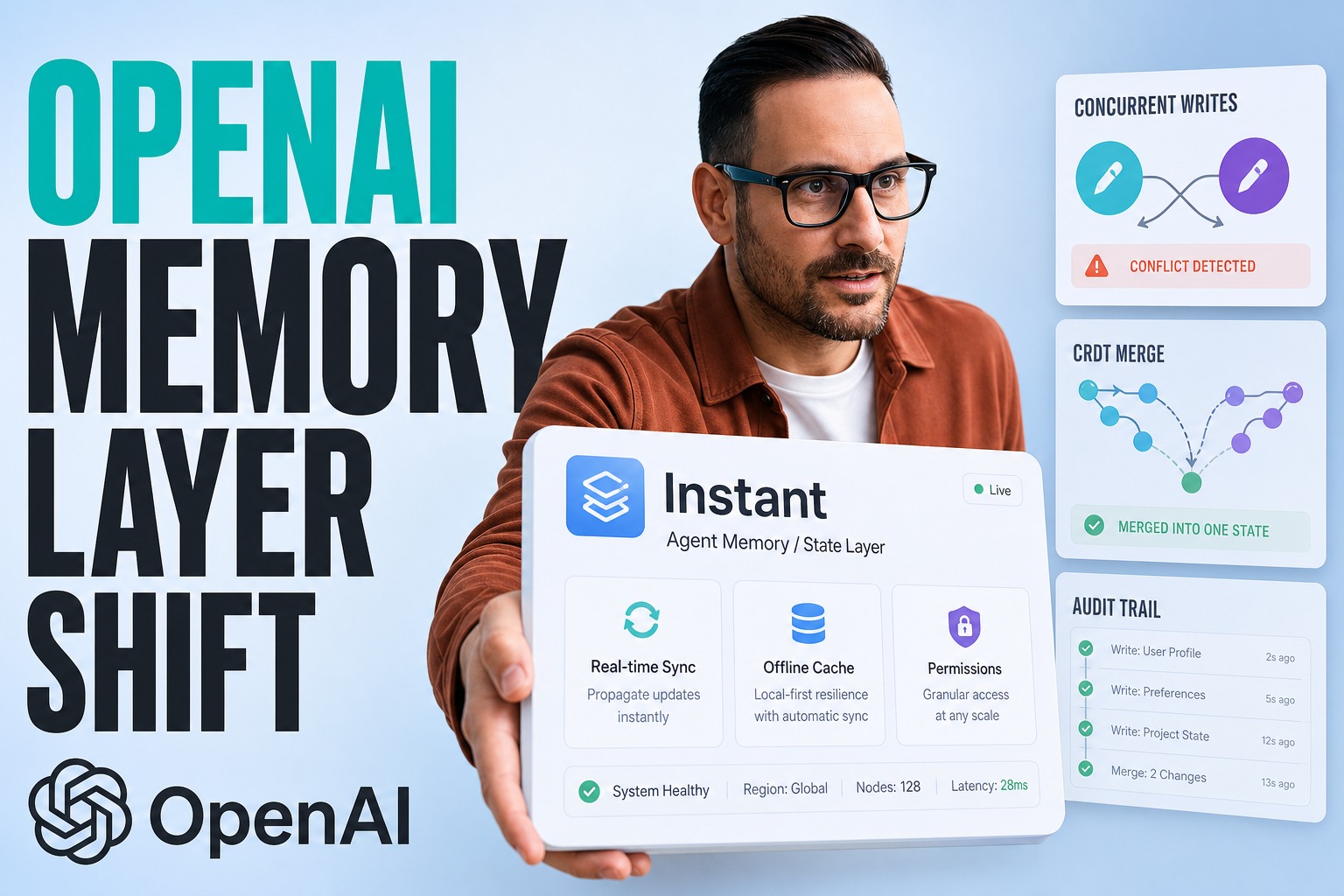
What changed this week that actually affects our architecture choices for AI agents? → OpenAI is bringing the Instant team in-house, and Instant’s cloud hosting stays up only until August 31, signaling a serious push toward a first-class ‘memory/state layer’ for agents.
What’s the real business/engineering question behind the news? → How do we implement persistent, concurrent, real-time agent state so autonomous workflows don’t corrupt data the moment multiple actors touch the same record?
Why does this matter now, not ‘someday’? → Agent capability is expanding quickly, but teams shipping calendar, CRM, or GitHub automation are already hitting state conflicts and ‘agent amnesia’ in production.
What should a CTO decide this quarter? → Whether to treat ‘agent memory’ as an app feature you build ad hoc, or as a dedicated platform layer with real-time sync, offline-first caching, and conflict resolution.
What’s the non-obvious angle we’re taking? → Model quality isn’t the blocker; the failure mode is state concurrency—so the winning agent stack is defined by its memory layer boundaries and guarantees.
Quick Answer: What is the right ‘memory layer’ architecture for AI agents in production?
A production-grade AI agent needs a persistent state layer that survives restarts, supports real-time synchronization, handles concurrent writes, and still works with offline caching. The dominant shift signaled by OpenAI absorbing Instant is that ‘memory’ is no longer a prompt trick; it’s a backend discipline. The right response this quarter is to design agents around a clear state boundary, with conflict resolution (often via CRDT-style approaches) treated as a core requirement.
If your agent roadmap assumes that better models will fix reliability, you’re optimizing the wrong layer: the first real scaling bottleneck is state consistency when multiple actors (agents and humans) write to the same data at the same time.
OpenAI’s Instant move is a platform bet that changes what ‘agent-ready’ backend means
Instant is described as an ‘ultimate tool for building backend infrastructure for AI Agents,’ bundling database, permission verification, real-time sync, and offline caching. When a model company chooses to acquire that capability rather than treat it as an integration detail, it signals that agent platforms are converging on a default: agents will be expected to run with durable memory and collaborative state, not just stateless chat sessions. In our view at Plavno, this shifts ‘agent readiness’ from prompt engineering to backend guarantees—exactly where most teams are weakest.
- Persistent state becomes part of the agent contract. If agents schedule meetings, change records, or submit PRs, the system must persist intent and outcomes as durable state, not ephemeral ‘chat history,’ or you will lose causality after any failure.
- Concurrency is the new normal, not an edge case. The moment a human edits a calendar slot while an agent is also editing it (or multiple agents collaborate), you’re in multi-writer territory, and naïve last-write-wins behavior becomes product-breaking.
- Real-time sync is an operational requirement. Once agents operate ‘live’ against shared objects, your backend needs synchronization semantics and predictable propagation paths, not just periodic polling and hope.
- Offline-first stops being a mobile-only concern. If a workflow spans intermittent connectivity (client apps, field operations, travel), caching and reconciliation become part of correctness, not a UX enhancement.
- Permission verification moves from app logic into data shape. As systems become agent-driven, permission models must be expressed close to data access, because an autonomous actor will explore any reachable surface area.
The dominant news signal: ‘memory for agents’ is being productized as infrastructure
Instant released a 1.0 version about a week before the team joined OpenAI, and its cloud hosting remains operational until August 31. Tens of thousands of customers now have to plan a migration. That pattern—rapid consolidation and short operational windows—tells us the market is treating the agent memory/state layer as foundational infrastructure, not a nice-to-have library. Teams shipping agents need to design for vendor shifts and portability, because these layers are becoming strategic.
- Platform risk becomes immediate. When hosting has a fixed end date, agent products depending on it face a forced re-architecture window; you need explicit exit paths for state layers.
- ‘One-stop backend’ is attractive precisely because it’s hard. Databases, auth, sync, caching, and conflict resolution are each deep domains; bundling them changes build-vs-buy calculus for CTOs.
- Agent orchestration without memory is a dead end. Long-horizon workflows require durable state to resume, audit, and correct; otherwise, every interruption becomes a logic reset.
- The developer experience is strategic. Instant’s ‘Firebase for the AI era’ framing matters because the winning platforms reduce backend complexity to a default path, not a bespoke project.
- The acquisition reinforces a platform trajectory. The input frames OpenAI as evolving from a model-making company toward a platform-building company; that implies tighter integration across model, tools, and state.
Why this matters more than ‘yet another acquisition’ for US engineering leaders
From a US CTO perspective, the hard part isn’t believing in agents; it’s shipping them safely inside real systems like scheduling, code delivery, or enterprise workflows. The input’s calendar collision example (three operations on the same data in the same millisecond) is not a hypothetical; it’s the default once agents and humans share objects. This is where teams discover that correctness is constrained by state semantics, not by how eloquent the model sounds.
- Calendar and CRM are adversarial data environments. Multiple parties update the same fields with different intentions; without explicit merge semantics, you get silent corruption.
- GitHub automation raises the stakes. Agents that read Issues, write code, submit PRs, and fix bugs depend on consistent state to avoid duplicate work and conflicting edits.
- Multi-agent collaboration amplifies contention. Platforms like EinsteinArena highlight collaboration and competition; regardless of domain, more agents means more write conflicts.
- Reliability failures become ‘business failures’. A single bad merge can invalidate schedules, approvals, or deployments; the incident reads like a product defect, not an AI quirk.
- Auditability becomes mandatory. When autonomous systems act, you need to persist intent, decisions, and outcomes in a way that can be inspected after the fact.
Agent systems don’t break in the model—they break at the state boundary
The input calls out a ‘fatal flaw’ of AI agents: persistent state management and real-time consistency. We agree, and we’ll push the claim further: the primary production failure mode is not hallucination, it’s state concurrency—the moment multiple writers touch shared data and the system can’t reconcile. That’s why a ‘memory layer’ is not a chat feature; it’s the engineering substrate for correctness.
If we’re building agents that schedule meetings or autonomously ship code, then state must encode the work-in-progress, not just the final answer. In practice, this means we design the architecture around an explicit state store, a synchronization path, and conflict handling rules, then choose models and tools around those constraints.
What Instant’s traction implies: the market rewards ‘boring’ correctness features
Instant is framed as industrial-grade infrastructure validated under high concurrency and high load, with reported traction that includes 10,000+ GitHub stars, more than 17,000 registered developers, more than 400,000 apps built, and 2.5 billion cumulative transactions. Whether we adopt any specific vendor or not, the signal is that developers are voting for a backend that hides complexity: permissions, synchronization, offline behavior, and conflict resolution. At Plavno, when we advise on platform direction in AI consulting, this is the category we treat as foundational.
- Stars and developer count indicate developer-experience pull. A backend that developers can adopt quickly wins mindshare, which then becomes an ecosystem advantage.
- Hundreds of thousands of apps suggest repeated patterns. If so many apps were built on one approach, it hints that ‘agent memory’ needs standard primitives, not bespoke tables per team.
- Billions of transactions highlight operational maturity. State layers aren’t judged by demos; they’re judged by whether they hold up under sustained real traffic.
- The Firebase analogy is strategically accurate. Firebase became the default backend for many mobile apps because it collapsed backend effort; Instant aims for the same collapse for agent-era apps.
- Short-run migrations are a forcing function. With hosting staying up only until August 31, teams must think like platform engineers: portability, backups, and replacement plans.
The ‘amnesia’ problem is actually a persistence and synchronization design problem
The input describes agents as suffering ‘amnesia’ and ‘concurrency syndrome.’ In production terms, amnesia is what happens when state is stored in transient contexts (sessions, prompts, tool outputs) rather than persisted as an authoritative record. Concurrency syndrome is what happens when multiple writers operate without reconciliation. Once an agent is allowed to act repeatedly over time, persistence and sync become the only way to keep the system coherent.
- Session memory is not system memory. Keeping history in a conversation window does not provide durable, queryable, auditable state that downstream systems can rely on.
- Tool calls create hidden state. If the agent’s ‘memory’ is scattered across tool outputs and logs, resuming a workflow becomes guesswork after any failure.
- Real-time sync requires defined semantics. It’s not enough to push updates quickly; you need to define what happens when updates conflict.
- Offline caching is part of correctness. Once clients or edge workflows operate offline, the reconciliation path defines what ‘truth’ means.
- Permissions must be enforced under automation. Agents are persistent actors; if permission checks aren’t consistent, they become an attack surface and a compliance risk.
CRDT-style conflict resolution is the quiet capability that enables multi-writer agents
The input explicitly mentions CRDT algorithms as a way to resolve merge conflicts when the network is restored. We treat that as the key capability behind the scenes: if your agent system must survive concurrent edits, you need a principled merge strategy. CRDT approaches are one way; other systems rely on locking or strict serialization. The point is that you must choose a conflict philosophy early, because it dictates UX, audit paths, and failure recovery.
- Strict locking reduces conflicts but increases brittleness. Locking can serialize writes, but it also creates operational failure modes under latency, retries, and partial outages.
- Last-write-wins is easy and often wrong. It can erase intent silently, which is unacceptable in scheduling, approvals, and any domain with human accountability.
- Merge-based approaches preserve parallelism. They allow multi-writer systems to keep moving, but require careful modeling of what can be merged safely.
- Offline-first amplifies the need for merge logic. If clients can diverge while offline, reconciliation is not optional; it is the backbone of recovery.
- Agents increase write frequency and autonomy. Even if humans are careful, autonomous workflows can generate high contention simply by being persistent.
Plavno’s stance: the memory layer is a product surface, not a database decision
When we build agent systems, we treat ‘memory’ as an explicit product surface with engineering guarantees: what is persisted, who can mutate it, how it synchronizes, and how conflicts are resolved. This is why we’re skeptical of teams that start with model selection and leave state to ‘later.’ OpenAI acquiring an agent backend team underlines that state is strategic. For teams investing in AI agents development, we recommend making the state layer the first architecture diagram you draw.
Where the memory layer sits in a real agent stack (and where it must not sit)
In practice, the memory layer must be authoritative and shared across the parts of the system that can act: the agent runtime, the UI, and any integration services. If it lives only inside the model context, you get fragile ‘memory’ that disappears when sessions rotate. If it lives only inside downstream systems, you get opaque behavior and impossible recovery. The sane position is a dedicated state layer with clear integration boundaries, supported by the same operational rigor as the rest of your cloud platform, which is why we often start from cloud software development concerns rather than AI demos.
| Memory approach | What it optimizes for | Where it fails first |
|---|---|---|
| Prompt or session history as ‘memory’ | Fast prototyping and conversational continuity | Any restart, any multi-user scenario, and any need for auditability or shared state |
| App-specific tables without sync semantics | Simple CRUD and direct ownership by one service | Concurrency conflicts, offline behavior, and cross-surface coordination (agent + UI + integrations) |
| Dedicated state layer with real-time sync and conflict handling | Multi-writer correctness and collaboration | Design complexity and the need to define merge/permission semantics upfront |
| Outsourced ‘one-stop’ backend (Firebase-style) | Speed of delivery and reduced backend surface area | Vendor dependency and migration risk when platform direction changes |
The architectural boundary that matters: intent state vs. outcome state
For production agents, we separate ‘intent’ (what the agent is trying to do, with constraints and approvals) from ‘outcome’ (what actually happened in external systems). This separation reduces chaos during retries and concurrency. When two actors compete for the same calendar slot, you want the system to preserve both intents, then resolve them through explicit rules, rather than overwriting one update. That’s how you keep agents correct under contention.
Define the authoritative object model for agent work, including what must be persisted as intent (plans, proposed edits, approvals) versus what is merely output text.
Decide how concurrent writes are handled for each object type, and pick one conflict philosophy (merge, lock, or explicit reconciliation) instead of letting defaults leak in.
Place permission verification close to the data access path so the agent runtime cannot bypass policy via indirect tool calls.
Design the synchronization path across surfaces (agent runtime, UI, services) so ‘real time’ has a defined meaning under retries and partial failure.
Plan for offline caching and reconnection semantics early if any client or workflow can be disconnected, because reconciliation rules will shape the entire data model.
How we evaluate an agent memory backend this quarter (without being vendor-led)
Instant’s story is compelling because it packaged obscure backend work—real-time sync, conflict resolution, offline-first—into an out-of-the-box SDK. But a CTO decision shouldn’t be ‘use Instant or don’t.’ The decision is whether your current architecture can honestly support multi-writer state with auditability. If it can’t, then you either adopt a platform approach or you budget engineering time to build comparable primitives.
In evaluation, we focus on what breaks under stress: what happens when three writes land in the same millisecond, how the system recovers after partial failure, and whether permission verification holds across all access paths. If you need to accelerate delivery, augmenting your team via outstaffing can help—but only if you keep architecture ownership internal and document the state semantics like a product requirement.
Real-world agent scenarios where the memory layer is the whole product
The input’s calendar example is the canonical case: multiple actors (your agent, your boss’s agent, and you) update the same slot at the same moment. The right system doesn’t ‘crash or get messed up’; it persists conflicting intents and resolves them deterministically. The same pattern repeats in GitHub automation, where agents read Issues, write code, submit PRs, and fix bugs: without durable state, you get duplicate effort, conflicting patches, and unrecoverable ambiguity about what was already done.
| Scenario from the input | What the agent is doing | What the state layer must guarantee |
|---|---|---|
| Scheduling collisions at the same time | Writing shared calendar data under contention | Deterministic conflict handling and a preserved history of intents and outcomes |
| GitHub Issues to PR automation | Reading Issues, writing code, submitting PRs, fixing bugs | Durable workflow state so retries and parallel work don’t produce conflicting changes |
| Multi-agent collaboration/competition (EinsteinArena context) | Multiple agents acting in parallel over shared tasks | Multi-writer synchronization semantics so collaboration doesn’t become data corruption |
| Offline/disconnected operation | Continuing to work without network, then reconnecting | Offline caching with reconciliation that resolves divergence without silent loss |
The risks you inherit when you ‘solve memory’ by adopting a platform layer
Instant’s cloud hosting remaining operational only until August 31 is a reminder that platform dependencies are real dependencies. When your memory layer is outsourced, your agent reliability becomes coupled to someone else’s roadmap and business decisions. That doesn’t mean ‘never buy’; it means you must treat the memory layer like a critical vendor: backups, portability, and security reviews are non-negotiable. We also recommend validating your security posture with services like cybersecurity and penetration testing before you grant autonomous actors broad data reach.
The fastest path to ‘agent scale’ is not adding more agents; it is making state changes safe, reversible, and auditable under concurrency.
Closing insight: OpenAI’s move makes ‘state engineering’ the competitive edge for agents
OpenAI absorbing Instant is a clear signal that the next wave of differentiation is not just smarter models—it’s the platform layer that makes long-horizon, autonomous workflows stable. Our central claim stands: agent failures happen at the state boundary, so the right response is to architect a dedicated memory/state layer with real-time sync, offline caching, and conflict resolution treated as first-class requirements. Author: Plavno team. Last updated: August 2026. If your agents are moving from demos to real workflows, we can help you define the state boundary, choose the right primitives, and de-risk migrations before August 31 pressure turns into a production incident.
 Chat GPT
  Perplexity
  Claude
  Gemini
