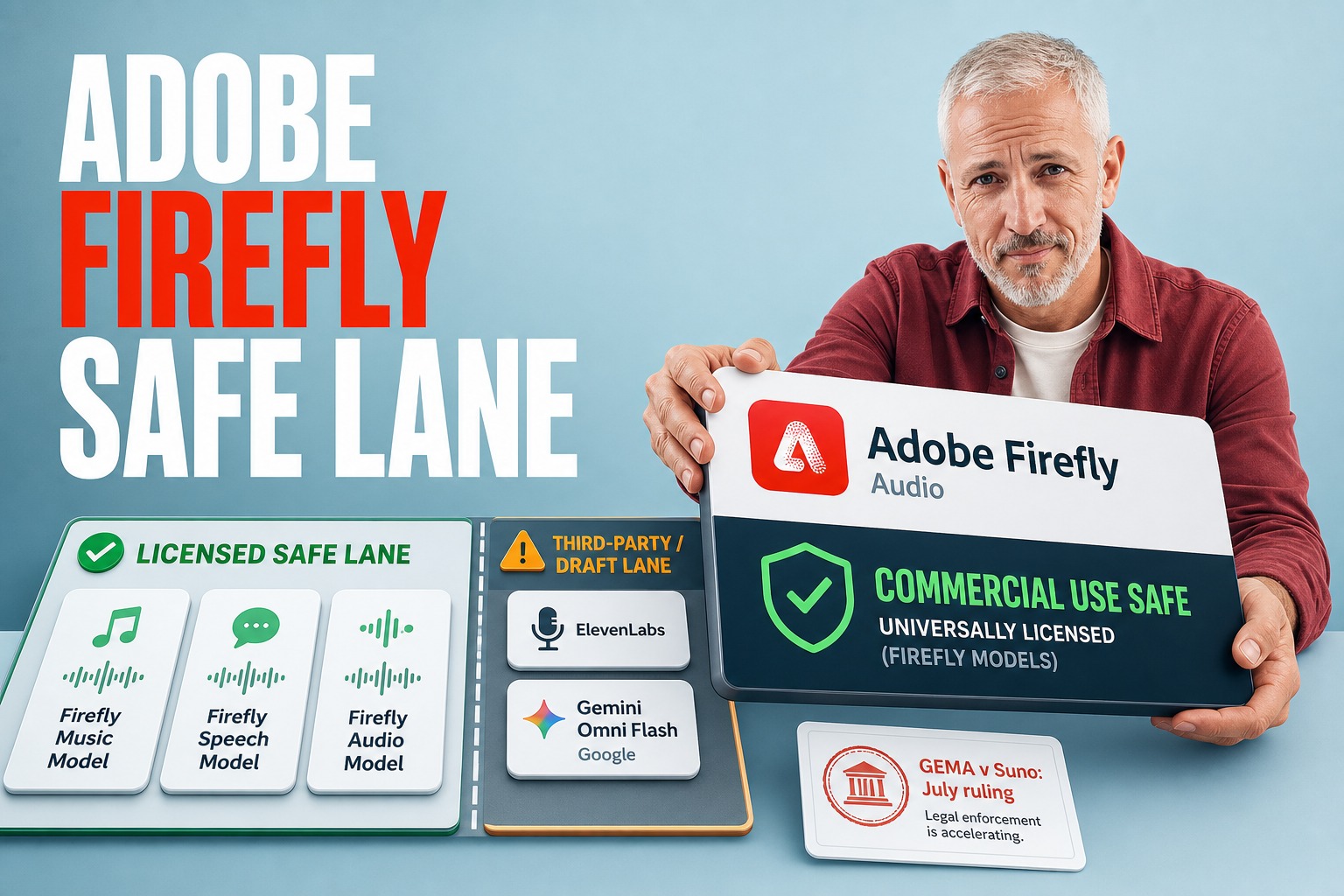
Did Adobe just make generative audio usable for brand and enterprise teams? → Mostly, yes—but only if we treat Firefly’s licensing promise as a hard boundary in our workflow, not as a blanket safety label.
What is the dominant shift this week? → Generative audio is being productized as an indemnity-like promise (commercially safe) rather than as a pure quality race.
What is the real search question engineers are trying to answer? → Can we ship AI-generated music, speech, and sound effects without takedowns or client-side licensing blowups?
What’s the non-obvious technical catch? → Firefly is a multi-model studio (including third parties like ElevenLabs and Google’s Gemini Omni Flash), and the commercial safety language attaches to Firefly models specifically.
What decision should a CTO make this quarter? → Whether to adopt Firefly audio as the default legal-safe lane for deliverables—and how to isolate any non-Firefly model output with separate governance and provenance tracking.
Quick Answer: should we use Adobe Firefly audio when the requirement is commercially safe output?
Yes—if your definition of success is reducing rights-holder exposure for client deliverables, Adobe Firefly’s Generate Music/Generate Speech/Generate Sound Effects are positioned explicitly around commercial safety and universal licensing for Firefly model outputs. But we should not treat the Firefly workspace as uniformly safe, because Firefly also hosts third-party systems (including ElevenLabs and Gemini Omni Flash), and the safety guarantee is harder to extend across that boundary.
- If you deliver to brands or regulated clients, Firefly audio is a governance tool first. The practical win is not that music-from-prompt exists (it already does), but that a major vendor is repeatedly selling a specific promise: output can go where your content goes without worrying about takedowns. For engineering teams, that changes the acceptance criteria for an audio pipeline from ‘sounds good’ to ‘ships safely.’
- Model choice becomes a contract boundary, not a preference. In production, the key design decision is whether the final exported assets contain only Firefly-model audio or a mix that includes competitors inside the same studio window. That decision determines what you can credibly tell Legal, what you can put in client-facing terms, and what you can automate.
- Workflow consolidation is the secondary signal, but it drives adoption. Adobe’s stated problem is tab-switching: creators bounce between apps and services, and audio is often last and most noticed. Engineering teams supporting internal creative ops can translate that into fewer handoffs, fewer external vendor logins, and fewer uncontrolled uploads of in-progress assets.
- The market context is now court-shaped, not community-shaped. A German court ruled in July that Suno broke copyright in a case brought by GEMA, and Suno has been retreating under legal pressure, adding watermarking and fingerprinting and capping downloads. That legal climate makes ‘commercially safe’ a buying criterion, not a marketing flourish.
The central claim: generative audio failures happen at licensing boundaries, so architecture matters more than the model
At Plavno, we think this launch matters because it forces an engineering decision: licensing provenance is now part of system design. Adobe is not winning by claiming the best sound; it is winning by saying the product is the license, trained on licensed and public domain material. The right response is to architect your pipeline so that Firefly-model output is a separate, auditable lane from any third-party model output—even if both are accessed inside the same Firefly studio.
If we cannot draw a clean line between what is covered by a vendor’s commercial safety language and what is not, then we do not have a safe workflow—we have a workflow that only feels safe.
What Adobe’s general availability really signals: licensing is becoming the feature, not the audio quality
Adobe made its audio tools generally available—Generate Music, Generate Speech, and Generate Sound Effects—alongside its existing image, video, and design tools in Firefly. The feature list is intentionally ordinary; competitors already generate music from prompts. The differentiator is that Adobe repeats commercially safe as the core value, and ties it to how Firefly models are trained. For teams shipping client work, that reframes evaluation from ‘best generator’ to ‘lowest downside.’
- Generate Music is being sold as a deliverable-grade asset, not a draft. Adobe says it produces universally licensed original tracks tuned to a video’s length and mood, and can go wherever your content goes without worrying about takedowns. For an engineering leader, that is essentially a deployment promise: content can be published and syndicated without retroactive rework.
- Generate Speech adds operational nuance by acknowledging competition. Adobe runs Generate Speech on the Firefly Speech Model, but also offers ElevenLabs as an option. That is a vendor admitting that speech quality and voice control can be a differentiator while simultaneously betting that the workspace is the control plane.
- Generate Sound Effects is about timing alignment, which is an integration problem. Adobe positions sound effects generation as matching the timing of a clip. In production systems, timing and alignment are where costs hide: asset re-cutting, re-rendering, and repeated review cycles.
- No separate subscription is a habit play with technical consequences. If audio generation rides in the same product surface with no extra purchase step, teams will use it by default. That means we should assume it will enter production workflows unless we set policy and gating early.
Generate Music, Speech, and Sound Effects run on different models, so they create different risk envelopes
Each capability runs on a different model: Firefly Music Model, Firefly Speech Model (with ElevenLabs as an option), and Firefly Audio Model for sound effects. That is not just an implementation detail; it implies separate provenance narratives and separate ‘what do we tell Legal?’ answers. A team might accept Firefly Music for background tracks while restricting speech synthesis to a narrower set of use cases, especially when a third-party option sits beside the in-house model.
- Music is where rights-holder attention concentrates fastest. The input explicitly notes that AI music reached the charts this year and artists stopped hiding it. In practice, that raises the probability that a brand campaign track becomes a visible target, even when it is used as ‘just background.’
- Speech introduces identity and brand risk even when licensing is fine. Adobe emphasizes control over voice, pacing, and emotion, and offers ElevenLabs as an option. For enterprise deployments, that means a policy question: which teams can generate voiceovers, under what approvals, and with what constraints on tone, character, and reuse.
- Sound effects are deceptively operational. When sound is matched to the timing of a clip, a change in edit length changes the audio contract. If your pipeline auto-regenerates effects on edit changes, you need to store lineage so reviewers can understand what changed and why.
- Multi-modal inputs change how projects are initiated. Adobe also added Gemini Omni Flash, which accepts video, audio, and image inputs alongside text. That pushes ideation into a single window, but it also pushes earlier mixing of vendor systems, which is exactly where licensing lanes can blur.
Adobe’s stated tab-switching problem is real, but it’s also a compliance problem in disguise
Adobe argues creators bounce between workspaces and services and that flow breaks, especially for audio, which is often last added and first noticed by audiences. From an engineering perspective, tab-switching is not just lost time; it’s uncontrolled data movement. Every export to ‘some other AI service’ becomes an unlogged transfer of client media, a shadow vendor in procurement, and an output that may not be covered by any consistent commercial safety story.
The real search query behind Firefly audio: can we ship AI music without takedowns?
The market is no longer asking whether AI audio is possible; it is asking whether it survives contact with a rights holder. Adobe’s entire pitch is that Firefly audio is built for real production because it is commercially safe, trained on licensed and public domain material. This matters now because courts are beginning to answer training-data legality questions, and a German court ruled in July that Suno broke copyright in a case brought by GEMA.
| Decision pressure in 2026 | What Firefly is implicitly offering | What engineers still have to design |
|---|---|---|
| Rights-holder enforcement risk | Firefly-model audio described as universally licensed and commercially safe | Provenance tracking and separation of Firefly vs non-Firefly outputs |
| Multi-vendor tooling sprawl | A single studio window hosting multiple systems | Governance that matches safety language to the exact model used |
| Faster content cycles (daily posting) | Audio generation integrated beside image/video/design | Review gates that keep speed without losing auditability |
| Client deliverables and brand work | A promise of fewer takedowns and fewer licensing surprises | Contract-friendly documentation of how each asset was produced |
Why Adobe hosting rival models changes procurement more than it changes creativity
Firefly does not run only on Adobe models; Adobe explicitly lists systems from Google, ElevenLabs, Kling AI, Luma AI, OpenAI, and Runway, and it added Google’s Gemini Omni Flash on Thursday. That is a platform bet: Adobe wants to be the workspace even when it is not the model. For enterprise teams, that means vendor management is drifting from ‘which model provider?’ to ‘which workspace controls the workflow and logs the choices?’ This is also where we typically advise clients to start with AI consulting rather than a model bake-off.
- A single UI can conceal a multi-vendor legal surface area. When ElevenLabs is an option next to the Firefly Speech Model, users can treat them as interchangeable. But any commercial safety language that attaches to Firefly models specifically is not automatically portable to a competitor model accessed in the same window.
- Procurement gets simpler for teams and harder for compliance. A creative department can say ‘we use Firefly,’ but the actual system mix may include Google and others. Engineering leadership should assume that internal reporting must move from tool-level to model-level, because ‘Firefly’ is not a single model.
- Gemini Omni Flash shifts workflows earlier in the funnel. Adobe notes it accepts video, audio, and image inputs alongside text and can turn a rough idea into a storyboarded first cut in the same window. That means third-party outputs can enter the project before anyone thinks about licensing, which is exactly when guardrails are most effective.
- Platform strategy can be valid even when safety language is scoped. Adobe can vouch for its own Firefly models more confidently than for others. That can still be a win if we treat Firefly-model lanes as ‘publish-ready’ and everything else as ‘draft or internal only.’
Where commercially safe ends: the safest model is the one you can scope
Adobe’s language attaches to Firefly models specifically, and that detail should drive our architecture. If we accept the central idea that the product is the license, then the unit of safety is the output of a particular model family, not the output of an app window. A reasonable engineer can disagree and claim ‘the workspace is enough,’ but that position collapses the moment a project mixes Firefly Music with third-party speech or external generation.
- Treat Firefly-model outputs as a distinct asset class. In a production content system, the file itself should carry provenance metadata that identifies whether it came from Firefly Music, Firefly Speech, or Firefly Audio, versus a third-party option. The goal is not surveillance; it is auditability when a takedown threat or client question arrives.
- Assume teams will optimize for speed, not for policy. Adobe is explicitly eliminating subscription friction and expanding the assistant to a free tier with daily generations. If engineering does not provide a safe default path, users will create their own path—and that path is usually the one with the weakest compliance story.
- Make deliverable exports policy-driven, not user-driven. If your organization ships content to brand channels, you want a gate that prevents non-Firefly audio from slipping into final exports unless it is reviewed and approved under a different standard.
- Do not confuse watermarking with safety. The input notes Suno moved to watermark and fingerprint its output this month and capped downloads under legal pressure. Those are risk-mitigation responses, but they are not the same thing as a credible commercial safety promise tied to training data provenance.
Adobe’s free Firefly AI Assistant is a habit engine, and habit is what puts AI into production
Adobe opened the Firefly AI Assistant to everyone with a free tier and daily generations. The assistant has creative skills, and Adobe calls out Create Storyboard and Create Brand Kit as among the most used, plus batch edits and branded mockups. A companion feature called Elements stores characters, locations, and objects so they carry between projects. For engineering teams, this matters because free daily usage normalizes AI generation inside the asset lifecycle.
- Free access increases the probability of shadow production. When teams can generate daily without procurement friction, output will appear in real campaigns before governance catches up. The engineering response is to build intake and approval paths that keep pace with that reality rather than trying to ban usage.
- Elements implies persistent project memory, which creates traceability expectations. If characters, locations, and objects persist across projects, the organization will expect consistency and reproducibility. That is operationally valuable, but it also means provenance questions will recur, because reused elements create reused liability narratives.
- Create Brand Kit points directly at enterprise constraints. The moment brand kits and mockups are involved, the audience is no longer hobbyists; it is teams shipping on-brand materials. That usually means approvals, archiving, and vendor risk reviews become non-negotiable.
- Batch edits are where automation meets accountability. Batch operations can propagate a single wrong assumption across many assets. If audio generation is batched, your review design must account for scale—otherwise you trade ‘tab-switching’ for ‘mass rework.’
The Berklee-funded statistic is useful, but the engineering implication is about throughput
Adobe cites research from Berklee College of Music: nearly four in five video creators, musicians, and marketers surveyed post video content daily or several times a week, and every respondent said they use music in their videos. Adobe funded the study and disclosed that it did not control recruitment, responses, analysis, or conclusions. We should treat the exact number as marketing context, but the operational point stands: teams produce a lot of video, and audio is always in the critical path.
| Workflow design choice | What it optimizes for | What it risks |
|---|---|---|
| Default to Firefly Music for deliverables | Strongest alignment with Adobe’s commercial safety language | Creative teams may feel constrained if they prefer other generators |
| Allow third-party models inside Firefly without separation | Maximum flexibility and experimentation | Blurred licensing scope and weaker client-facing assurances |
| Gate final exports by provenance | Clear compliance story and fewer surprises | Extra implementation work in asset management and review tooling |
| Keep non-Firefly audio for internal drafts only | Speed for ideation without deliverable risk | Friction when teams want to ‘just ship the draft’ |
Evaluate Firefly audio like you would any dependency that can trigger incident response
The engineer’s mistake is to treat licensing as a legal-only concern and audio as ‘creative.’ In reality, takedowns and rights challenges behave like production incidents: they have timelines, customer impact, and remediation costs. Adobe is explicitly promising fewer of those incidents for Firefly-model output. Our job is to test whether the promise is scoping to the assets we actually ship, and to design a response when projects mix models.
Start from the distribution surface, not the prompt. Decide where assets will go—social content, live vlogs, short films, product tutorials, podcast clips, or client channels—because Adobe’s pitch is ‘go wherever your content does.’ If your distribution includes brand clients, you need a higher bar than internal marketing.
Define what counts as a deliverable-grade lane. Make an explicit decision that Firefly Music/Firefly Speech/Firefly Audio outputs are one lane, and anything generated through third-party systems (even inside Firefly) is another lane. This is the single most important architectural move to keep commercial safety language meaningful.
Instrument provenance at the moment of generation. Do not wait until export. In practice, teams remix, cut, and reuse audio assets; if you only label at the end, you lose lineage. The goal is to preserve which model produced the first version of a track or voiceover.
Design review around the highest-risk format. The input explicitly highlights that audio is often last added and first noticed. That means review queues will bottleneck if you treat audio as a late-stage surprise. Pull audio generation earlier, so reviewers can catch issues before final edit lock.
Write the client-facing story now, before you need it. Adobe’s promise is being tested in courts and markets in real time. If a rights-holder challenge comes, your team should already know what you will say: which model generated the asset, what safety claim applies, and what remediation path you can execute.
The Suno ruling is the reason Firefly’s licensing pitch suddenly matters to engineering teams
A German court ruled in July that Suno broke copyright, the first such decision in Europe, in a case brought by GEMA. The input also notes Suno has been retreating under legal pressure, adding watermarking and fingerprinting and capping downloads. That sequence is important because it shows how fast a generative-audio provider’s product surface can change under legal stress. If your workflow depends on a vendor’s permissiveness, your workflow is fragile.
When the legal environment changes, the first thing to break is not model quality—it’s your ability to keep shipping on the same terms.
Real workflows where Firefly audio is the right default, and where it creates new friction
Firefly audio is most compelling when your operational pain is not ‘we can’t make music’ but ‘we can’t clear music repeatedly for brand work.’ In those environments, consolidating generation into a single studio and leaning on Firefly models for deliverables can reduce recurring licensing complications that creators themselves describe as a problem when working for brands. At the same time, the presence of rival models in the same studio can tempt teams to mix outputs casually.
If we are building systems for creative operations, we typically see Firefly audio succeed when it is integrated into a controlled publishing pipeline, not when it is treated as an open sandbox. This is where product thinking and engineering discipline meet: the UI is easy, but the organization still needs a clear separation between ideation and shipping.
- Brand content teams that publish frequently benefit from a default-safe lane. If your org is producing social content or product tutorials and music is always present, Firefly Music’s universal licensing pitch gives you a policy you can automate. The trade-off is creative limitation: some teams will want to pull in ‘the cool new model’ they saw online.
- Agencies and studios delivering to clients benefit from fewer recurring clearance loops. The input explicitly notes licensing background music is a recurring complication for creators working for brands. In practice, that shows up as project delays and last-minute swaps; a Firefly-only deliverable lane can reduce those fire drills.
- Teams doing rapid storyboarding benefit from multi-modal ideation, but risk mixing vendors too early. With Gemini Omni Flash accepting video, audio, and image inputs, a rough idea can become a storyboarded first cut in the same window. That speed is valuable, but it increases the chance that non-Firefly outputs become part of the project backbone.
- Organizations with strict vendor controls need model-level logging, not tool-level logging. Firefly hosting Google, ElevenLabs, and others is operationally convenient, but compliance teams will ask ‘which system generated this asset?’ not ‘which UI did you click?’ If you cannot answer that precisely, you have to assume the strictest policy applies.
Where we see teams stumble: they standardize the workspace but never standardize the provenance story
It is easy to mandate ‘use Firefly’ and assume the rest takes care of itself, because Adobe is intentionally positioning Firefly as the place where projects start. The failure mode is that teams then use Firefly as a portal to multiple vendors, and the final asset becomes a collage of outputs with different safety claims. The fix is not more training; it is a system rule: deliverables must be traceable to a specific model family with a known commercial posture.
Risks you still own even if Firefly says commercially safe
Adobe’s promise is powerful, but it is not a substitute for operational responsibility. The input itself frames the open question: whether a track survives contact with a rights holder, and whether courts will decide that licensed training data can still produce derivative output. That uncertainty means engineering leadership must plan for dispute response, not just for generation speed. Also, Adobe’s commercial safety language attaches to Firefly models specifically, which means your risk posture changes when you switch models.
A second risk is organizational: Firefly’s free assistant tier and lack of separate audio subscription encourage casual usage. In practice, casual usage is how unreviewed assets make it into branded deliverables. The right stance is to treat generative audio like any other production dependency that can change, be challenged, or become constrained under external pressure.
The only sustainable response: build a two-lane system and keep shipping even when the market shifts
Our position at Plavno is that Adobe’s move is a blueprint for the next phase of generative media: vendors will compete on licensing posture, and enterprises will operationalize that posture as workflow lanes. The practical response is not to bet everything on one vendor’s promise, but to design a system where Firefly-model audio is the default lane for publishable deliverables, while third-party model outputs remain clearly labeled, review-gated, and optionally restricted to internal drafts.
When we build these workflows, we treat provenance as part of the asset, not a separate spreadsheet. That typically requires engineering investment in storage conventions, metadata capture, and export rules—work that fits naturally into broader AI automation programs when creative output is part of a business process rather than an ad hoc activity.
If your team is already generating audio for brand work, the highest-leverage project is not ‘more prompts’—it’s a provenance-aware pipeline that keeps Firefly-model guarantees intact while still letting teams experiment safely. We can help you define the lanes, the approval gates, and the operational playbook so you do not discover your policy gaps during a takedown threat.
Author: Plavno team
Last updated: August 2026
 Chat GPT
  Perplexity
  Claude
  Gemini
