Why Healthcare Providers Are Investing in Clinical AI Assistants
Discover how Clinical AI Assistants are revolutionizing healthcare by automating documentation, reducing physician burnout, and ensuring accurate medical coding.
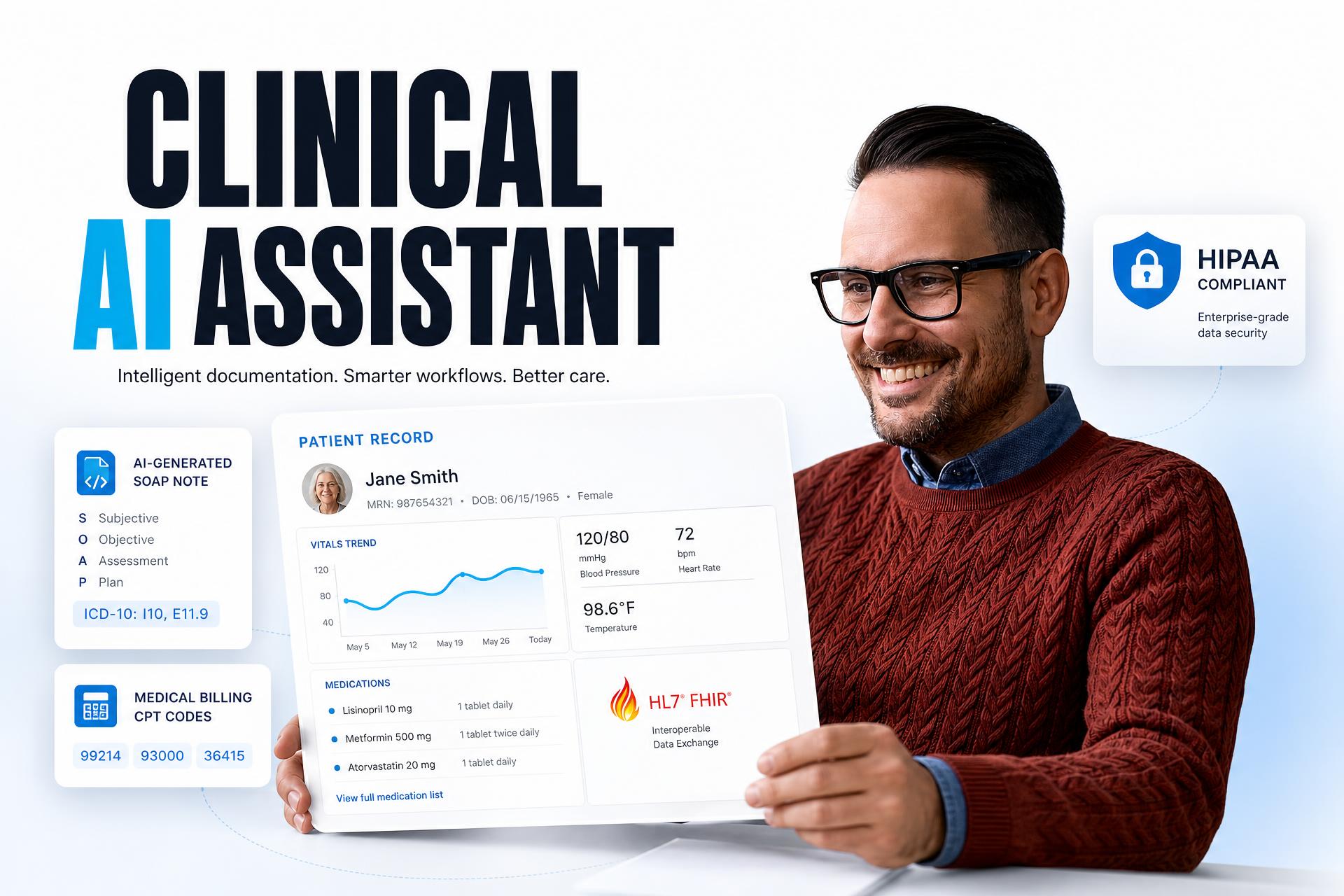
The administrative burden in healthcare has reached a breaking point. Physicians spend nearly two hours on administrative tasks for every hour of direct patient care, a primary driver of burnout and a massive leak in operational revenue. While Electronic Health Records (EHRs) were supposed to solve this, they often compounded the problem by turning doctors into data entry clerks. The industry is now pivoting hard toward automation, not just to reduce costs, but to reclaim the patient-provider relationship. This is where the Clinical AI Assistant enters the fray—not as a futuristic novelty, but as a necessary architectural layer that sits between the messy reality of patient interaction and the rigid structures of medical coding and billing.
Healthcare enterprises are grappling with a systemic inefficiency that legacy software cannot fix. The volume of patient data is exploding, yet the interfaces to manage it remain static and cumbersome. The challenge isn't just digitizing records; it's interpreting unstructured data—voice, handwritten notes, faxes—and normalizing it into structured, actionable information without introducing liability.
Deploying a robust Clinical AI Assistant requires more than wrapping a generic Large Language Model (LLM) in a chat interface. It demands a sophisticated, event-driven architecture capable of handling sensitive PHI (Protected Health Information), ensuring low latency, and maintaining strict audit trails. We typically design these systems using a microservices approach orchestrated on Kubernetes, separating the ingestion layer from the reasoning layer and the integration layer.
The core workflow usually begins with data ingestion. During a patient encounter, the system captures audio via a secure web socket or mobile endpoint. This stream is processed by a streaming ASR (Automatic Speech Recognition) engine—often OpenAI Whisper or a fine-tuned Nova model—to generate raw transcripts. Simultaneously, we run a sidecar process for PII redaction, using frameworks like Microsoft Presidio or regex-based entity recognition to strip identifiers before the data hits non-compliant storage or external inference endpoints.
Once transcribed and sanitized, the text moves to the orchestration layer. This is where frameworks like LangChain or LlamaIndex manage the state and context. We employ a RAG (Retrieval-Augmented Generation) pattern to ground the LLM's responses. The system queries a vector database (such as Pinecone, Milvus, or pgvector) containing the patient's historical records, embedded using high-performance models like Voyage AI or OpenAI text-embedding-3. This retrieval step ensures the AI has the necessary context—current medications, allergies, recent lab results—before generating a summary or a note.
For complex tasks, we utilize multi-agent frameworks like AutoGen or CrewAI. Instead of one monolithic model doing everything, we deploy specialized agents: a "Scribe Agent" focused on SOAP note generation, a "Coder Agent" dedicated to medical billing codes, and a "Triage Agent" for analyzing symptoms. An orchestrator manages the hand-offs between these agents. For example, the Scribe Agent drafts the note, passes it to the Coder Agent to verify CPT codes against clinical documentation integrity (CDI) rules, and finally, a human-in-the-loop validation step occurs via the EHR integration.
Integration with existing hospital systems is critical. We build reverse proxies or API gateways that translate the AI's JSON output into HL7 FHIR (Fast Healthcare Interoperability Resources) messages. This allows the AI to push structured data directly into systems like Epic, Cerner, or Meditech. We utilize asynchronous messaging queues (RabbitMQ, Kafka) to handle the load, ensuring that if the EHR API is rate-limited or down, the AI system buffers the requests and retries with idempotency keys, preventing duplicate records.
Implementing these solutions shifts the economics of healthcare delivery. The ROI is not merely theoretical; it is measurable in time recovered, revenue captured, and risk mitigated. By automating the tedious aspects of patient documentation, organizations can significantly extend their capacity without hiring additional staff.
Quantitatively, providers using advanced ambient scribing often report a 30–50% reduction in documentation time. This translates to seeing 2–3 more patients per day per physician, directly increasing top-line revenue. Furthermore, the accuracy of AI-assisted coding reduces claim denials. We see denial rates drop by approximately 20–30% when AI is used to cross-reference documentation with payer requirements before submission. This reduction in rework lowers administrative overhead and accelerates cash flow.
From an operational standpoint, hospital automation driven by AI reduces the "pajama time" physicians spend finishing notes after hours. This improvement in work-life balance is a critical factor in retaining talent in a competitive market. The cost of replacing a physician can exceed $250,000; thus, technology that improves retention offers a massive, albeit indirect, financial return. Additionally, the structured data generated by AI assistants can be mined for population health analytics, providing value beyond the immediate clinical encounter.
Deploying healthcare AI is not a "plug and play" operation; it requires a rigorous roadmap to ensure safety and adoption. We recommend a phased approach that prioritizes high-impact, low-risk use cases before expanding to complex autonomous decision-making.
Common pitfalls to avoid include relying solely on general-purpose models without medical grounding, which increases the risk of hallucinations, and neglecting the user interface. If the physician has to click multiple times to accept the AI's suggestion, they won't use it. The integration must be ambient and invisible. Another major risk is ignoring latency; if the note takes 10 minutes to process, it breaks the clinical flow. Target sub-5-second latency for initial summaries and full note completion within the patient checkout window.
At Plavno, we do not build generic chatbots. We engineer enterprise-grade medical assistants designed for the rigors of high-acuity environments. Our approach is grounded in a deep understanding of both the underlying AI infrastructure and the stringent demands of healthcare compliance. We leverage our expertise in AI healthcare and MedTech software development to create solutions that integrate seamlessly with your existing ecosystem.
We utilize a modern, stack-agnostic methodology. Whether we are deploying medical voice AI assistants using AutoGen for multi-agent orchestration or building custom RAG pipelines with LlamaIndex, our focus is on performance and security. We understand that clinical workflows are non-negotiable; our systems are built to handle interruptions, context switching, and the need for absolute data accuracy. Our experience in machine learning development ensures that the models we deploy are not only accurate but also optimized for cost and latency.
Furthermore, we offer flexible engagement models. Whether you need to hire developers to augment your internal team or require a full turnkey solution via outsourcing, we adapt to your governance structures. We specialize in AI assistant development that respects data sovereignty, often deploying on-premise or in private clouds to meet strict regulatory requirements. By combining our AI agents development capabilities with deep healthcare domain knowledge, we deliver tools that actually work at the point of care.
The deployment of a Clinical AI Assistant is no longer an experimental pilot for forward-thinking hospitals; it is an operational imperative. The convergence of advanced LLMs, robust vector databases, and standardized healthcare APIs makes it possible to finally bridge the gap between clinical interaction and digital record-keeping. By automating documentation, optimizing coding, and streamlining workflows, these AI solutions allow physicians to return to what they do best: caring for patients. For enterprises looking to navigate this complex landscape, the key is to partner with engineers who understand the stakes and the stack. The future of healthcare is automated, intelligent, and deeply integrated—and it is being built today.
Contact Us
Plavno experts contact you within 24h
Discuss your project details
We can sign NDA for complete secrecy
Submit a comprehensive project proposal with estimates, timelines, team composition, etc
Plavno has a team of experts ready to start your project. Ask us!

Vitaly Kovalev
Sales Manager
