When a sales ops analyst asks an internal chatbot to “reconcile Q3 revenue against the ERP ledger, flag any anomalies, and email the CFO a one‑page summary,” the response often stalls at “I’m not connected to your ERP.” The bottleneck isn’t the language model; it’s the missing glue that lets an LLM invoke tools, retrieve data, and orchestrate a multi‑step workflow. Enterprise AI agents—software‑defined actors that combine large language models with tool use, state management, and secure APIs—are emerging as the de‑facto interface for complex business processes. By turning conversational intent into executable actions, they replace static chatbots with a programmable, extensible layer that can drive AI workflow automation across any legacy stack.
Industry challenge & market context
- Legacy ERP and CRM systems expose only CRUD APIs, forcing developers to write custom adapters for each new integration.
- Traditional chatbots are stateless, cannot maintain context across multiple steps, and lack the ability to call external services.
- Business users demand self‑service analytics and automation, but IT teams are constrained by security policies, data residency, and compliance audits.
- Vendor lock‑in and siloed SaaS products increase total cost of ownership and impede cross‑system orchestration.
- Rapidly rising token costs and model latency (e.g., GPT‑4 ≈ 30 ms per 1 k token) make unoptimized calls financially unsustainable at scale.
Technical architecture and how enterprise AI agents work in practice
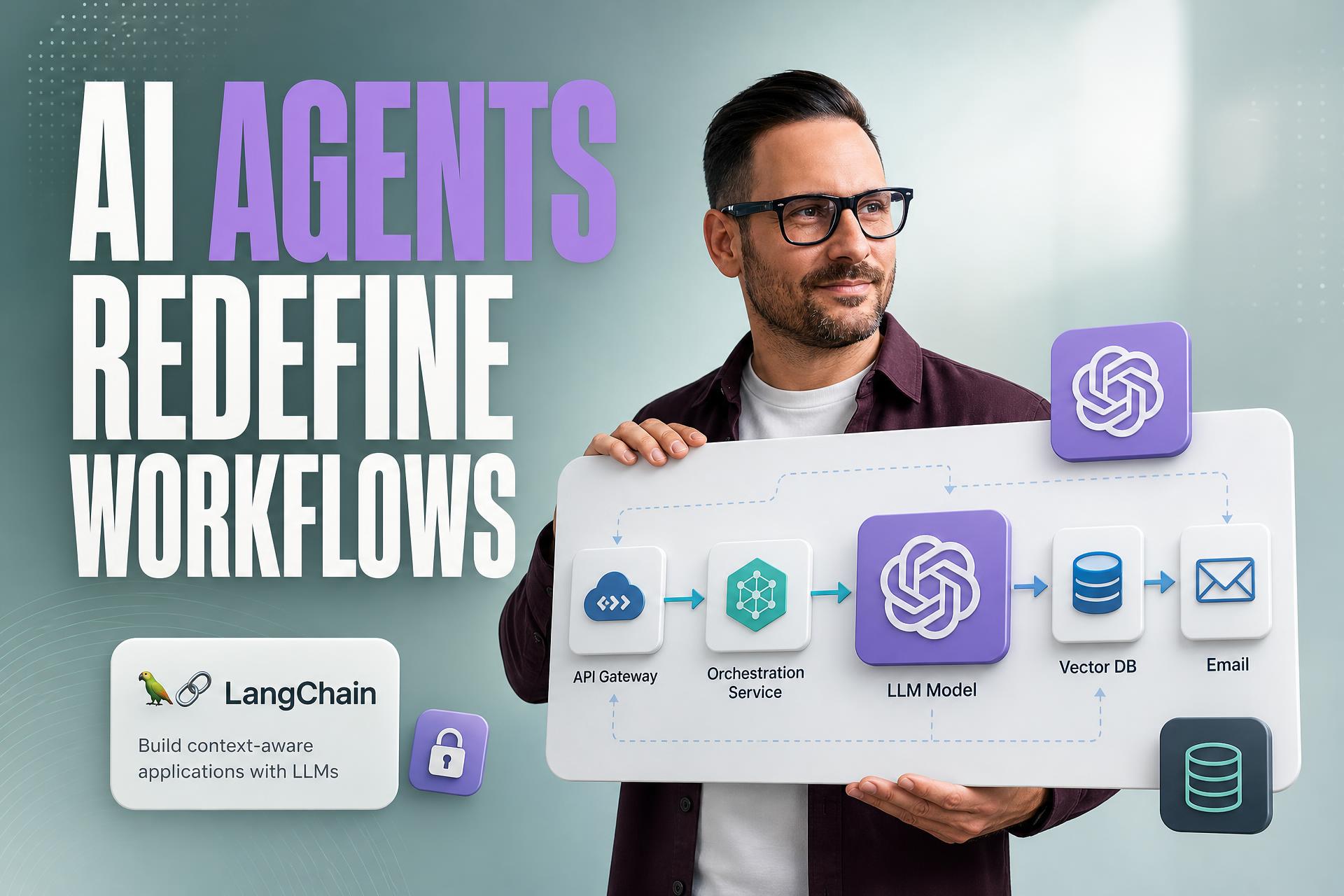
At a high level, an enterprise AI agent platform consists of five layers: ingestion, orchestration, model, data store, and security. The following diagram (conceptual) illustrates the data flow when a user asks an agent to “generate a compliance report for the last 30 days.”
System components
- API Gateway: Edge entry point (AWS API Gateway or Kong) that terminates TLS, enforces OAuth2 scopes, and routes requests to the orchestration layer.
- Orchestration Layer: Stateless microservice (Python FastAPI or Node Express) that parses intent, selects the appropriate agent, and manages the execution graph. Frameworks such as LangChain, LlamaIndex, AutoGen, and CrewAI provide built‑in tool‑calling abstractions.
- Model Layer: Hosted LLM endpoints (OpenAI agents, Claude agents, Gemini agents) accessed via REST or gRPC. Each request includes a system prompt that defines the agent’s role and a tool schema describing available functions.
- Data Store: Vector database (Pinecone, Qdrant) for embeddings, relational store (PostgreSQL) for transactional data, and a cache (Redis) for short‑lived context.
- Security & Governance: Centralized IAM (Keycloak), audit logging (Elastic Stack), and policy enforcement points for data residency (e.g., EU‑region clusters).
Data pipelines and flows
- User request arrives at the API Gateway → validated OAuth2 token → forwarded to Orchestration Service.
- Orchestration parses the request, creates a task graph (e.g., retrieve sales data → run anomaly detection → format PDF → send email).
- Each node in the graph may invoke a tool: a SQL query via a PostgreSQL connector, a Python function for statistical analysis, or a third‑party service via a webhook.
- Intermediate results are stored as embeddings in the vector DB to enable retrieval‑augmented generation (RAG) for context‑rich responses.
- Final artifact is persisted to an object store (S3) and a notification is sent through an event bus (Kafka) to downstream consumers.
Model orchestration and tool use
- Prompt engineering defines a
function calling schema that lists tool names, input parameters, and return types. - The LLM decides, based on the user intent, which tool to invoke. For example, an OpenAI agent may call a
run_sql function to fetch revenue figures. - After the tool returns data, the model re‑generates a response, possibly invoking additional tools (e.g., a PDF generator) in a loop until the task graph is complete.
- State is persisted in a Redis hash keyed by a UUID, enabling the agent to resume after a transient failure without re‑executing completed steps.
APIs and integration patterns
- REST endpoints for synchronous calls (e.g.,
/v1/agents/execute) with idempotency keys to guarantee exactly‑once semantics. - GraphQL for flexible data selection when the agent needs to compose partial fields from multiple services.
- Webhooks for asynchronous callbacks from long‑running tools (e.g., batch ETL jobs).
- Event streams (Kafka topics) for fire‑and‑forget actions such as audit trail emission or downstream analytics triggers.
Infrastructure considerations
- Containerized services deployed on Kubernetes with pod‑level autoscaling (HPA) based on CPU, memory, and custom metrics like request latency.
- Serverless functions (AWS Lambda, Azure Functions) for infrequent tool calls to reduce idle cost.
- Vector DB clusters provisioned with dedicated SSDs to keep embedding retrieval latency under 5 ms for 1 M vectors.
- Message queues (RabbitMQ) for guaranteed delivery of critical tasks, combined with a circuit‑breaker pattern to protect downstream APIs.
- Observability stack: OpenTelemetry for tracing, Prometheus for metrics, Grafana dashboards for latency and error rates.
Deployment models
- Single‑tenant Kubernetes clusters per enterprise for strict data isolation.
- Multi‑tenant SaaS deployment with namespace isolation and per‑tenant resource quotas.
- Hybrid on‑premise edge nodes for latency‑sensitive workloads (e.g., real‑time fraud detection) while keeping the control plane in the cloud.
- Failover across regions using active‑passive DNS and state replication to meet a 99.99 % SLA.
Enterprise AI agents turn “conversation” into a programmable workflow, effectively collapsing the UI‑to‑backend gap that has plagued digital transformation for decades.
Business impact & measurable ROI
- Reduced integration effort: Teams report a 40‑60 % drop in custom connector code because agents can invoke existing APIs via a unified tool schema.
- Faster time‑to‑value: A pilot that automated invoice reconciliation cut the average processing time from 3 days to under 30 minutes, saving roughly $120 k per year for a $50 M finance department.
- Lower operational cost: By batching LLM calls and caching embeddings, token consumption fell by 35 % while maintaining answer quality, translating to a $15 k monthly reduction in OpenAI usage.
- Improved compliance: Centralized audit logs and immutable execution graphs provide a clear trail for SOX and GDPR audits, reducing audit preparation effort by an estimated 20 %.
- Scalable user experience: With Kubernetes autoscaling, the platform sustained 1 200 concurrent agent sessions with average latency of 210 ms, well within the 300 ms SLA for interactive use.
Implementation strategy
Adopting enterprise AI agents should follow a disciplined, incremental roadmap that balances technical risk with business urgency.
- Phase 1 – Discovery & pilot: Identify a high‑impact use case (e.g., HR onboarding assistance). Build a minimal agent using LangChain, a single tool (HRIS API), and a sandbox LLM (Claude agents). Measure latency, token cost, and user satisfaction.
- Phase 2 – Core platform: Harden the orchestration service, introduce vector DB for RAG, and implement OAuth2 + API‑key rotation. Deploy to a dedicated namespace with CI/CD pipelines (GitHub Actions → Helm).
- Phase 3 – Scale & governance: Add multi‑tenant support, integrate with enterprise event bus (Kafka), and enforce audit logging. Establish SLAs for latency and error budgets.
- Phase 4 – Ecosystem expansion: Expose a marketplace of reusable tools (e.g., PDF generator, sentiment analysis) and enable citizen developers to compose agents via a low‑code UI.
- Phase 5 – Continuous improvement: Fine‑tune LLMs on domain‑specific data, monitor token usage, and iterate on prompt engineering to improve accuracy.
Common pitfalls
- Neglecting idempotency: Re‑executed tool calls can cause duplicate records; always include a request ID.
- Over‑relying on a single LLM: Model outages or rate‑limit throttling can halt workflows; implement fallback to a secondary provider (e.g., Gemini agents).
- Ignoring data residency: Storing embeddings in a region that violates compliance can trigger legal exposure; enforce region‑based routing.
- Skipping observability: Without tracing, latency spikes become invisible; instrument every tool call with OpenTelemetry.
- Under‑estimating state size: Large context windows can exceed token limits; prune or summarize intermediate results before re‑prompting.
Why Plavno’s approach works
Plavno combines an engineering‑first mindset with enterprise‑grade architecture to deliver AI agents that actually move the needle.
- Our teams leverage proven frameworks (AI agents development, LangChain, AutoGen) and integrate them with existing software development consulting expertise.
- We design for both single‑tenant security and multi‑tenant efficiency, using Kubernetes, Docker, and serverless patterns that align with cloud software development best practices.
- Our AI‑automation practice (AI workflow automation) embeds compliance checkpoints, audit trails, and role‑based access control, ensuring that every agent action is traceable.
- Through our AI voice assistant development portfolio, we have built end‑to‑end pipelines that combine speech‑to‑text, LLM reasoning, and tool execution, proving the scalability of agentic AI across modalities.
- Our delivery model (hire developer, outstaffing) lets enterprises retain control while tapping into a deep bench of AI specialists.
A well‑architected enterprise AI agent platform reduces integration code by up to 60 % while delivering a measurable 4‑digit ROI within the first year.
Conclusion
Enterprise AI agents are no longer a research curiosity; they are the pragmatic interface that lets businesses translate natural language into secure, auditable, and scalable workflows. By embedding tool use, state management, and robust orchestration into the AI stack, organizations can finally unlock the promise of AI workflow automation without rewriting their entire integration layer. For CTOs and architects seeking a concrete path forward, the next step is to pilot an agentic solution on a high‑value use case and let the platform grow from there. Plavno’s proven expertise in AI agents development, cloud‑native architecture, and enterprise governance makes us the ideal partner to accelerate that journey.