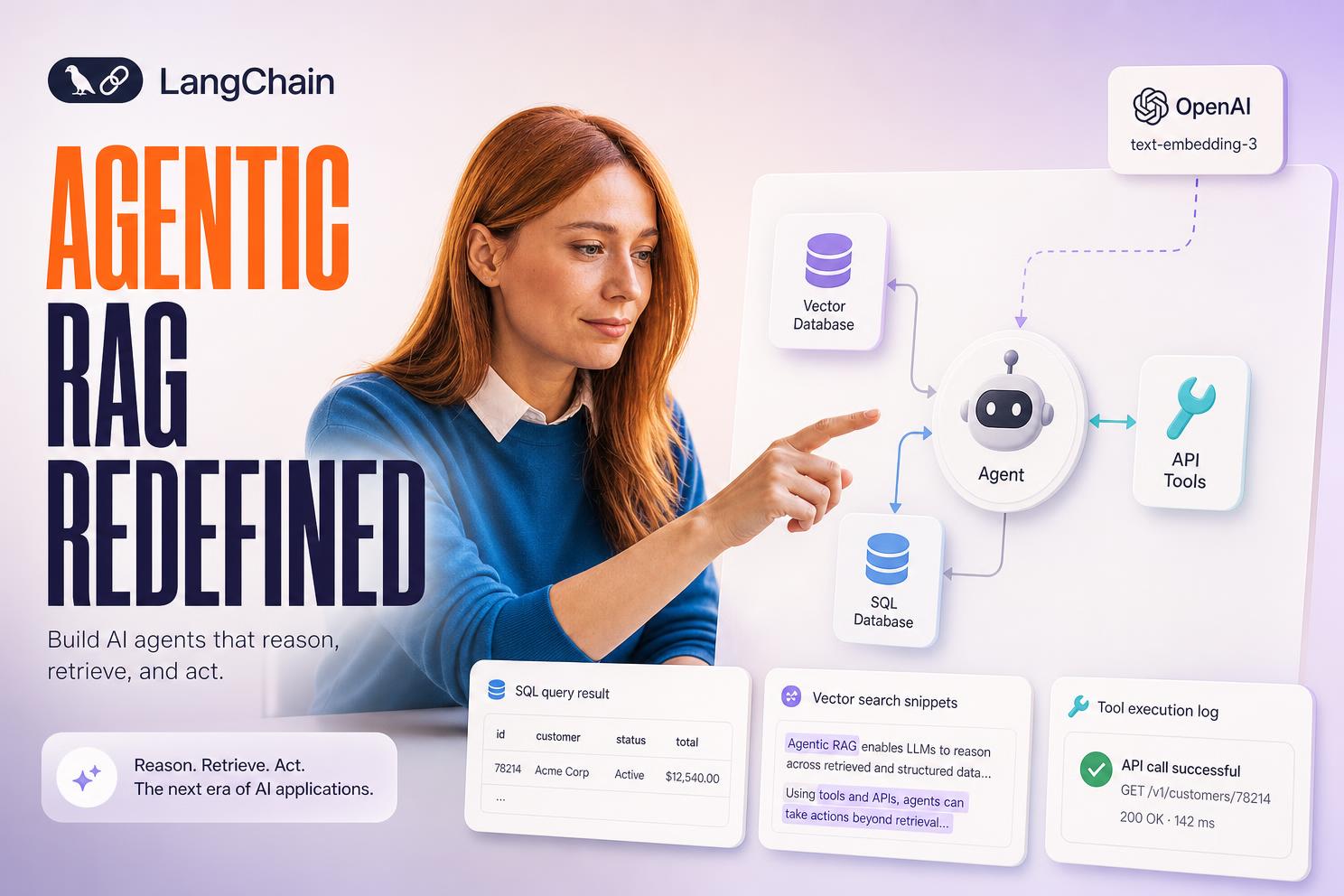
Basic Retrieval-Augmented Generation (RAG) is effectively a read-only operation: it retrieves context from an index and synthesizes an answer. For simple queries, this works. But for complex enterprise workflows—where a user needs to analyze data across a CRM, a PDF repository, and an SQL database, then trigger an API action—static retrieval fails. The industry is realizing that stuffing a prompt with vector search results is not sufficient for multi-step reasoning. We are seeing a decisive shift toward agentic RAG, where LLMs are not just generating text but are orchestrating tools, planning sub-tasks, and validating their own outputs. This is not a minor upgrade; it is a fundamental architectural change required to move AI from "chatbot" to "co-worker."
Industry challenge & market context
Enterprises have rushed to implement enterprise RAG systems, only to hit a wall of complexity. The initial excitement of semantic search fades when CTOs realize that a standard RAG pipeline cannot handle the ambiguity of real-world business logic. A user asking, "How did our Q3 performance in EMEA compare to projections?" is not asking for a document snippet. They are asking for a comparison between unstructured text (earnings call transcripts) and structured data (SQL sales figures). A naive RAG system either hallucinates the comparison or fails to retrieve the correct data context.
The bottlenecks are technical and operational. Legacy search architectures cannot bridge the gap between LLM retrieval and deterministic business logic. Organizations are facing risks where the AI confidently cites outdated policy documents because the vector similarity score was technically "correct" but contextually wrong. Furthermore, static RAG offers no path to action; it can tell you the server is down (by reading a log), but it cannot run a diagnostic script or restart a service. This limitation is driving the demand for agentic systems that can reason, plan, and execute.
- Fragmented data silos make unified context impossible without complex middleware.
- High token costs and latency issues arise from repeatedly stuffing large context windows with irrelevant retrieval chunks.
- Lack of determinism leads to "hallucinated workflows" where the AI suggests actions it cannot actually perform.
- Security risks increase when LLMs are given broad access to retrieval tools without strict governance.
- Maintenance overhead explodes when hard-coded prompt logic tries to account for every edge case.
Technical architecture and how agentic RAG works in practice
Implementing agentic RAG requires moving beyond a simple "retrieve-and-read" loop to a dynamic "reason-act-observe" cycle. In this architecture, the LLM acts as an orchestrator rather than a mere generator. It has access to a toolkit—vector databases, SQL engines, APIs, and web scrapers—and decides, in real-time, which tool to use based on the user's intent.
Consider a scenario in logistics: a user asks, "Why is shipment #402 delayed, and what is the financial impact?" An agentic system breaks this down. First, it queries the PostgreSQL database via a SQL tool to get the shipment status and current location. Simultaneously, it uses a vector search tool to scrape the carrier's email updates for semantic keywords like "weather delay" or "customs hold." It then calculates the financial penalty by referencing the contract terms stored in a AI knowledge base. Finally, it synthesizes these distinct data points into a coherent report. This requires a robust architecture involving several distinct layers.
System Components:
- Orchestration Layer: Frameworks like LangChain or LlamaIndex manage the agent loop, handling state management and memory. For multi-agent collaboration, we often utilize CrewAI or Microsoft’s AutoGen to allow specialized agents (e.g., a "Researcher" agent and a "Coder" agent) to negotiate and solve tasks.
- Tool Layer: This is the interface between the LLM and the enterprise. Tools are defined as Python or Node functions with strict schemas (input/output validation). Examples include a Pandas DataFrame analyzer, a Salesforce API connector, or a Slack notification sender.
- Retrieval Layer: Beyond a single vector DB, this includes a hybrid search setup. We combine dense vector retrieval (using OpenAI text-embedding-3 or HuggingFace models) with sparse keyword retrieval (BM25) via Elasticsearch or Solr to maximize recall.
- Model Layer: The "brain" running the reasoning. While GPT-4o is common for complex reasoning, we often route simpler queries to smaller, faster models like Llama-3-70B or Mistral to optimize latency and cost.
- Execution Environment: A sandboxed container (Docker) or serverless function (AWS Lambda) where the tool code actually runs. This ensures that if an agent attempts to execute malicious code, it is contained within an ephemeral environment with no persistence.
Data Pipelines and Flows:
Data ingestion is no longer just "chunk and embed." For agentic workflows, we need knowledge graphs that map relationships between entities (e.g., Customer -> Order -> Invoice). When data flows into the system, it passes through an ETL pipeline that extracts metadata, cleans the text, and updates both the vector store and the graph database. When a query arrives, the router analyzes the intent. If it requires real-time data, the pipeline bypasses the static vector store and hits the live API. If it requires historical context, it retrieves from the vector store. The flow is asynchronous: the agent dispatches tool calls, waits for the event stream (via Kafka or RabbitMQ) to return results, and updates its short-term memory buffer.
Model Orchestration:
The core of agentic RAG is the reasoning loop. We typically implement the ReAct (Reason + Act) pattern. The LLM generates a "thought" explaining what it needs to do next. It then generates a specific function call. The system executes that function and feeds the output back to the LLM as a new observation. This loop continues until the LLM determines it has the final answer. To prevent infinite loops, we implement hard limits on step counts and "self-correction" mechanisms where a secondary validator model checks the output before it is shown to the user.
The shift from static RAG to agentic RAG is effectively the shift from a "lookup table" mindset to a "software engineer" mindset. We are no longer just searching for information; we are building software that writes software on the fly to solve specific problems.
Infrastructure and Deployment:
- Compute: GPU instances (NVIDIA A100s or H100s) for hosting open-source models, or high-CPU instances for managing the orchestration logic.
- Vector Stores: Pinecone, Weaviate, or Milvus for high-throughput embedding similarity search.
- Caching: Redis is critical here. We cache the results of tool calls (e.g., "get_user_profile") so that if the agent needs the same data in the next step, it doesn't re-query the database, saving both latency and money.
- Deployment: We deploy these systems on Kubernetes (EKS/GKE) to handle auto-scaling. If a query triggers a heavy agent loop, the cluster spins up more pods to handle the load.
- Observability: Tools like LangSmith or Arize are used to trace the agent's thought process. We need to see exactly which tool was called, what arguments were passed, and why the agent failed if it did.
Business impact & measurable ROI
Moving to an agentic architecture is not just a technical exercise; it delivers tangible business value by automating workflows that previously required human intervention. In a standard RAG development project, the ROI is usually measured in "time saved searching." In agentic RAG, the ROI is measured in "tasks completed without human touch."
For example, in a financial services context, an agentic system can automate the generation of credit memos. Instead of an analyst pulling data from three different systems and writing a report, the agent retrieves the policy, pulls the transaction history, calculates the risk score using a Python tool, and drafts the memo. This reduces a 4-hour task to a 5-minute review. We typically see operational efficiency gains of 30-50% in knowledge-intensive workflows. Furthermore, by grounding the LLM's reasoning in tool outputs, we significantly reduce hallucination rates, which directly mitigates reputational and compliance risk.
Agentic RAG transforms the LLM from a cost center (high token usage for low-value chat) into a revenue driver by automating complex, multi-step decision processes that were previously out of reach for automation.
Key Business Benefits:
- Reduced Operational Costs: Automating multi-step workflows reduces headcount needs for routine data processing and analysis.
- Faster Time-to-Decision: Agentic systems operate 24/7, providing instant synthesis of complex data sets for executive decision-making.
- Higher Accuracy: The "self-correction" and tool-validation loops ensure that answers are fact-checked against live data sources before delivery.
- Scalability: Once an agent workflow is defined, it can be scaled across the organization without linearly increasing human support staff.
- Better Customer Experience: In support scenarios, agents can actually resolve issues (by querying billing systems or processing refunds) rather than just explaining how to resolve them.
Implementation strategy for agentic RAG
Deploying these systems requires a disciplined approach. You cannot simply "turn on" agent capabilities and hope for the best. The strategy must move from low-risk pilots to production-grade, governed systems.
- Phase 1: Assessment and Tooling Audit. Identify the high-value workflows where the "gap" between data and action is widest. Audit your APIs to ensure they are robust enough for LLM consumption (REST/GraphQL with clear schemas).
- Phase 2: The "Single-Agent" Pilot. Build a single agent with a narrow toolkit (e.g., a SQL reader and one vector store). Focus on a specific use case, like internal HR policy问答. Use this to tune your prompt engineering and tool definitions.
- Phase 3: Multi-Agent Orchestration. Introduce frameworks like CrewAI or AutoGen to handle complex tasks. Assign specific roles (e.g., a "Data Analyst" agent and a "Writer" agent) and test their hand-off protocols.
- Phase 4: Governance and Security Hardening. Implement strict guardrails. Use tools like NeMo Guardrails or LangChain callbacks to prevent the agent from calling unauthorized APIs or accessing restricted user data.
- Phase 5: Production Scaling. Move to a containerized infrastructure (Kubernetes). Implement observability stacks (tracing, logging) to monitor token usage, latency, and tool failure rates.
Common Pitfalls to Avoid:
- Overloading the agent with too many tools at once, which leads to "decision paralysis" and poor routing.
- Neglecting error handling in tool code; if an API throws a 500 error, the agent must know how to recover gracefully, not crash.
- Ignoring the context window; long chains of thought can consume the entire token limit before the final answer is generated.
- Allowing direct database write access without human-in-the-loop approval for the initial rollout.
- Failing to cache retrieval results, leading to unnecessary costs and latency on repeated queries.
Why Plavno’s approach works
At Plavno, we don't treat AI as a magic black box. We treat it as an engineering discipline. We specialize in building AI agents that are deeply integrated into your existing enterprise architecture. Our approach begins with a rigorous AI consulting phase to map your business logic to technical capabilities. We don't just wrap an API; we build the underlying infrastructure, the data pipelines, and the security layers required to make agentic RAG reliable at scale.
We understand that every industry has unique constraints. In fintech, we build agents that prioritize audit trails and deterministic calculation over creative writing. In healthcare, we focus on HIPAA-compliant data retrieval and strict validation of medical advice. Our expertise in custom software development allows us to modify the source code of underlying frameworks or build custom tools when off-the-shelf solutions don't fit your specific needs.
Whether you need to automate legal discovery or optimize supply chain logic, Plavno delivers enterprise-grade solutions. We leverage modern stacks like Kubernetes, Docker, and LangChain, but our value lies in the architecture—we design systems that are observable, maintainable, and secure. If you are ready to move beyond basic chatbots and deploy intelligent agents that drive real ROI, our team is ready to engineer the solution.
The transition from basic RAG to agentic RAG is inevitable for enterprises that want to leverage AI for actual work, not just information retrieval. It requires a shift in architecture, tooling, and mindset. By implementing systems that can reason, plan, and act, you unlock a level of automation that was previously impossible. The technology is here today; the challenge is implementation. Partner with engineers who understand the complexity and can build a robust foundation for your AI future.