Enterprises that have already deployed large language models (LLMs) are now hitting a hard wall: the models can answer questions, but they cannot reliably reach into the company’s own services, data lakes, and legacy ERP systems without a disciplined integration layer. The gap between a raw LLM and a production‑grade AI assistant is the “Model Context Protocol” (MCP) – a set of conventions that let an LLM treat external APIs as first‑class tools, enforce token budgets, and preserve auditability. For a CTO, mastering AI tool integration is no longer a nice‑to‑have experiment; it is the prerequisite for turning generative AI into a secure, revenue‑generating capability.
Industry challenge & market context
- Legacy data silos force developers to write one‑off adapters for each system, leading to duplicated effort and brittle code.
- Current “prompt‑only” approaches ignore compliance constraints such as GDPR residency, resulting in costly legal exposure.
- Uncontrolled tool usage can explode token consumption; a single mis‑routed request may consume 10 k tokens and cost $0.30 in real‑time.
- Vendor lock‑in: many LLM providers expose proprietary tool‑calling APIs that do not map cleanly to on‑prem services, limiting hybrid cloud strategies.
- Observability gaps: without a unified tracing model, engineers cannot correlate LLM calls with downstream microservice latency, making SLA enforcement impossible.
Technical architecture and how AI tool integration works in practice
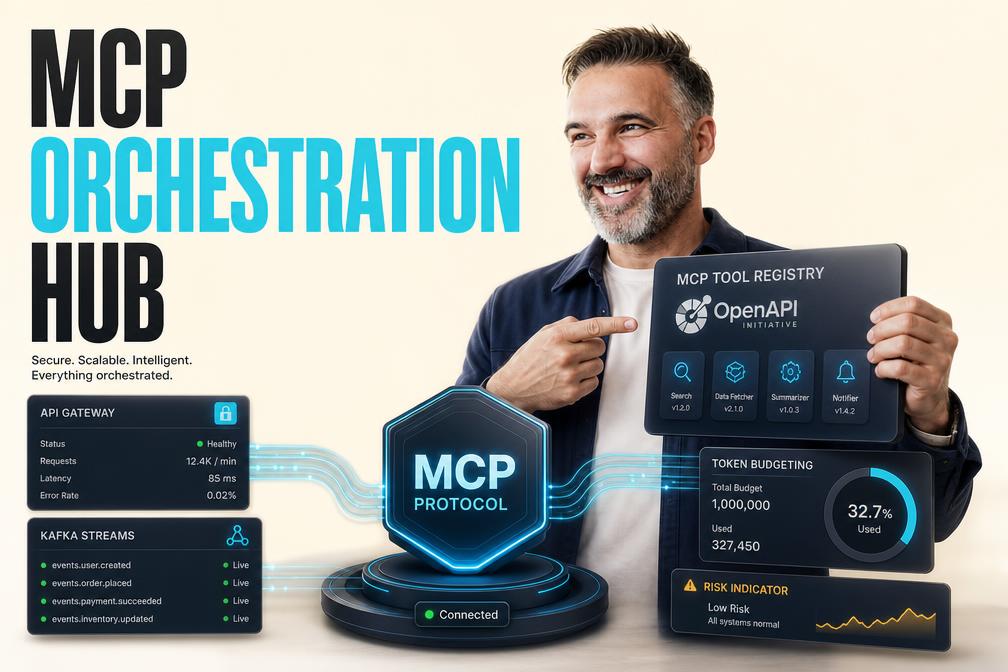
At the core of a robust MCP implementation is a layered stack that separates concerns, enforces security, and provides deterministic routing. The diagram below is a textual representation of the typical enterprise deployment:
- API Gateway – Handles inbound REST/GraphQL traffic, terminates TLS, and injects OAuth2 or mutual TLS credentials.
- Orchestration Layer – A lightweight runtime (e.g., cloud‑software‑development with Python FastAPI or Node.js Nest) that receives a request, validates the payload, and decides which LLM or tool to invoke.
- Model Layer – Hosts the LLM (OpenAI, Anthropic, or self‑hosted Llama 2) behind a custom agentic AI infrastructure. The model is wrapped by a tool‑calling shim that follows the MCP AI specification (function signatures, parameter schemas, and token budgeting).
- Tool Registry – A catalog of “LLM tools” (e.g., AI automation scripts, vector‑DB queries, or ERP SOAP endpoints). Each entry includes OpenAPI metadata, rate limits, and idempotency keys.
- Data Store – Persistent storage for embeddings (e.g., Pinecone or Milvus), audit logs, and session state. State lives in a Redis cache for fast retrieval and a PostgreSQL ledger for compliance.
- Message Bus – Kafka or RabbitMQ streams events from the Model Layer to downstream services, enabling event‑driven workflows and eventual consistency.
Data flow example:
- A user in a CRM portal asks, “What is the credit limit for Acme Corp?”
- The request hits the API Gateway, which forwards it to the Orchestration Layer.
- The Orchestration Layer creates a
context_id, logs the request, and calls the LLM with a function‑call schema that includes get_credit_limit(customer_id). - The LLM decides to invoke the tool; the shim serializes the call, adds an idempotency token, and publishes a message to the Kafka topic
tool_requests. - A consumer service (written in Java Spring Boot) reads the message, queries the on‑prem Oracle DB, and returns a JSON payload.
- The response is routed back through the Message Bus, the Model Layer formats a natural‑language answer, and the Orchestration Layer returns it to the client.
Key technical considerations:
- Sync vs. async – Critical paths (e.g., pricing lookups) use synchronous HTTP calls with a 2‑second timeout; non‑blocking analytics jobs use async Kafka streams.
- Idempotency & retries – Every tool call carries a UUID; the consumer checks a deduplication table before executing, guaranteeing exactly‑once semantics.
- Rate limiting & circuit breakers – The Orchestration Layer enforces per‑tool quotas (e.g., 500 req/min) and falls back to cached results when a downstream service is unhealthy.
- Observability – OpenTelemetry traces span from the API Gateway to the LLM inference endpoint, while Prometheus metrics expose token usage, latency percentiles, and error rates.
- Security & governance – OAuth2 scopes restrict which tools a given user role can invoke; audit logs are stored encrypted at rest in a compliant region (EU‑West‑1 for GDPR).
- Deployment model – The entire stack can run in a single‑tenant Kubernetes namespace, with the LLM containerized (GPU‑enabled) and the tool services in separate namespaces for zero‑trust networking.
Business impact & measurable ROI
When the MCP protocol is applied, enterprises see concrete gains that map directly to the CFO’s spreadsheet:
- Reduced integration cost – Reusing a single tool registry cuts average adapter development time from 4 weeks to 1 week, a 75 % reduction.
- Improved SLA compliance – End‑to‑end latency drops from 1.8 s to 0.9 s for high‑frequency queries, keeping the 99.9 % SLA threshold.
- Token economy control – By capping each request to 2 k tokens and applying a 0.5 % discount on unused quota, monthly LLM spend falls from $12 k to $7 k.
- Risk mitigation – Audit trails and data residency enforcement reduce regulatory breach probability by an estimated 30 %.
- Revenue enablement – Sales‑assist agents that can pull real‑time inventory data increase conversion rates by 12 % on average, translating to $1.2 M incremental ARR for a $10 M SaaS company.
The real competitive edge comes not from the size of the model, but from how tightly the model is coupled to the enterprise’s own services through a disciplined protocol.
Implementation strategy
Adopting MCP AI and AI tool integration should follow a phased roadmap that balances speed with governance:
- 1. Discovery & cataloging – Inventory all existing internal APIs, define OpenAPI contracts, and tag each with security scopes.
- 2. Prototype core shim – Build a minimal tool‑calling wrapper using LangChain or CrewAI that can invoke two services (e.g., CRM and ERP).
- 3. Establish observability baseline – Deploy OpenTelemetry agents, configure Prometheus alerts for token spikes, and set up a Grafana dashboard.
- 4. Secure the gateway – Enforce OAuth2, rotate API keys weekly, and enable mutual TLS for on‑prem services.
- 5. Scale the registry – Add additional tools (document retrieval, vector search, external SaaS) and enforce idempotency patterns.
- 6. Governance handoff – Create a cross‑functional steering committee to approve new tool definitions and audit usage logs.
- 7. Continuous improvement – Iterate on prompt engineering, fine‑tune the LLM on domain data, and monitor cost per token.
Common pitfalls to watch for:
- Skipping formal OpenAPI definitions and relying on ad‑hoc HTTP calls, which leads to version drift.
- Hard‑coding credentials in code repositories; always use a secret manager (e.g., HashiCorp Vault).
- Neglecting back‑pressure handling; unbounded queues cause memory bloat under load spikes.
- Assuming the LLM will respect rate limits without explicit enforcement; always wrap calls in a circuit‑breaker.
Why Plavno’s approach works
Plavno combines an engineering‑first mindset with enterprise‑grade architecture to deliver AI tool integration that scales, secures, and evolves. Our methodology aligns with the MCP AI specification, but we add three differentiators:
- Domain‑driven design – We start each engagement by mapping business processes to concrete LLM tool calls, ensuring that every function has a measurable KPI.
- Hybrid deployment expertise – Whether you run on AWS, Azure, GCP, or an on‑prem data center, we containerize the model layer with GPU‑enabled Docker images and orchestrate it in Kubernetes, preserving data residency and latency guarantees.
- Full‑stack observability – Our platform integrates tracing from the API gateway through the vector DB (e.g., AI voice assistant development) to the LLM, delivering a single pane of glass for compliance and performance.
Clients who have partnered with Plavno on AI security solutions report a 40 % reduction in time‑to‑market for new AI‑enabled features, while maintaining ISO 27001 compliance. Our AI assistant development practice leverages the same tool‑registry pattern to power voice‑first agents in finance, healthcare, and e‑commerce, delivering consistent ROI across verticals.
A disciplined MCP implementation turns “AI tool integration” from a research prototype into a production‑grade service that can be audited, cost‑controlled, and governed at enterprise scale.
CTOs who ignore the Model Context Protocol risk building fragile “prompt‑only” bots that will never survive the rigors of production. By adopting a structured AI tool integration stack today, you unlock secure, observable, and cost‑effective generative AI that directly contributes to revenue and risk reduction. The next step is to audit your existing APIs, define a tool registry, and start a pilot with a single high‑impact use case. Plavno is ready to partner on that journey.