The promise of fully autonomous agents is seductive: a workforce of digital employees that reason, plan, and execute without human intervention. Yet, in enterprise environments, the gap between a compelling LLM demo and a production-grade system is often defined by catastrophic risk. A hallucination is not just a wrong answer in a chat window; it is a misrouted $100,000 wire transfer, a deleted production database, or a privacy violation that triggers a GDPR audit. As we move from simple chatbots to complex enterprise AI agents, the industry is realizing that full autonomy is rarely the optimal starting point. The most valuable systems are those that leverage the speed of AI while retaining the judgment, accountability, and contextual nuance of human experts. This is the core of the human-in-the-loop AI paradigm.
Industry challenge & market context
Enterprises are rushing to deploy AI agents to automate workflows, but the "set it and forget it" approach is causing friction. The primary challenge is the stochastic nature of Large Language Models (LLMs). Unlike traditional deterministic code, an LLM’s output is probabilistic, meaning that even with temperature settings near zero, there is no guarantee of 100% accuracy. In high-stakes domains like finance, legal, and healthcare, this non-determinism is a blocker for full autonomy.
Legacy automation approaches, such as RPA (Robotic Process Automation), failed because they were too brittle—they broke the moment the UI changed. Current AI agents face the opposite problem: they are too creative. They can "reason" their way into solutions that are syntactically correct but semantically disastrous. Without a robust AI governance layer, organizations expose themselves to significant operational and compliance risks.
- Compliance and regulatory drift: In regulated industries, every action must be attributable. A fully autonomous agent acting on a user's behalf creates a "black box" problem where it is difficult to prove who authorized a specific trade or data access request.
- Context window limitations and memory loss: Agents often lose track of long-term business logic or specific constraints buried in thousands of pages of documentation, leading to decisions that violate internal policies.
- Integration friction: Agents attempting to interact with legacy APIs via REST or GraphQL may generate malformed payloads or cause rate-limiting issues, crashing downstream services.
- Liability and brand risk: A "rogue" customer support agent offering unauthorized refunds or making offensive remarks can cause immediate reputational damage and financial loss.
Technical architecture and how human-in-the-loop AI works in practice
Implementing human-in-the-loop AI is not simply "cc'ing a manager on an email." It requires a deliberate architectural pattern that intercepts the agent's execution pipeline. We treat the human as a specific type of "tool" in the agent's toolkit—one that provides high-confidence, ground-truth validation. The architecture must support asynchronous workflows, state management, and auditability.
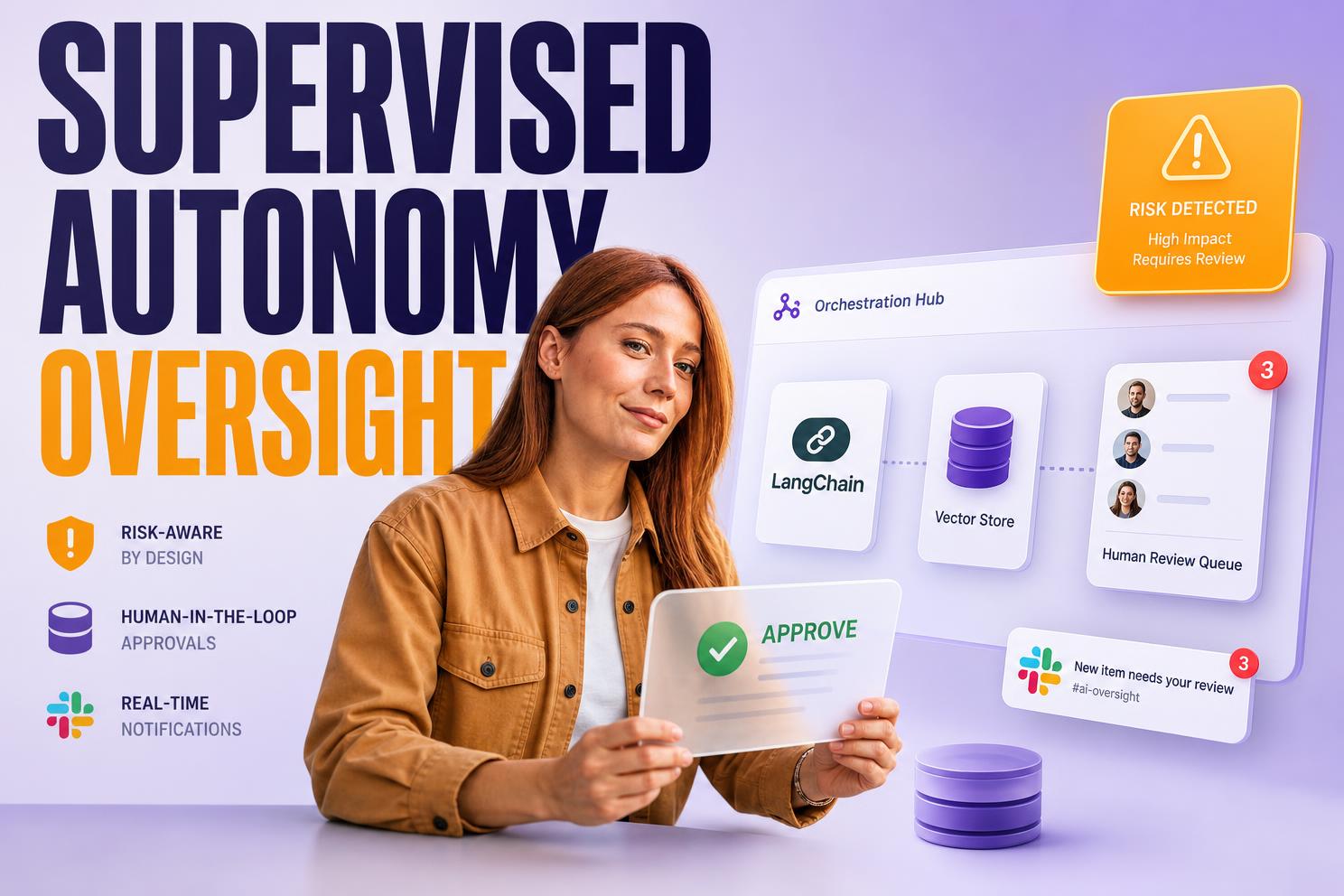
A robust implementation typically involves an orchestration layer (using frameworks like LangChain or AutoGen) sitting between the LLM and your business logic. When an agent decides to perform a "high-risk" action—defined by your policy—it does not execute the tool immediately. Instead, it serializes the intended action and pushes it into a review queue.
The most effective pattern for enterprise agents is not full autonomy, but "supervised autonomy." The system handles 90% of the cognitive load—gathering data, drafting responses, formulating plans—while the human handles the last 10% of verification, which covers 100% of the liability.
Consider a scenario in a logistics company where an agent optimizes shipping routes. The agent calculates a new route that saves 15% on fuel but involves a carrier with a history of delays. The system flags this as "medium risk." It pauses execution, generates a summary of the plan, and sends a notification via webhook to a Slack channel or a dedicated dashboard. The fleet manager reviews the suggestion, clicks "Approve," and the agent proceeds to call the carrier's API to book the shipment.
To build this, you need specific components working in concert:
- API Gateway & Ingestion Layer: The entry point (Kong, AWS API Gateway) handles authentication (OAuth2/JWT) and rate limiting. It routes requests to the orchestration service.
- Orchestration Layer: This is the brain, often built with Python or Node.js runtimes. It uses frameworks like LangChain, LlamaIndex, or CrewAI to manage the agent's state, memory, and tool selection. This layer determines if a tool call requires a human-in-the-loop check based on metadata tags (e.g.,
risk_level: "high"). - The "Human" Tool Interface: Instead of a direct API call to a CRM, the agent calls a
request_approval tool. This tool writes the payload to a database (PostgreSQL) and emits an event (Kafka/RabbitMQ) to a notification service. - Review Dashboard: A React or Vue.js frontend that consumes the event stream. It presents the pending actions to human operators with context: "Agent X wants to do Y because of Z."
- State Management & Vector Store: We use a vector database (Pinecone, Milvus, or pgvector) to store the context of *why* the agent made a decision. This is crucial for audit trails. If a human approves an action, the vector store links the human's decision ID to the agent's reasoning trace.
- Execution Engine: Once the human approves, a background worker (Celery, AWS Lambda) picks up the approved payload and executes the actual API call (e.g., Stripe for payments, Salesforce for CRM updates).
Infrastructure-wise, this setup is best deployed on Kubernetes to handle the scaling of the agent workers and the review services. You must implement idempotency keys in your API calls to ensure that if the agent retries a request after a human approval, it doesn't duplicate the transaction. Observability is non-negotiable; tools like OpenTelemetry should trace the entire flow from user prompt to agent reasoning to human approval to final execution, allowing you to measure latency and identify bottlenecks in the AI approval workflow.
Architecturally, the human review step must be treated as a blocking, synchronous operation in the agent's reasoning chain, but implemented as an asynchronous event in the backend infrastructure. This decoupling prevents the LLM context window from timing out while waiting for a human to click a button.
Business impact & measurable ROI
Adopting a supervised approach to safe AI automation provides measurable returns that go beyond simple efficiency. While full autonomy aims to eliminate human effort, human-in-the-loop AI aims to amplify human capacity. The ROI is driven by three main levers: risk reduction, throughput acceleration, and compliance enablement.
From a risk perspective, the value is immediate. By filtering high-risk actions through a human, you virtually eliminate "catastrophic" hallucinations. In financial services, a single erroneous transaction can cost millions in fines and remediation. A human-in-the-loop system acts as a circuit breaker, ensuring that no money moves or data is deleted without a biometric or MFA-verified sign-off.
Throughput gains are realized because the AI handles the "groundwork." In a typical AI automation workflow for document processing, the agent can extract data, classify documents, and normalize fields across thousands of PDFs in seconds. The human only intervens when the confidence score drops below 0.9 or when a discrepancy is found. This allows a single operator to process the volume that previously required a team of ten, reducing operational costs by 60-80% while maintaining higher accuracy than a manual process.
- Reduced error rates: By validating only the edge cases, businesses report a reduction in critical processing errors from 2-5% (human-only) to less than 0.1% (AI + Human review).
- Faster time-to-decision: While the human review adds a small latency (minutes), the overall cycle time is drastically reduced compared to manual processing because the AI pre-assembles all necessary information and drafts the action.
- Compliance as a feature: The audit logs generated by the review process provide a digital trail that satisfies regulators like GDPR, HIPAA, or SOC2 auditors, turning a cost center into a compliance asset.
- Trust adoption: Employees are more willing to adopt AI tools if they feel they have control. Human-in-the-loop systems reduce resistance to change because the AI is positioned as an assistant, not a replacement.
Implementation strategy
Deploying human-in-the-loop AI requires a phased approach. You cannot simply flip a switch on a legacy system. You must identify the right use cases, establish your governance boundaries, and build the feedback loops that allow the system to improve over time.
Start by mapping your business processes to identify "high volume, medium risk" tasks. These are the sweet spots. Low-risk tasks can be fully automated; high-risk tasks will always require human oversight. The value lies in the middle ground where the AI can do 80% of the work but needs a sanity check for the final 20%.
- Define the "Guardrails": Codify what constitutes a risky action. Is it a dollar amount? A specific data field (e.g., "SSN")? A specific sentiment in the output? These rules must be configurable logic in your orchestration layer, not hard-coded prompts.
- Pilot the "Supervisor" Pattern: Build a pilot using a framework like LangGraph or AutoGen that supports stateful, multi-agent workflows. Implement a "Supervisor Agent" whose only job is to route tasks to worker agents or to a human interface based on the guardrails.
- Build the Feedback Loop: When a human rejects an agent's proposed action, capture that data. Use it to fine-tune your model or update your RAG (Retrieval-Augmented Generation) index. This is how the system learns to stop making the same mistakes.
- UX for the Reviewer: Do not dump raw JSON on your human reviewers. Build a UI that highlights the *delta*—what changed, why the agent wants to do it, and relevant context snippets. A good UX reduces review time from minutes to seconds.
Common pitfalls to avoid include overloading reviewers with false positives (which causes alert fatigue) and creating tight coupling between the LLM and the review UI. If the UI is down, the agent should be able to queue requests gracefully. Another failure mode is ignoring the "cold start" problem; initially, the system will require more human intervention as it learns the nuances of your business logic. Plan for this resource ramp-up.
Why Plavno’s approach works
At Plavno, we do not treat AI as a magic box that solves problems by osmosis. We approach AI solutions as an engineering challenge. Our team of principal engineers and architects builds systems that are deterministic where they need to be and probabilistic where it makes sense. We specialize in integrating complex agent architectures into existing enterprise ecosystems, ensuring that your data pipelines, security protocols, and legacy APIs work seamlessly with modern LLM capabilities.
We understand that AI governance is a technical requirement, not just a policy document. Our architectures utilize event-driven design, robust vector databases, and containerized orchestration to ensure that your human-in-the-loop workflows are scalable, observable, and secure. Whether you are looking to build AI assistants for internal knowledge management or complex chatbots for customer engagement, we ensure that the human element is architected as a first-class component.
Our experience in custom software development allows us to tailor the approval workflows to your specific operational reality. We don't just give you a dashboard; we integrate the approval triggers into the tools your team already uses, whether that is Salesforce, Slack, or a custom CRM. By combining deep technical expertise with a pragmatic focus on business risk, Plavno delivers AI agents that are powerful enough to drive growth but safe enough to trust.
Full autonomy is a destination, but for most enterprises, it is not the starting line. By embracing human-in-the-loop AI, you can deploy powerful agents today, capturing immediate value while mitigating the risks that keep CTOs awake at night. The goal is not to replace your workforce, but to augment it with a digital layer that handles the noise, leaving your experts to handle the signal. If you are ready to architect AI solutions that balance speed with safety, contact Plavno to engineer your future.