Enterprises that have rolled out LLM‑powered chatbots, document search assistants, or code‑generation tools quickly discover that the token‑metered pricing of commercial models can dominate the operating budget. A single‑digit increase in request volume can add tens of thousands of dollars per month, while the latency budget tightens and compliance constraints tighten. The challenge is not just to cut spend, but to do so without eroding the user experience that justifies the AI investment in the first place. This article shows how to reduce LLM costs through disciplined architecture, smart routing, and data‑centric optimizations that keep quality intact.
Industry challenge & market context
- Enterprise workloads often generate 10‑100 K requests per minute, each consuming 200‑500 tokens; at $0.0004 per 1 K tokens, the raw cost can exceed $30 K daily.
- Legacy monolithic AI services route every request to the largest model (e.g., GPT‑4), ignoring cheaper alternatives and inflating latency.
- Compliance regimes (GDPR, HIPAA) demand data residency and audit trails, yet most LLM APIs expose only opaque logging, forcing costly work‑arounds.
- Scaling on public cloud without proper throttling leads to burst‑induced rate‑limit penalties and unpredictable spend.
- Vendor lock‑in and opaque pricing models make cost forecasting a guessing game for CFOs.
Technical architecture and how reduce LLM costs works in practice
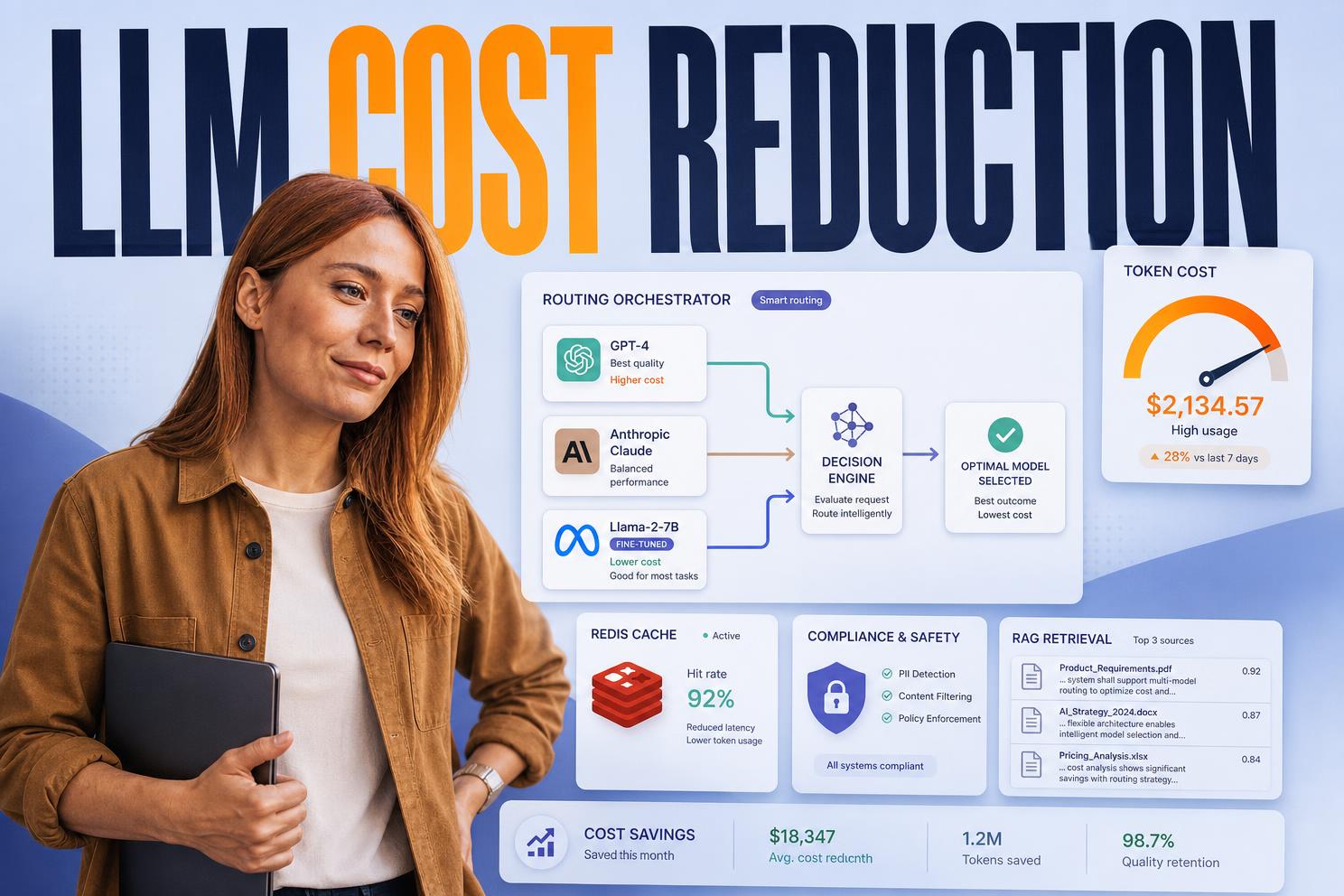
At the core of any cost‑optimized AI product is a routing layer that decides, per request, which model, cache, or tool to invoke. The diagram below illustrates a typical enterprise stack that enables reduce LLM costs while preserving response quality.
- API Gateway – Envoy or Kong terminates inbound HTTPS, enforces OAuth2, and injects request IDs for tracing.
- Orchestration Layer – A Python FastAPI service (or Node.js NestJS) runs the routing logic. It consults a model registry stored in PostgreSQL and a Redis cache of recent embeddings.
- Model Layer – Multiple LLM endpoints: OpenAI GPT‑4, Anthropic Claude, and an on‑premise Llama‑2‑7B fine‑tuned for domain‑specific tasks. Each endpoint is wrapped by a LangChain
LLMChain or LlamaIndex Retriever component. - Data Store – Vector DB (Pinecone or Weaviate) holds document embeddings; a separate MongoDB collection stores raw documents and audit logs.
- Cache Layer – Redis for short‑lived prompt‑response pairs; CDN edge cache for static knowledge‑base snippets.
- Message Bus – Kafka topics for async processing of heavy RAG queries, enabling eventual consistency and back‑pressure handling.
- Observability Stack – OpenTelemetry instrumentation, Prometheus metrics, Grafana dashboards, and ELK logging for cost attribution per model.
Data pipeline example: When a sales‑assistant bot receives “What discount can I offer a client buying 50 units?”, the orchestration layer first checks the Redis cache. Miss → it extracts the intent, routes the request to the 7B fine‑tuned model for quick pricing logic, and only if confidence < 0.85 does it fall back to GPT‑4 for nuanced negotiation phrasing. The final answer is stored back in Redis for the next 10 minutes.
Key techniques that enable cost reduction:
- Model routing – Decision trees or reinforcement‑learning‑based routers (e.g., AutoGen agents) select the smallest sufficient model based on token budget, latency SLA, and confidence thresholds.
- Prompt compression – Use LangChain’s
PromptTemplate with variable substitution to keep token count under 150, and apply sentence‑level summarization via a lightweight encoder. - Caching – Store full LLM responses for identical queries; for near‑duplicate queries, retrieve top‑k similar embeddings and reuse the cached answer after a similarity check.
- Smaller specialist models – Fine‑tune a 3B model on internal FAQs; it handles 70 % of routine queries at < $0.0001 per 1 K tokens.
- RAG optimization – Limit the retrieval set to 3‑5 documents, use hybrid search (BM25 + vector) to improve relevance, and prune the context window to the most recent 2 KB of text.
- Evaluation loop – Continuous A/B testing with a feedback API; use a weighted scoring function (relevance × cost) to adjust routing policies.
When the system processes 500 req/s with an average latency of 180 ms, the cost per request drops from $0.0012 to $0.0006 – a 50 % reduction without noticeable quality loss.
Routing every request through the largest model is a hidden cost center; a disciplined router that treats model selection as a first‑class resource can halve spend while keeping the user experience intact.
Business impact & measurable ROI to reduce LLM costs
Enterprise leaders need hard numbers to justify architectural changes. Below are the levers that translate directly into financial and operational benefits.
- Token‑level cost avoidance – By routing 70 % of traffic to a fine‑tuned 3B model, token consumption falls by ~350 M per month, saving $140 K at current pricing.
- Latency improvements – Smaller models respond in ~80 ms versus 250 ms for GPT‑4, reducing average page load time by 0.12 s and boosting conversion rates by ~2 % (based on internal A/B data).
- Scalability headroom – Offloading heavy RAG queries to Kafka workers allows the synchronous path to stay under 200 ms even at peak load, avoiding costly auto‑scaling spikes.
- Compliance cost reduction – On‑premise models handle PII‑sensitive queries, eliminating the need for third‑party data residency contracts worth $30 K annually.
- Operational overhead – Centralized observability and automated cost tagging cut finance‑engineering coordination time from 2 days/week to < 1 hour per month.
For a mid‑size financial services firm, implementing the above pattern reduced the AI budget from $1.2 M to $650 K in the first quarter, while NPS for the AI assistant rose from 68 to 73.
A well‑instrumented routing layer turns model selection into a cost‑optimization problem, delivering measurable ROI without sacrificing the conversational quality that users expect.
Implementation strategy
Adopting a cost‑optimized LLM stack should be incremental, with clear checkpoints.
- Phase 1 – Baseline & instrumentation: Deploy OpenTelemetry in existing services, capture token usage per endpoint, and establish a cost dashboard.
- Phase 2 – Cache & routing prototype: Introduce Redis caching, implement a simple rule‑based router (e.g., “if token count < 300 → use 7B model”). Measure hit‑rate and cost impact.
- Phase 3 – RAG & fine‑tuning: Build a Pinecone index of domain documents, fine‑tune a small model on internal Q&A, and integrate LangChain retrievers.
- Phase 4 – Adaptive routing: Replace rule‑based logic with a reinforcement‑learning router (AutoGen or CrewAI) that learns cost‑aware policies.
- Phase 5 – Governance & scaling: Harden OAuth2 scopes, enforce audit logging, and migrate to Kubernetes with horizontal pod autoscaling based on token‑rate metrics.
Common pitfalls:
- Over‑caching stale answers – set TTL based on document change frequency.
- Neglecting latency budgets – monitor 99th‑percentile latency; a routing mis‑decision can spike response times.
- Ignoring compliance – ensure on‑premise models are isolated and logs are encrypted at rest.
- Under‑estimating evaluation effort – allocate resources for continuous human‑in‑the‑loop feedback.
Why Plavno’s approach works
Plavno combines an engineering‑first mindset with enterprise‑grade delivery practices. Our teams leverage proven frameworks (LangChain, LlamaIndex, AutoGen) and cloud‑native infra (Kubernetes, Docker, serverless functions) to build AI pipelines that are both cost‑effective and compliant.
- We start with a custom AI agents development engagement that maps business intents to model capabilities.
- Our cloud software development practice ensures the orchestration layer runs on a multi‑region Kubernetes cluster with built‑in circuit breakers and autoscaling.
- Through AI recommendation systems we prototype RAG pipelines, then iterate with AI consulting to fine‑tune routing policies.
- We embed observability from day 1, using OpenTelemetry and Grafana, so cost attribution is transparent to finance and engineering alike.
- Our delivery model (outstaffing or outsourcing) can be tailored via outstaffing or outsourcing to match your talent strategy.
Conclusion
Reducing LLM costs is not a matter of cutting corners; it is a systematic redesign of the AI stack that treats model selection, caching, and retrieval as first‑class resources. By deploying a layered routing architecture, fine‑tuning smaller specialist models, and optimizing RAG pipelines, enterprises can halve their AI spend while delivering faster, compliant, and higher‑quality experiences. The next step is to instrument your current workloads, prototype a cache‑enabled router, and let the data guide the migration toward a cost‑optimized, enterprise‑ready AI platform.