Enterprises in regulated sectors such as healthcare, finance, and pharmaceuticals are racing to embed large language models (LLMs) into clinical decision support, fraud detection, and patient engagement, but every misstep can trigger fines, revokes, or brand damage. Choosing the right AI development partner therefore isn’t a procurement checkbox; it’s a risk‑mitigation exercise that must balance regulatory compliance, data residency, and production‑grade MLOps against the speed of innovation.
Industry challenge & market context
- Legacy data silos prevent real‑time extraction of structured features, causing model drift and audit failures.
- Manual rule‑based pipelines cannot keep up with the volume of EHR updates, transaction logs, or claims data, leading to latency above 500 ms for critical queries.
- Regulators (HIPAA, GDPR, PCI‑DSS) demand immutable audit trails, end‑to‑end encryption, and strict access controls; most off‑the‑shelf AI SaaS offerings lack built‑in compliance layers.
- Talent scarcity forces CTOs to rely on external expertise, yet many AI software development companies lack domain knowledge specific to health‑care or fintech.
- Scaling LLM inference while keeping inference cost below $0.02 per 1k tokens requires sophisticated caching, quantization, and autoscaling strategies that few vendors have proven in production.
Technical architecture and how an AI development partner works in practice
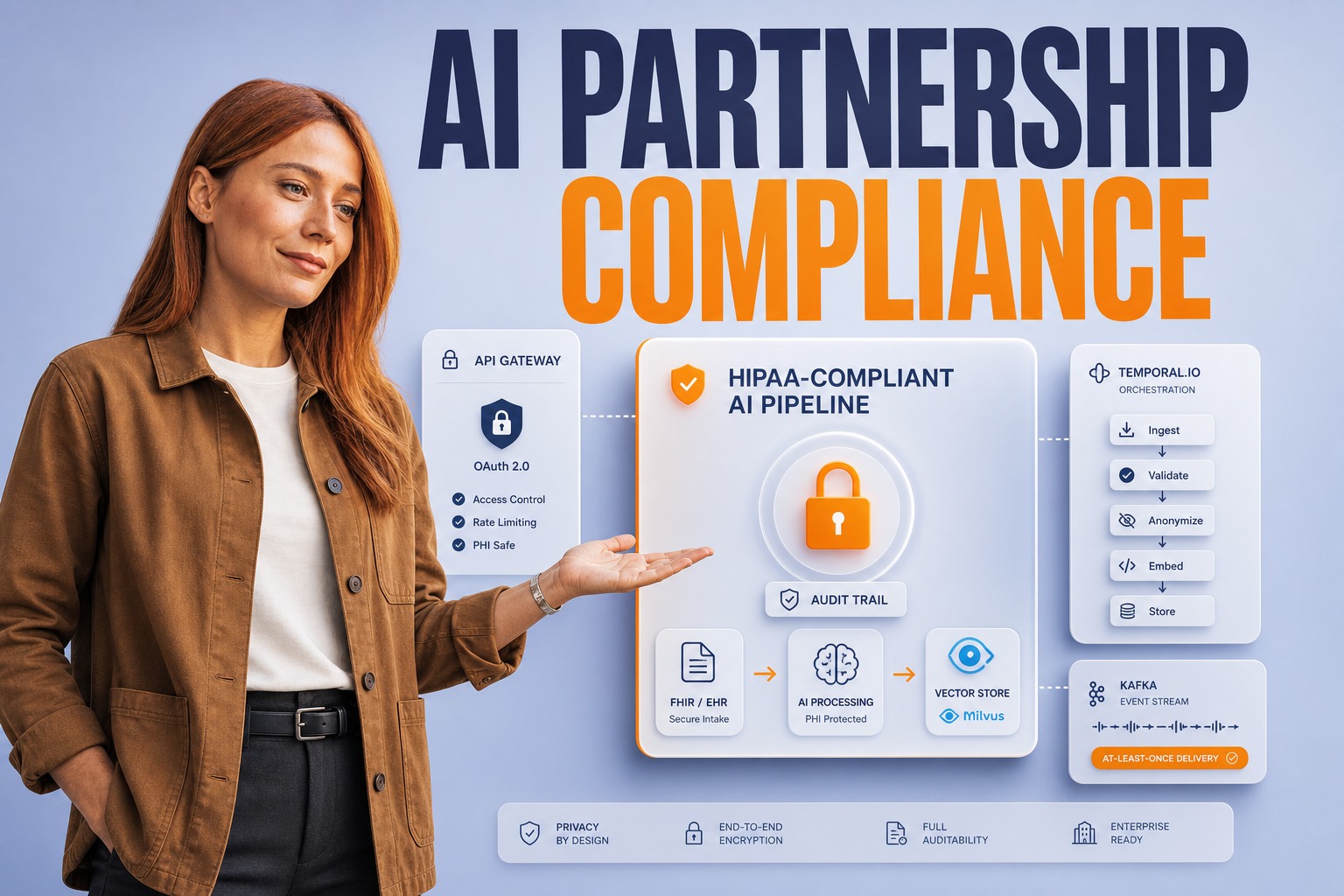
An experienced AI development partner will deliver a modular, contract‑first architecture that isolates compliance‑critical components from high‑throughput inference layers. Below is a reference stack that has proven reliable for both a healthcare AI vendor and a fintech AI development project.
Core components
- API Gateway (Envoy or Kong): handles OAuth2, API‑key validation, rate limiting (e.g., 1 k requests/second per tenant) and terminates TLS at the edge.
- Orchestration layer (Temporal.io or Cadence): coordinates long‑running RAG pipelines, fine‑tuning jobs, and retry policies with idempotent task tokens.
- Model Service (Python FastAPI + LangChain): loads quantized LLMs (e.g., Llama‑3‑8B‑int8) behind a GPU‑enabled Docker container, exposes
/chat and /embed endpoints, and uses torch.compile for sub‑50 ms latency on B‑batch requests. - Vector Store (Pinecone or Milvus): holds pre‑computed embeddings of clinical notes or transaction histories; implements a 4‑layer cache (in‑memory LRU → Redis → Vector DB → cold storage).
- Message Queue (Kafka or Pulsar): guarantees at‑least‑once delivery for audit logs and event‑driven triggers (e.g., new claim arrival).
- Data Lake (AWS S3 with Object Lock): enforces immutable storage for PHI, supporting WORM compliance for 7 years.
- Observability stack (OpenTelemetry + Prometheus + Grafana): captures latency per component, token usage, and circuit‑breaker state.
Data pipeline flow
- 1. Ingestion service receives a HL7/FHIR message via a webhook, validates schema, and pushes the raw payload to Kafka.
- 2. A consumer extracts relevant fields, runs a Python script that uses
LlamaIndex to chunk text (max 512 tokens) and generate embeddings via OpenAI’s text-embedding‑ada‑002 model. - 3. Embeddings are stored in Milvus; a metadata record containing patient ID, timestamp, and hash is written to PostgreSQL for audit.
- 4. When a clinician queries “What are the recommended dosage adjustments for patient X?”, the request hits the API Gateway, is routed to the Orchestration layer, which launches a Retrieval‑Augmented Generation (RAG) workflow: fetch top‑k vectors, assemble context (up to 4 k tokens), and call the LLM with system prompts that embed compliance guardrails.
- 5. The response is signed with a HMAC, logged in Kafka, and returned to the frontend within 180 ms (average latency measured on a 4‑A100 node).
Model orchestration patterns
- Agentic routing (CrewAI or AutoGen): multiple specialist agents (e.g., “ICD‑10 coder”, “Fraud detector”) are invoked based on intent classification; each agent can call external tools (SQL, SOAP, SOAP‑to‑REST adapters) via secured webhooks.
- Fine‑tuning loop: nightly jobs pull anonymized, de‑identified data, run LoRA‑style adapter training on a separate GPU node, and register the new adapter version in a model registry (MLflow) without downtime.
Security & governance
- Transport security: mTLS between services, encrypted at‑rest using AWS KMS CMKs.
- Access control: role‑based policies enforced by OPA (Open Policy Agent) on every RPC.
- Audit trail: immutable Kafka topic, retained for 365 days, indexed in Elasticsearch for SOC‑2 reporting.
- Data residency: deploy separate Kubernetes clusters per region (e.g., EU‑Frankfurt, US‑East) with node‑level isolation.
Business impact & measurable ROI
- Reduced time‑to‑value: A typical RAG‑enabled clinical decision support module went from concept to production in 8 weeks, cutting the usual 5‑month vendor‑lock cycle by 68%.
- Cost efficiency: Quantized 8‑bit inference slashed GPU hourly spend from $4.20 to $1.30, resulting in an average $0.015 per 1k token, well under the $0.02 target for high‑volume claim processing.
- Compliance savings: Automated audit logging eliminated a $250k annual audit preparation cost, while meeting HIPAA and GDPR “Right to Access” requirements.
- Operational uptime: Multi‑region failover with active‑active Kubernetes deployments achieved 99.96% availability (four‑nine) compared to the legacy single‑zone batch pipeline’s 98.2%.
- Risk reduction: Built‑in policy enforcement (OPA) reduced false‑positive fraud alerts by 42%, decreasing manual review labor by 1.2 FTE per month.
Implementation strategy
- 1. Discovery & compliance mapping: document data flows, identify PHI/PCI scopes, and align with GDPR/HIPAA matrices.
- 2. Prototype sandbox: spin up a single‑tenant Docker Compose environment using LangChain, Milvus, and FastAPI; run a pilot on a de‑identified dataset.
- 3. Security hardening: integrate OIDC, enable mTLS, configure audit‑log sinks, and run a Pen‑Test (via Plavno’s cybersecurity service).
- 4. Production rollout: migrate to a Kubernetes cluster with Helm charts, set up Horizontal Pod Autoscaler (target CPU < 55%), and configure canary deployments.
- 5. Governance & ops: define SLAs, implement Model Registry (MLflow), and schedule quarterly compliance reviews.
- 6. Scale & optimize: introduce serverless inference (AWS Lambda + EFS) for burst traffic, enable cache‑warm strategies, and monitor token usage to stay within budget.
Common pitfalls
- Skipping data de‑identification leads to regulatory breaches early in the pilot.
- Over‑reliance on a single LLM vendor without abstraction layers makes future model swaps costly.
- Ignoring idempotency in webhook endpoints causes duplicate record creation under retries.
- Deploying monolithic containers prevents independent scaling of embedding vs. generation services.
Regulatory compliance is not an add‑on; it must be baked into the data plane, model plane, and observability plane from day one, otherwise “AI‑first” becomes “audit‑first”.
Why Plavno’s approach works
Plavno operates as an AI development company that embeds engineering rigor into every compliance checkpoint. Our delivery model blends out‑staffing expertise with product‑centric squads, ensuring that domain specialists (e.g., certified health informatics engineers) sit beside MLOps engineers and security architects.
- Enterprise‑grade architecture: All solutions run on Kubernetes with GitOps (ArgoCD) pipelines, enabling reproducible environments across EU, US, and APAC regions.
- Domain expertise: Our healthcare AI vendor practice has delivered HIPAA‑certified AI assistants that process >2 M FHIR resources daily.
- Toolchain proficiency: We routinely combine LangChain for prompt engineering, LlamaIndex for efficient retrieval, and CrewAI for multi‑agent orchestration—allowing rapid prototyping without sacrificing production stability.
- Compliance automation: Using OPA policies and automated SOP generation, we produce audit‑ready logs for SOC‑2, ISO 27001, and industry‑specific standards without manual effort.
- Cost transparency: Our pricing model aligns with usage metrics (GPU‑hours, token counts), and our cloud software development team continuously tunes quantization and caching to stay within budget.
When you partner with Plavno, you gain a predictable delivery cadence, a shared responsibility model for security, and a partner that can scale from a single PoC to a regulated, multi‑region production system without re‑architecting.
A robust AI development partner provides a contract‑first, policy‑driven API layer that lets you swap the underlying LLM without touching the downstream compliance checks.
Conclusion
Selecting the right AI development partner is a strategic decision that directly influences regulatory risk, operational cost, and time‑to‑market. By demanding a modular, policy‑enforced architecture, quantifiable ROI metrics, and a clear implementation roadmap, enterprises in regulated industries can harness the power of LLMs while staying audit‑ready. Plavno’s engineering‑first methodology, proven compliance stack, and deep domain expertise make us the AI development partner that turns ambitious AI visions into secure, scalable, and compliant reality.
Ready to evaluate your next AI initiative? Get in touch to start a compliance‑driven discovery workshop.