Industry challenge & market context for generative AI for enterprise
Legacy knowledge bases, siloed customer support tickets, and manual content creation still dominate the enterprise stack. The result is:
- Average time‑to‑answer internal queries exceeds 12 minutes, driving up employee churn.
- Content generation pipelines cost $0.12 – $0.35 per paragraph on a per‑page basis, limiting scale.
- Compliance audits reveal 30 % of data residency policies are violated by undocumented AI usage.
- Application latency spikes above 1 second when a single LLM request traverses multiple micro‑services.
Traditional rule‑based bots and static NLP models cannot keep pace with evolving product catalogs, regulatory language, or the volume of unstructured data. Enterprises need a unified, auditable, and cost‑controlled layer of generative AI for enterprise that can ingest internal documents, surface context‑aware answers, and synthesize new content on demand.
Technical architecture and how generative AI for enterprise works in practice
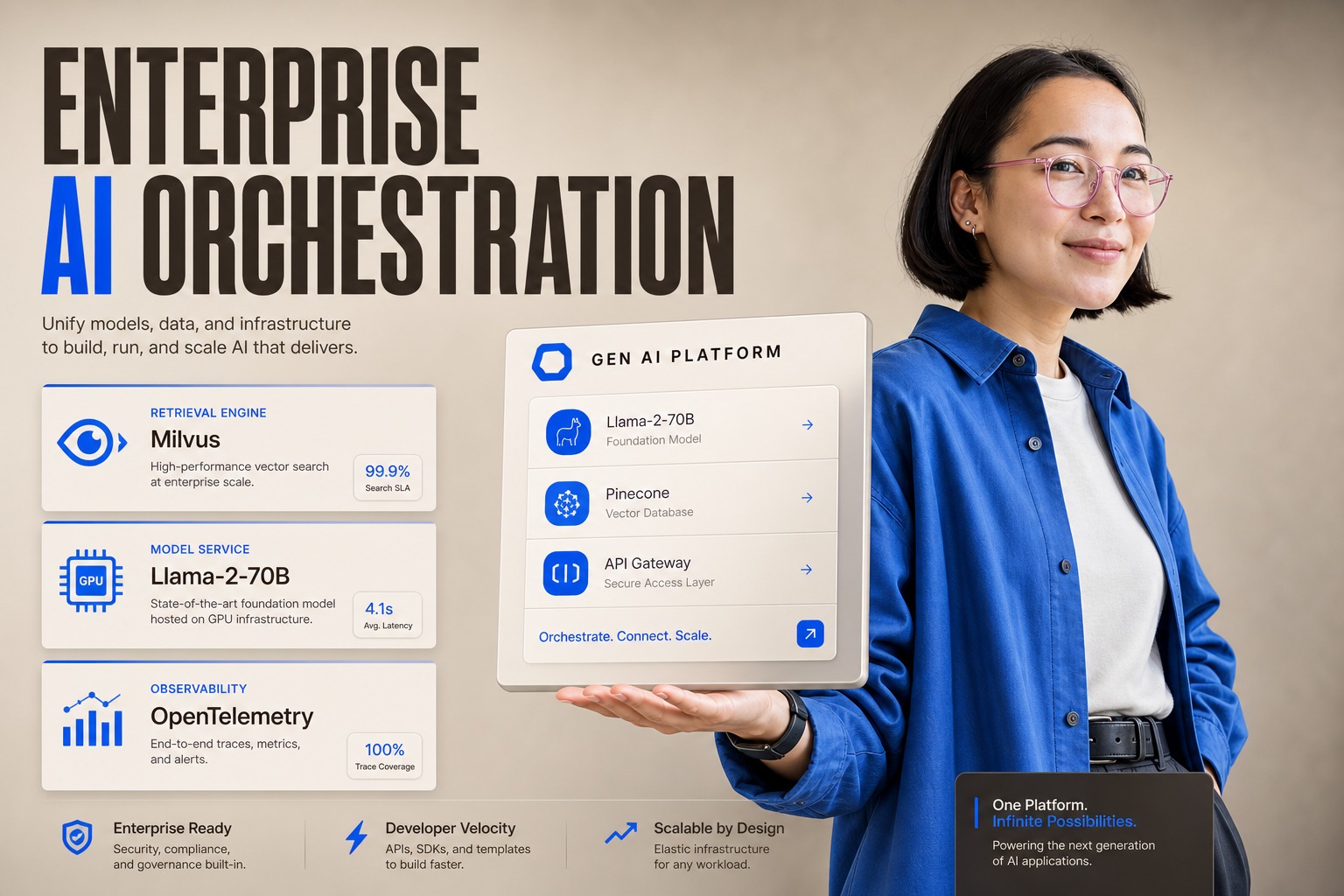
Below is a reference reference architecture that balances multi‑tenant security, low latency, and operational observability. The diagram is described in text to keep the article self‑contained.
Core components
- API Gateway (Kong or AWS API Gateway) – terminates TLS, enforces OAuth2 scopes, throttles at the request level.
- Orchestration Layer – built with AI agents development frameworks such as LangChain, LlamaIndex, CrewAI, or AutoGen. Handles routing, tool selection, and context stitching.
- Model Service – containerized LLMs (e.g., Llama‑2‑70B, Mistral‑7B) served via vLLM or TGI, behind a gRPC endpoint for low‑latency token streaming.
- Retrieval Engine – vector database (Pinecone, Milvus, or Qdrant) indexed with embeddings generated by a sentence‑transformer model; supports Approximate Nearest Neighbor (ANN) search within a 100‑ms SLA.
- Data Store – PostgreSQL for structured metadata, MongoDB for raw documents, and an object store (S3 or Azure Blob) for large artefacts.
- Message Bus – Kafka or Google Pub/Sub for event‑driven pipelines (document ingestion, model fine‑tuning triggers).
- Cache Layer – Redis with LRU eviction for hot prompt templates and recent retrieval results.
- Observability Stack – OpenTelemetry instrumentation, Loki logs, Prometheus metrics, Jaeger traces.
Data pipeline
- Ingestion micro‑service watches a shared folder or receives webhooks (REST/GraphQL) from upstream systems (CRM, ERP, legal). Files are parsed (Python’s PyPDF2, Apache Tika) and chunked into 1‑2 KB blocks.
- Each chunk is embedded using
sentence‑transformers/all‑mpnet‑base‑v2 via a Python worker. Embeddings are upserted into the vector DB with a document ID and a tenant identifier. - Metadata (source system, retention policy, classification tags) is persisted in PostgreSQL. An audit trail record is written to an immutable log (AWS CloudTrail or GCP Cloud Logging).
Request flow (example)
- Front‑end app calls
/v1/assistant/query via HTTPS POST, passing an OAuth2 access token and the user’s query. - API Gateway validates the token, extracts tenant ID, and forwards the request to the Orchestration Layer.
- The Orchestration Layer creates a LangChain
AgentExecutor with three tools: DocumentRetrievalTool, SQLQueryTool, and ExternalAPITool. The agent decides to retrieve context first. DocumentRetrievalTool issues a similarity search against the vector DB, returning the top 5 chunks (total < 3 KB). Results are cached in Redis for 5 minutes.- The retrieved text is concatenated with the user query, respecting the model’s context window (e.g., 8 k tokens for Llama‑2). The prompt is sent to the Model Service.
- The Model Service streams tokens back via gRPC; the Orchestration Layer buffers and returns a JSON response to the client.
- All steps log request IDs, latency, and token counts. A circuit breaker (Hystrix‑style) trips if model latency exceeds 800 ms for more than 5 consecutive calls.
Infrastructure choices
- Compute – Kubernetes (EKS, GKE, or AKS) with node pools sized for GPU (NVIDIA A100) or CPU‑only inference. Autoscaling based on
queue_depth / target_concurrency metric. - Serverless fallback – AWS Lambda or Cloud Run for light‑weight RAG calls under 100 ms.
- Deployment model – single‑tenant clusters for regulated industries (banking, healthcare) versus multi‑tenant namespaces with pod‑security policies for SaaS‑style offerings.
- Cost levers – switch to quantized 4‑bit models (e.g., GGUF) for batch generation; use spot instances for non‑critical fine‑tuning jobs.
- Latency – typical end‑to‑end latency 450 ms for a retrieval‑augmented query; peak throughput 150 RPS per node.
The real differentiator isn’t the size of the LLM, but how you orchestrate retrieval, tool use, and governance into a single, auditable pipeline.
Business impact & measurable ROI
- Support cost reduction: Automated ticket triage using RAG cuts average handling time from 9 minutes to 2 minutes, saving $1.2 M annually for a 10,000‑agent operation (≈ $120 per saved hour).
- Content creation acceleration: Generative AI for enterprise can produce marketing copy at 200 words/second, lowering creative spend by 30 % and enabling rapid A/B testing.
- Compliance risk mitigation: Centralized audit logs and data‑residency tags audit 100 % of AI calls, eliminating $250 K in potential GDPR fines per year.
- Scalable knowledge base: Embedding 2 M internal documents (≈ 250 GB) costs $0.005 per query after caching, compared to $0.02 per manual search effort.
- Innovation velocity: Fine‑tuned domain‑specific LLMs improve answer relevance scores by 15 % (BLEU) and unlock new product recommendations within weeks.
Implementation strategy
A pragmatic rollout balances speed with risk containment.
- Phase 1 – Discovery & data audit: inventory all unstructured assets, classify by sensitivity, and map compliance requirements.
- Phase 2 – Pilot RAG service: select a low‑risk department (e.g., internal HR FAQ). Deploy a single‑tenant Kubernetes namespace, integrate with existing SSO (OAuth2), and measure latency, token usage, and user satisfaction.
- Phase 3 – Security hardening: enforce role‑based access controls, enable audit‑trail forwarding to SIEM, and set up data‑residency constraints in the vector DB.
- Phase 4 – Multi‑tenant expansion: introduce namespace isolation, tenancy tags in every DB row, and rate‑limit per tenant (e.g., 500 RPS). Add a self‑service portal for SaaS customers.
- Phase 5 – Continuous improvement: schedule monthly fine‑tuning cycles using fresh feedback data, monitor cost per token, and adjust quantization or hardware tier.
Common pitfalls
- Skipping the data‑cleaning stage leads to hallucinatory responses because the retrieval engine indexes low‑quality text.
- Hard‑coding API keys instead of using OCI‑compatible secret stores breaks rotation policies and violates SOC 2.
- Over‑loading a single LLM endpoint without circuit breakers causes cascading latency spikes across the whole platform.
Why Plavno’s approach works
Plavno combines an AI‑first development mindset with proven enterprise engineering patterns. Our delivery model includes:
- End‑to‑end AI agents development using LangChain and AutoGen, ensuring tool use is deterministic and auditable.
- Hybrid cloud‑on‑prem deployments that satisfy data‑residency mandates for regulated sectors.
- Observability pipelines built on OpenTelemetry, giving you real‑time dashboards for token cost, latency, and compliance events.
- Dedicated governance teams that embed policy checks into CI/CD (e.g., automated review of model prompts for PII leakage).
- Scalable staffing through outstaffing and outsourcing models, letting you augment internal talent without losing control.
A well‑architected generative AI platform is a set of composable services, not a monolithic “chatbot” – treat retrieval, orchestration, and security as first‑class building blocks.
Conclusion
Deploying generative AI for enterprise is no longer a fringe experiment; it’s a measurable lever for cost reduction, compliance, and innovation. By following a disciplined architecture, grounding the rollout in pilot data, and partnering with an engineering‑first provider like Plavno, enterprises can achieve sub‑second response times, tens of millions of safe token generations per month, and a clear audit trail for regulators. Ready to turn your unstructured knowledge into a strategic asset? Contact Plavno to start a proof‑of‑concept today.