Industry challenge & market context
Enterprises that have tried to bolt a generic chatbot onto a legacy ERP or to plug a pre‑trained recommendation engine into a proprietary supply‑chain system quickly hit three hard limits:
- Workflow complexity. Modern processes span dozens of micro‑services, include conditional approvals, and require real‑time compliance checks. Off‑the‑shelf AI models only understand linear dialogs.
- Proprietary data silos. Sensitive transaction logs, regulated health records, or high‑frequency market feeds cannot be exported to a SaaS platform without violating data residency or GDPR requirements.
- Integration friction. Most commercial AI tools expose a single REST endpoint. Enterprises need event‑driven pipelines, GraphQL mutations, and guaranteed exactly‑once semantics across Kafka, RabbitMQ, or IBM MQ.
Attempting to force these scenarios into a one‑size‑fits‑all solution leads to:
- Unpredictable latency spikes (often > 500 ms) that break SLAs.
- Hidden compliance risk when data leaves the corporate firewall.
- Technical debt from “glue code” that bypasses security policies.
The moment you need to stitch AI into a regulated, multi‑tenant workflow, the off‑the‑shelf model stops being a product and becomes a liability.
Technical architecture and how custom AI software development works in practice
Building a robust, enterprise‑grade AI layer starts with a modular architecture that isolates the model from business logic, enforces policy, and scales horizontally.
Core components
- API Gateway. Handles OAuth2, API‑key validation, rate limiting, and request routing. Common choices: Kong, AWS API Gateway, or NGINX with OpenID Connect.
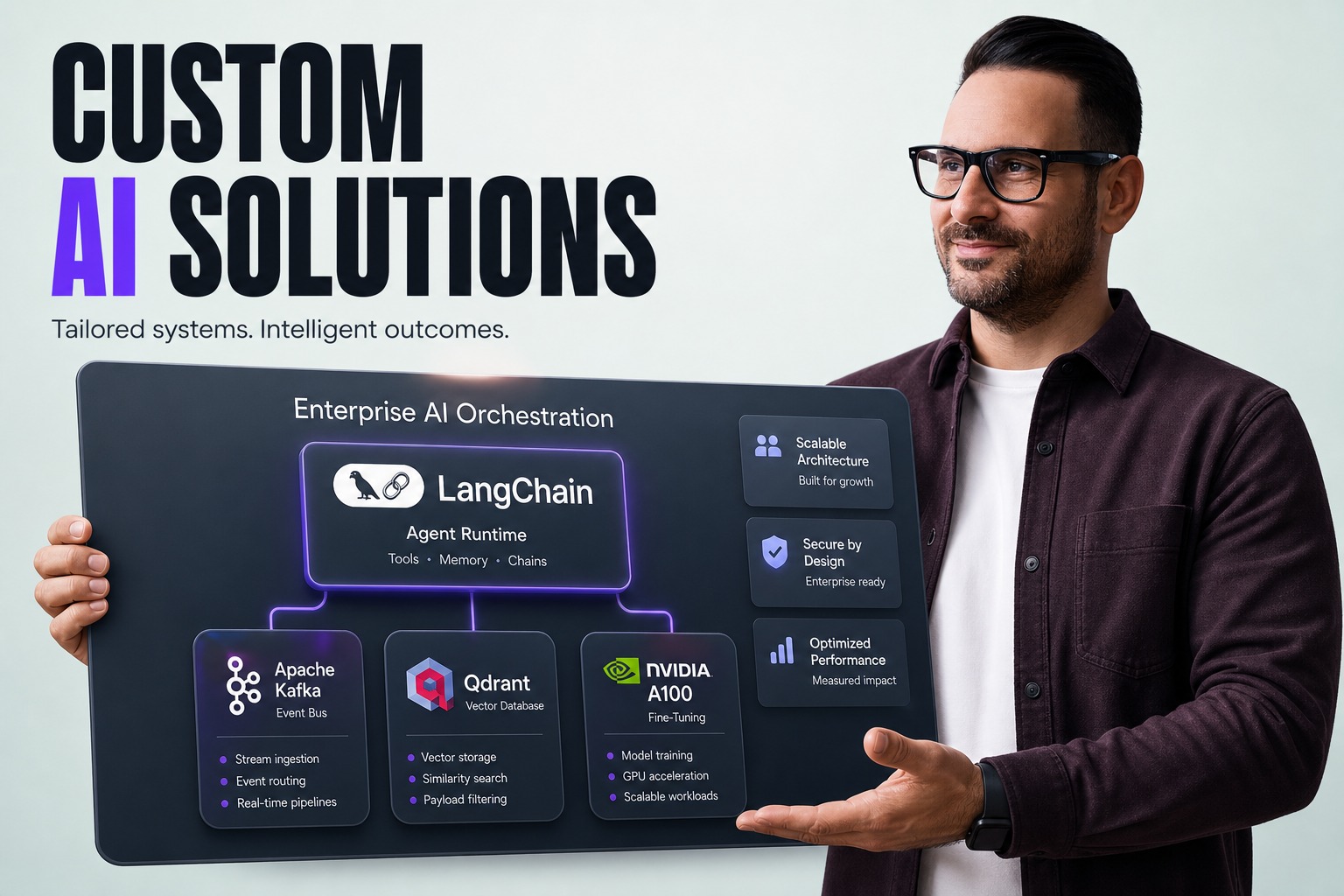
- Orchestration layer. Executes RAG pipelines, agent routing, and tool selection. Frameworks such as LangChain, LlamaIndex, CrewAI or AutoGen provide composable agents and memory stores.
- Model layer. Hosts LLMs (e.g., Llama 2, Mistral, OpenAI GPT‑4) in containers or serverless inference endpoints. Fine‑tuned checkpoints sit alongside a vector database for embeddings.
- Data store. Structured relational DB (PostgreSQL) for transaction metadata, and a vector DB (Pinecone, Qdrant, or Milvus) for semantic retrieval.
- Message bus. Kafka topics or RabbitMQ queues carry async events (e.g., “order‑approved”) ensuring eventual consistency.
- Observability stack. OpenTelemetry for tracing, Prometheus/Grafana for metrics, Loki for logs, and a circuit‑breaker library (Resilience4j) to guard downstream services.
Data pipeline example
- 1. A user uploads a new contract PDF via the document‑management portal.
- 2. An event is published to
document.uploaded Kafka topic. - 3. A consumer extracts text, runs a chunking job, and stores embeddings in Qdrant.
- 4. The orchestration layer registers the document ID in a Redis cache with a TTL of 24 h for quick reference.
- 5. When a compliance officer queries “show clauses about termination,” the API gateway authenticates the request, forwards it to the orchestration layer, which performs a RAG query: retrieve top‑k embeddings, concatenate with the prompt, and invoke the LLM with a 4,096‑token context window.
- 6. The response is streamed back via Server‑Sent Events, logged for audit, and the interaction is stored in an immutable audit table (Append‑Only) for regulatory review.
Model orchestration patterns
- Router‑agent pattern. A lightweight decision engine (implemented with LangChain Router) decides whether the request needs retrieval, tool execution, or direct generation.
- Tool use. The LLM can call external APIs (e.g., ERP / SAP endpoint) through a defined
tool schema. The orchestrator validates parameters, enforces idempotency tokens, and retries with exponential back‑off. - Fine‑tuning loop. Periodic batch jobs collect labeled Q&A pairs, sample 10 % of traffic, and fine‑tune the base model on a dedicated GPU node (NVIDIA A100) using LoRA adapters to keep cost < $0.30 per hour.
API & integration layer
- REST endpoints for CRUD operations, protected by OAuth2 scopes.
- GraphQL mutations for complex queries that need selective field fetching (e.g., compliance‑driven partial document retrieval).
- Webhooks for third‑party notifications (e.g., Slack alert when a high‑risk clause is detected).
- Event streams (Kafka) for asynchronous workflows such as “document‑review‑complete”.
Infrastructure choices
- Containers orchestrated by Kubernetes (EKS, GKE, or on‑prem AKS) with Helm charts for each micro‑service.
- Docker images built on lightweight
python:3.11-slim or node:20-alpine bases. - Serverless fallback (AWS Lambda or Azure Functions) for bursty inference traffic, keeping cold‑start latency around 120 ms.
- Hybrid deployment: sensitive data‑processing pods locked in a VPC, public inference pods behind CloudFront CDN.
- Scaling: horizontal pod autoscaler (HPA) based on CPU < 70 % and custom metric “tokens_per_second”. Target throughput 500 QPS with 95th‑percentile latency ≤ 150 ms.
Business impact & measurable ROI
Custom AI solutions translate technical advantages into hard numbers that matter to the C‑suite.
- Process acceleration. Automating contract clause extraction reduced manual review time from 30 minutes to 2 minutes per document, a 93 % productivity gain.
- Cost containment. By running inference on spot‑instance GPU nodes and throttling to 80 % of the allocated token budget, operational spend fell from $12 k/month to $5 k/month – a 58 % reduction.
- Compliance safeguard. End‑to‑end audit logs and data‑residency enforcement eliminated the risk of GDPR fines (potentially €20 M) by ensuring no personal data left EU‑hosted clusters.
- Revenue enablement. A personalized product‑recommendation engine powered by RAG increased cross‑sell conversion by 4.3 % (≈ $1.2 M annually for a $28 M e‑commerce platform).
- Scalability. Event‑driven architecture allowed peak traffic of 2,000 concurrent requests during a quarterly earnings release without SLA breach, thanks to async queue buffering and circuit‑breaker fallback to cached responses.
When the AI layer is built as a first‑class service with proper observability, the same codebase that serves 10 QPS in dev can reliably handle 10,000 QPS in production.
Implementation strategy
Turning a vision into a production‑grade AI system requires disciplined phases.
- Phase 1 – Discovery & data audit. Map all data sources, classify sensitivity, and define the compliance perimeter. Deliver a data‑lineage diagram and a “risk register”.
- Phase 2 – MVP architecture proof. Deploy a minimal LangChain RAG pipeline on a single Kubernetes namespace. Connect one vector DB and one downstream ERP API. Validate latency (< 200 ms) and token‑cost model.
- Phase 3 – Security hardening. Implement OAuth2 scopes, API‑key rotation, audit‑trail tables, and encryption‑at‑rest via KMS. Run a third‑party pen‑test to certify the perimeter.
- Phase 4 – Scale & multi‑tenant enablement. Refactor services to be stateless, externalize session state to Redis, and add tenant‑ID in every request header. Deploy to multiple regions with active‑active failover.
- Phase 5 – Continuous improvement. Set up a feedback loop: capture failed queries, label them, and automate nightly fine‑tuning runs. Monitor “hallucination rate” via a custom metric and aim for < 1 %.
Common pitfalls
- Skipping data‑governance early leads to re‑architecting later.
- Relying on a single LLM without fallback; always provision a cheap, deterministic rule‑engine as a backup.
- Ignoring rate‑limit headers from third‑party APIs, causing cascading failures.
- Hard‑coding token limits in prompts; use dynamic truncation based on model’s context window.
Why Plavno’s approach works
Plavno combines an engineering‑first philosophy with deep enterprise experience:
- We start with custom software development workshops that surface hidden workflow constraints and data‑ownership rules.
- Our AI specialists leverage LangChain, CrewAI, and AutoGen to build composable agents that can be re‑used across projects, reducing time‑to‑value by up to 40 %.
- Infrastructure is delivered as code (Terraform, Helm) and runs on a choice of cloud, on‑prem, or hybrid, matching strict residency policies.
- Our observability pipeline integrates with existing Splunk or Elastic stacks, giving you full traceability without an extra vendor lock‑in.
- Through our hiring models — outsourcing or outstaffing — you gain flexible talent that scales with the project, while retaining IP ownership.
- Case studies span fintech compliance bots, medical voice assistants, and e‑government document classifiers, all built on the same disciplined stack.
When you partner with Plavno, you get a partner that talks the same language as your architects, writes production‑grade code, and embeds governance from day 1.
Ready to move from generic AI experiments to a custom AI software development platform that respects your data, your latency targets, and your compliance envelope? Contact us for a technical discovery session and see how a purpose‑built solution can unlock measurable ROI.