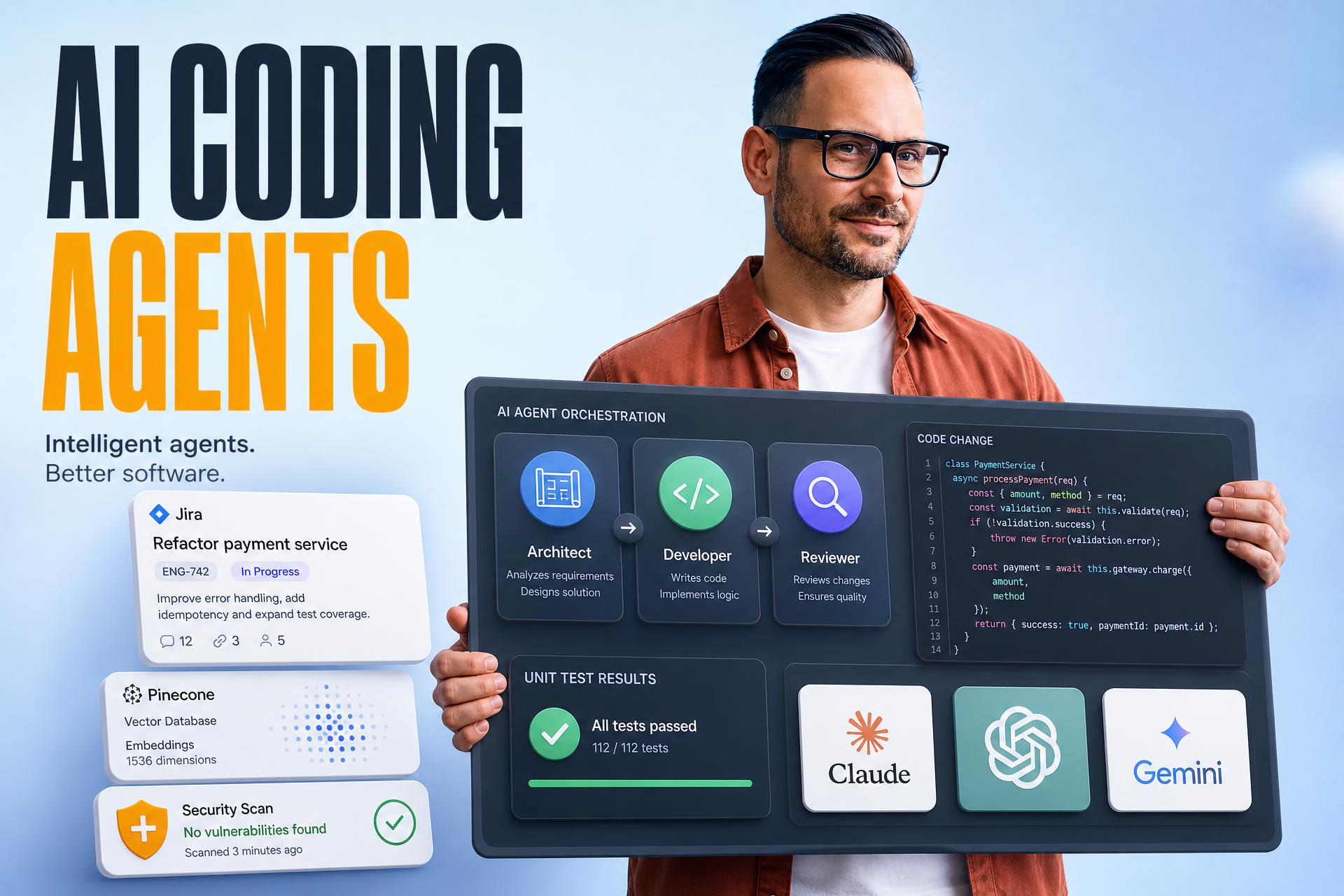
The era of treating Large Language Models (LLMs) as mere autocomplete engines is over. For enterprise engineering teams, the value proposition has shifted from "suggesting the next line of code" to "autonomously resolving complex Jira tickets." This transition requires a fundamental rethinking of tooling, architecture, and governance. We are no longer comparing chatbots; we are evaluating AI coding agents—autonomous systems capable of planning, executing, and verifying code changes within a complex software ecosystem. The difference between a productivity booster and a security liability lies in how these agents are architected, integrated into the CI/CD pipeline, and governed by strict engineering oversight.
Industry challenge & market context
Enterprises are under immense pressure to accelerate delivery while maintaining security and stability. Legacy development cycles are too slow, but simply dropping a generic LLM into a developer’s IDE introduces significant risks. The market is flooded with options—Claude Code, OpenAI Codex, and the Gemini coding assistant—each promising to revolutionize AI software development. However, CTOs and architects are struggling to separate marketing hype from production-grade utility. The challenge is not just code generation; it is context awareness, security compliance, and the ability to operate within existing enterprise guardrails.
- Velocity bottlenecks in legacy CI/CD pipelines where code review and testing account for 40-60% of cycle time.
- Context window limitations that prevent agents from understanding monolithic architectures or complex microservice dependencies.
- Security risks including data leakage, prompt injection, and the propagation of vulnerable code patterns (e.g., SQL injection, hardcoded secrets).
- Lack of auditability in autonomous decision-making, making it difficult to satisfy compliance requirements like SOC2 or GDPR.
- High rates of hallucination in generated code, leading to non-deterministic builds and runtime errors that slip into production.
Technical architecture and how AI coding agents works in practice
Deploying an AI coding agent effectively requires more than an API key; it requires a robust orchestration layer. At Plavno, we architect these systems not as simple chat interfaces, but as event-driven microservices that interact directly with the engineering stack. A typical production architecture involves an API Gateway, an orchestration layer (often using frameworks like LangChain or CrewAI), a model layer (hosting Claude, GPT-4, or Gemini), and a persistent context store.
When a developer or product manager triggers an agent, the system initiates a retrieval-augmented generation (RAG) pipeline. The agent does not "guess" the codebase structure; it queries a vector database (such as Pinecone or Milvus) populated with embeddings of your documentation, schema definitions, and git history. This ensures the agent operates with the specific context of your business logic. For instance, when refactoring a payment service, the agent retrieves the relevant API contracts and database schemas before generating a single line of code.
The most successful implementations treat the coding agent as a distinct microservice with its own identity, IAM roles, and circuit breakers, rather than a plugin running on a developer's laptop.
Model orchestration is critical. We utilize multi-agent frameworks like AutoGen or CrewAI to delegate tasks. One agent might act as the "Architect," analyzing the request and generating a plan, while a "Developer" agent writes the code, and a "Reviewer" agent runs static analysis and unit tests. This separation of concerns ensures higher quality output. The orchestration layer manages the state, ensuring that if an agent fails a unit test, it can self-correct by iterating on the code without human intervention, up to a configured retry limit.
Infrastructure-wise, these agents are best deployed in containerized environments (Docker/Kubernetes) to allow for autoscaling based on queue depth. If a team pushes 50 refactoring tasks overnight, the Kubernetes cluster spins up additional pods to process the jobs in parallel, leveraging serverless functions for specific triggers like webhook events. Communication between the agent and the codebase happens via secure APIs (REST or GraphQL) and git operations over SSH with restricted keys.
- API Gateway: Handles authentication (OAuth2/JWT), rate limiting, and routing requests to the orchestration service.
- Orchestration Layer: Built on Python or Node.js using LangChain or LlamaIndex; manages agent lifecycles, prompt templates, and tool routing.
- Context Store: Vector databases (e.g., Weaviate, pgvector) storing embeddings of code, docs, and tickets; coupled with a metadata store for filtering.
- Model Layer: Abstraction interface allowing dynamic routing between Claude, OpenAI, or Gemini based on task requirements (e.g., routing complex logic to Claude 3 Opus, fast completion to GPT-4o).
- Sandboxed Execution Environment: Isolated Docker containers where generated code is executed and tested to prevent runtime attacks on the host system.
- Observability Stack: Integration with Datadog or Prometheus for tracing token usage, latency, and success rates; logging all agent decisions for audit trails.
Business impact & measurable ROI
Integrating AI coding agents into the software development lifecycle (SDLC) drives measurable ROI, but only when implemented with engineering rigor. The primary value driver is the reduction of "toil"—repetitive, low-value work that consumes senior engineering time. By offloading boilerplate generation, unit test creation, and documentation updates to agents, enterprises see a significant acceleration in time-to-market.
Quantitatively, we observe that mature implementations can reduce the initial draft time for feature branches by 30-50%. More importantly, the consistency of code improves. Agents do not get tired; they apply the same linting rules and design patterns 100% of the time. This reduces technical debt accumulation. From a cost perspective, while there is an upfront infrastructure and token cost, it is offset by the reduced need for junior staff to perform routine maintenance tasks. The cost of running an agent (compute + tokens) is often a fraction of the hourly rate for a software engineer.
ROI is not just about speed; it is about risk mitigation. Automated agents that enforce security scans and compliance checks during the commit phase prevent vulnerabilities that would cost millions to remediate post-production.
- Velocity: Reduction in cycle time by 2-5 days per sprint for maintenance tasks and legacy refactoring.
- Quality: 15-25% reduction in bug density due to consistent application of linting rules and automated unit test coverage.
- Cost Efficiency: Lower operational overhead for routine code reviews, allowing senior architects to focus on high-level system design.
- Developer Satisfaction: Reduced burnout by eliminating repetitive coding tasks, allowing engineers to focus on complex problem-solving.
- Risk Reduction: Automated compliance checks integrated into the agent workflow ensure adherence to security policies before code is even pushed to the repository.
Implementation strategy
Successfully deploying AI coding agents requires a phased approach. Enterprises should not attempt a "big bang" rollout. Instead, start with a pilot program focused on a specific, high-impact domain, such as automated unit test generation or legacy documentation migration. This allows the team to fine-tune prompts, evaluate different models (Claude vs OpenAI vs Gemini), and establish trust in the system's outputs.
Once the pilot proves successful, the strategy shifts to scaling and governance. This involves integrating the agents into the CI/CD pipeline (e.g., GitHub Actions, GitLab CI) so that code generation and review happen automatically as part of the workflow. Governance becomes paramount here. You must define strict "guardrails"—policies that dictate what the agent can and cannot do (e.g., no direct writes to production databases, no modification of critical auth libraries without human approval).
- Assessment: Audit current workflows to identify high-friction, repetitive tasks suitable for automation (e.g., API client generation, test scaffolding).
- Pilot Selection: Choose a single, non-critical service or repository to test Claude Code, OpenAI Codex, or Gemini coding assistant capabilities in isolation.
- Infrastructure Setup: Deploy the orchestration layer and vector database; ensure secure VPC connectivity and IAM role configuration.
- Guardrail Definition: Configure policy-as-code tools (e.g., OPA) to restrict agent actions and enforce security scanning (Snyk, SonarQube) on all generated code.
- Integration: Connect agents to issue trackers (Jira, Linear) and version control (GitHub, GitLab) via webhooks to enable autonomous task processing.
- Observability & Tuning: Implement tracing to monitor token costs and latency; continuously fine-tune prompts and retrieval strategies based on failure analysis.
Common pitfalls to avoid include over-relying on the model's internal knowledge without RAG (leading to hallucinations), neglecting to sandbox the execution environment (creating security vulnerabilities), and failing to set budget limits on API usage (leading to cost overruns). Additionally, avoid "shadow AI" usage where developers use public, unapproved tools, creating data leakage risks. Centralized governance is essential.
Why Plavno’s approach works
At Plavno, we do not simply wrap APIs; we engineer solutions. We understand that AI software development is a discipline that requires deep expertise in both machine learning and enterprise architecture. Our approach is "engineering-first," meaning we prioritize stability, security, and scalability over flashy demos. We build custom AI coding agents that are tailored to your specific tech stack, whether that is a .NET legacy monolith or a modern React microservices architecture.
We leverage our extensive experience in custom software development to ensure that AI agents integrate seamlessly with your existing systems. Our team specializes in AI agents development, creating sophisticated orchestration layers that manage complex workflows. We focus heavily on the "human-in-the-loop" paradigm, ensuring that agents augment your engineers rather than replacing them, maintaining oversight and accountability.
Furthermore, our expertise in AI consulting allows us to guide enterprises through the strategic evaluation of models like Claude, OpenAI, and Gemini. We help you navigate the trade-offs between context window size, latency, and cost to select the right tool for the job. Whether you need to build an MVP rapidly or modernize complex enterprise infrastructure, our solutions are designed to deliver tangible business value. We also provide flexible outsourcing and outstaffing models to integrate our AI experts directly into your teams.
Security is non-negotiable. We implement enterprise-grade encryption, strict access controls, and comprehensive audit trails for all agent interactions. By choosing Plavno, you partner with a team that understands the nuances of software development consulting and the transformative power of AI. We ensure that your adoption of coding agents accelerates your roadmap without compromising on quality or security.
Conclusion
The evaluation of AI coding agents—whether Claude, OpenAI Codex, or Gemini—must be grounded in technical reality and business necessity. The winning model is not the one with the flashiest demo, but the one that integrates most effectively into your architecture, adheres to your security protocols, and reliably reduces engineering toil. Success requires a robust orchestration layer, a well-managed context store, and strict governance. By focusing on these engineering fundamentals, enterprises can transform AI from a novelty into a core driver of software delivery velocity and quality. As the technology matures, the gap between companies that treat AI as a toy and those that treat it as infrastructure will widen significantly. Position your organization on the right side of that divide by investing in architecture-first, secure, and scalable AI solutions.