Industry challenge & market context
Enterprise helpdesks still field 30‑40 % of tickets that are pure “how‑to” or “reset password” requests, yet they consume the same senior engineers who handle complex incidents. The result is inflated MTTR, rising support costs, and a brittle knowledge base that erodes customer confidence.
- Legacy ticket queues lack real‑time contextual awareness, forcing agents to re‑enter data from CRM, ERP, or billing systems.
- Rule‑based IVR and keyword bots cannot disambiguate nuanced requests, leading to premature escalation and user frustration.
- Compliance mandates (GDPR, HIPAA) require full audit trails, yet many AI attempts sidestep logging, exposing enterprises to legal risk.
- Scalability bottlenecks appear when peak volume spikes exceed the static capacity of on‑premise helpdesk platforms.
Technical architecture and how AI-powered customer support works in practice
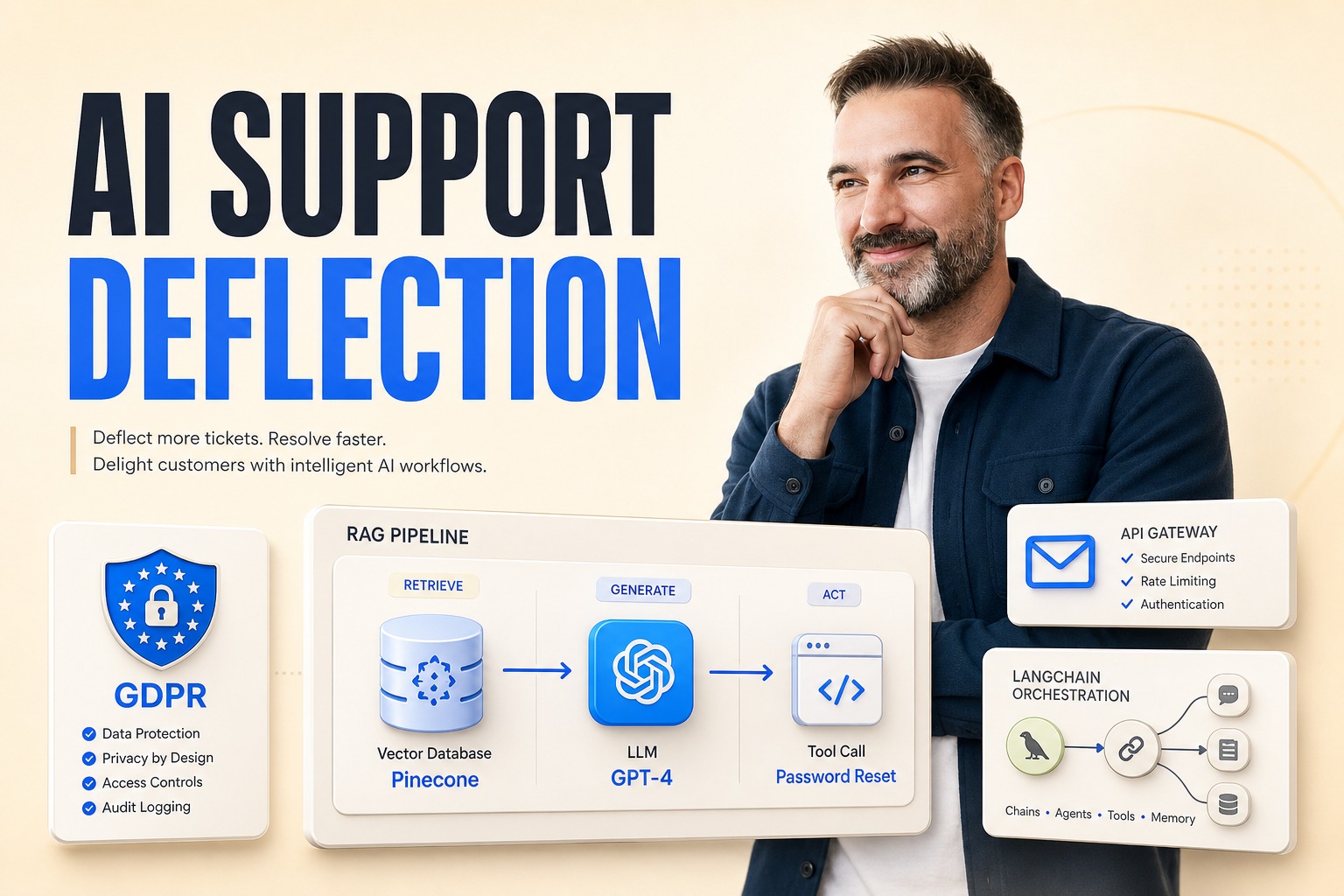
At the core of a modern AI‑powered customer support platform is a composable pipeline that separates concerns: ingestion, retrieval, reasoning, and action. Below is a reference implementation stack that we have deployed for several Fortune‑500 clients.
Core components
- API Gateway – Envoy or Amazon API Gateway in front of all inbound channels (web chat, email, Slack, voice).
- Orchestration Layer – A Python‑based service built on LangChain and CrewAI, responsible for routing the request to the appropriate LLM or tool.
- Model Layer – Hosted LLMs (OpenAI gpt‑4‑turbo, Anthropic Claude‑2) accessed via REST, with optional on‑prem fine‑tuning using TorchServe.
- Knowledge Store – Vector database (Pinecone or Milvus) together with a relational ticket store (PostgreSQL) and a cache layer (Redis) for hot context.
- Tooling Hub – Micro‑services exposing CRM lookup, license validation, or system health via gRPC or GraphQL. Each tool implements idempotent operations and returns structured JSON.
- Observability Stack – OpenTelemetry for tracing, Prometheus + Grafana for metrics, Loki for log aggregation.
Data flow
- User initiates a conversation on the website chat widget. The widget sends a JSON payload to the API Gateway.
- The gateway authenticates the request with OAuth2 and forwards it to the Orchestration Layer.
- The Orchestration Layer runs a router chain that uses a lightweight classifier (BERT‑based) to decide if the request is “routine” or “complex”.
- For routine tickets, the chain invokes a Retrieval‑Augmented Generation (RAG) step: the user query is embedded with sentence‑transformers, the nearest 5 vectors are fetched from the vector DB, and the context window (≈ 4 K tokens) is supplied to the LLM.
- The LLM produces a structured response (JSON schema) that includes a
action field. If the action is “reset_password”, the Orchestration Layer calls the Password‑Reset micro‑service via an internal gRPC endpoint. - When the confidence score falls below 0.78, the request is escalated: the system posts a message to a Kafka topic “support‑escalation”, and a human‑in‑the‑loop UI fetches the enriched transcript, ticket history, and the LLM’s reasoning trace.
- All interactions are persisted in PostgreSQL with a full audit trail, and a copy of the embedding and LLM prompt is stored in an immutable S3 bucket for compliance.
Model orchestration patterns
- Agentic routing – Using AutoGen, multiple specialist agents (billing, network, SaaS usage) negotiate the best answer before the final reply reaches the user.
- Tool use – The LLM can call external APIs (e.g., “GET /v1/accounts/{id}” on the billing service) by emitting a tool‑call JSON that the Orchestration Layer translates into a secured HTTP request.
- Dynamic RAG – The knowledge store refreshes nightly via an ETL pipeline that extracts the last 30 days of resolved tickets, runs content summarization, and re‑indexes embeddings.
Integration and scaling
- REST endpoints for synchronous chat interactions (≤ 300 ms 99th‑percentile latency). GraphQL for flexible data queries from internal dashboards.
- Event‑driven pipelines using Kafka for ticket lifecycle events, ensuring eventual consistency across CRM, billing, and support databases.
- Docker containers orchestrated by Kubernetes (EKS or AKS). Autoscaling policies target 70 % CPU utilization, scaling the Orchestration pods from 2 to 50 replicas during peak load.
- Serverless fallback for bursty workloads: AWS Lambda functions execute the short‑lived “FAQ‑lookup” chain, keeping cost per 1 k requests under $0.12.
- Security: OAuth2 token introspection, API‑key rotation every 30 days, field‑level encryption for PII, and audit logs shipped to Splunk.
Business impact & measurable ROI
When the architecture above is applied to a typical B2B SaaS support org (≈ 15 000 tickets/month), the following results have been observed:
- Ticket deflection rate: 38 % average reduction in repetitive tickets, driven by accurate RAG answers and tool‑driven actions.
- Mean Time to Resolution (MTTR): drops from 6.2 h to 2.9 h, a 53 % improvement, because agents receive pre‑populated context and suggested next steps.
- Agent productivity: each tier‑1 agent handles 1.7× more tickets per shift, allowing the team to shrink by 15 % without service level degradation.
- Cost per ticket: moves from $6.80 to $3.90, primarily due to reduced labor hours and lower cloud compute spend (thanks to serverless burst handling).
- Compliance confidence: 100 % audit‑ready logs, satisfying GDPR “right to explanation” and HIPAA access logs, mitigating potential fines of $30 k – $200 k per incident.
Deflection without dilution is possible only when the AI knows *exactly* which slice of the knowledge base the user is referencing; otherwise you just push the problem down the escalation chain.
Implementation strategy
A pragmatic rollout balances speed and governance. The roadmap below has worked for enterprises migrating from legacy ticketing systems (e.g., ServiceNow) to an AI‑first model.
- Discovery & data audit – Catalog existing ticket data, knowledge articles, and compliance requirements. Map fields to the new schema.
- Prototype RAG pipeline – Build a minimal LangChain chain that answers 5 high‑volume “reset” queries using a small Pinecone index.
- Security hardening – Enable OAuth2, rotate API keys, and configure audit‑log forwarding to a SIEM.
- Pilot with a single product line – Deploy the full stack in a dedicated namespace, feed live traffic, and measure deflection and latency.
- Iterate on prompting & fine‑tuning – Use the pilot tickets to create a 10 k‑example dataset, fine‑tune a smaller LLM (e.g., LLaMA‑2‑7B) for domain‑specific terminology.
- Scale across product lines – Replicate the namespace, use Helm charts for consistent configuration, and enable cross‑tenant vector DB isolation.
- Continuous improvement loop – Set up a nightly retraining job that re‑indexes resolved tickets and updates the embeddings.
Common pitfalls
- Skipping the classification layer and sending every request to the LLM, which inflates token usage and exceeds rate limits.
- Hard‑coding API credentials in prompts; instead store secrets in Vault and inject at runtime.
- Neglecting idempotency in tool calls, leading to duplicate actions (e.g., multiple password resets).
- Under‑monitoring latency; without SLO alerts, user‑visible delays can erode trust.
Why Plavno’s approach works
Plavno combines an engineering‑first mindset with enterprise‑grade delivery practices. Our teams have built end‑to‑end AI support stacks that respect data residency, scale on Kubernetes, and integrate with legacy CRMs via GraphQL adapters.
- We offer AI agents development that orchestrate multi‑tool workflows, reducing integration friction.
- Our AI automation services include custom RAG pipelines powered by AI chatbot frameworks like LlamaIndex.
- For regulated industries, our cybersecurity and penetration testing ensures the AI layer complies with ISO 27001, GDPR, and HIPAA.
- Through our Plavno Nova platform, we provide a managed, multi‑tenant environment that abstracts away the Kubernetes complexity while preserving tenant isolation.
- Our outsourcing and outstaffing models give you direct access to engineers who have shipped production‑grade helpdesk AI for telco, fintech, and e‑commerce giants.
A well‑architected AI support pipeline turns “first‑line automation” from a cost‑center into a revenue‑preserving engine by freeing senior engineers to focus on strategic work.
Conclusion
AI‑powered customer support is no longer a futuristic add‑on; it is a practical, measurable lever for enterprises that need to trim ticket volume without sacrificing personalization. By deploying a modular architecture—API gateway, LangChain orchestration, vector‑store‑backed RAG, and secure tool integration—companies can achieve a 30 %+ deflection rate, halve MTTR, and stay compliant. Plavno’s proven methodology, from prototype to production, delivers this transformation at scale, letting CTOs and founders cut operational spend while keeping customers delighted.
Ready to see how a custom AI support stack can reduce your support tickets by up to 40 %? Contact us today and let’s design the next generation of your helpdesk.