Enterprise AI has moved past the science experiment phase. Companies are deploying Large Language Models (LLMs), RAG pipelines, and autonomous agents into production environments where they drive real revenue and support critical operations. However, a fundamental disconnect remains: we are building probabilistic systems on infrastructure designed for deterministic software. Traditional monitoring watches for server crashes and 500 errors, but it is blind to semantic drift, hallucinations, and the gradual degradation of model context. This gap is where projects fail, budgets bleed, and trust erodes. To scale AI effectively, organizations need a dedicated layer of oversight that understands not just system health, but reasoning quality. This is the domain of AI Observability.
Industry challenge & market context
The transition from proof-of-concept to production exposes the fragility of AI systems. In a controlled sandbox, an LLM might appear flawless, but in the wild, it faces adversarial inputs, evolving data contexts, and complex multi-step reasoning tasks. Relying on standard APM (Application Performance Monitoring) tools creates a false sense of security. You might know that your API responded in 200ms, but you do not know if it confidently invented a regulation that doesn't exist. The enterprise bottlenecks are not just computational; they are operational and qualitative.
- Legacy APM tools lack semantic understanding. They can track latency and throughput, but they cannot evaluate the factual consistency of a generated summary or the relevance of a retrieved document in a RAG pipeline.
- Debugging is opaque. When a model gives a wrong answer, traditional logs show the input and output but fail to expose the intermediate reasoning steps, the specific retrieval chunks used, or the weight of specific tools in an agent framework.
- Cost control is difficult. Without granular tracking of token usage per user, per session, and per agent workflow, cloud bills for API calls to OpenAI, Anthropic, or Azure can spiral unpredictably.
- Compliance risks are high. Industries like finance and healthcare require strict audit trails. Knowing *that* a decision was made is insufficient; you must prove *how* the model arrived at it, which requires deep tracing and data lineage.
- Model drift is inevitable. The data distribution your model was trained on or retrieved from changes over time, leading to a silent drop in performance that standard dashboards will miss until customers complain.
Technical architecture and how AI Observability works in practice
Implementing AI Observability requires an architectural shift. You cannot simply bolt on a dashboard; you must weave inspection points into the fabric of your AI pipelines. This involves instrumenting the orchestration layer, the vector databases, and the model endpoints to create a unified trace of every inference request.
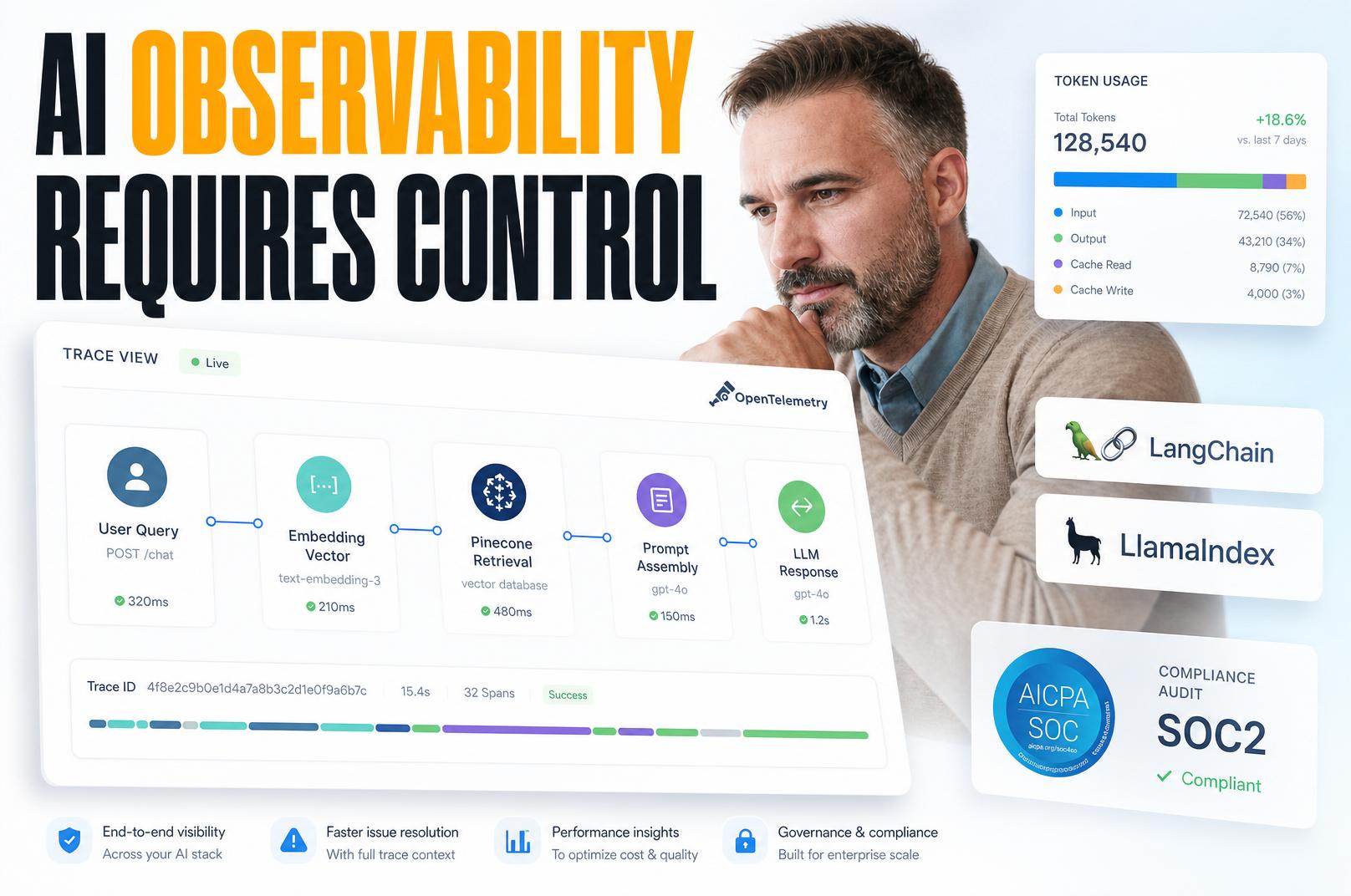
Consider a typical enterprise RAG application built with LangChain or LlamaIndex. When a user submits a query, the system generates an embedding, queries a vector database (e.g., Pinecone or Milvus), constructs a prompt with the retrieved context, and sends it to an LLM. In an observable architecture, each of these steps emits a span to a centralized tracing backend (often leveraging OpenTelemetry).
The shift to probabilistic computing requires a new definition of "uptime." For AI systems, availability is meaningless without veracity. Your observability stack must prioritize semantic validation over simple latency metrics.
In practice, this means capturing the full state of the execution. We capture the raw user query, the embedding vector generated, the IDs and scores of the top-k retrieved chunks, the final prompt sent to the model (including system messages), and the model's response. This data is immutable and indexed, allowing engineers to reconstruct the exact "thought process" of the system for any given interaction.
For agentic workflows using frameworks like CrewAI or AutoGen, the complexity increases. Agents perform multi-turn reasoning, calling tools (APIs, databases, calculators) iteratively. Observability here must track the chain of thought, the tool outputs, and the self-correction loops. If an agent decides to call a weather API three times before answering, the trace must show why—perhaps the first two calls failed schema validation or returned unexpected data formats.
Infrastructure plays a critical role. These traces are high-volume and high-cardinality. Storing them requires scalable, often cloud-native, storage solutions. We typically deploy the observability layer as a sidecar or an intermediate proxy within a Kubernetes cluster. This proxy intercepts requests to LLM providers, adding metadata and routing logic before forwarding the payload. This pattern allows for "guardrails" to be injected dynamically—blocking PII from leaving the network or flagging toxic inputs before they reach the model.
- Instrumentation: Integrating SDKs (Python/Node) into the application code to wrap LLM calls and vector database queries, automatically capturing inputs, outputs, and metadata.
- Tracing: Using OpenTelemetry to create a trace graph that links the user request to the retrieval step, the model inference, and any subsequent tool calls, visualizing the entire latency budget.
- Evaluation Pipelines: Running automated "LLM-as-a-judge" workflows in the background or asynchronously to score responses on faithfulness, relevance, and tone against a "golden dataset" of known good answers.
- Logging & Storage: Streaming trace data to a centralized object store (e.g., S3) coupled with a queryable analytics engine (e.g., ClickHouse or Elasticsearch) for forensic analysis.
- Feedback Loops: Implementing APIs (REST or GraphQL) that allow frontend interfaces or human reviewers to flag incorrect responses, which are then fed back into the system to create new evaluation datasets or trigger retraining/fine-tuning pipelines.
When a user asks a complex question like "Summarize the liability clauses in our Q3 contracts," the system retrieves documents via a vector search. The observability layer logs the cosine similarity scores of those retrievals. If the final answer is hallucinated, the engineer can inspect the trace, see that the retrieval score was low (e.g., 0.65), and adjust the chunking strategy or embedding model to improve AI quality assurance.
Business impact & measurable ROI
Investing in robust observability is not merely a technical best practice; it is a business imperative that directly affects the bottom line. For CTOs and CFOs, the value proposition shifts from "keeping the lights on" to "protecting the brand and optimizing spend."
The most immediate ROI is cost optimization. By tracing token usage at the feature level, organizations can identify inefficient prompts. For example, you might discover that a specific customer support agent is repeating the same system context in every turn, bloating the token count by 40%. Optimizing these prompts based on observability data can reduce API costs significantly, often saving thousands of dollars per month in high-traffic environments. Furthermore, caching strategies—identifying repeated queries and serving cached results—can only be implemented effectively if you have visibility into query frequency and latency patterns.
You cannot optimize what you cannot measure. Granular tracing of token consumption and latency per agent allows engineering teams to enforce strict cost budgets and performance SLAs, turning AI from a cost center into a predictable operational expense.
Risk reduction is another major factor. In regulated industries, a hallucination can result in fines or legal action. An AI monitoring system that detects a drop in "faithfulness" scores can automatically trigger a circuit breaker, switching the system to a safe mode or routing the query to a human reviewer. This capability prevents a single model failure from cascading into a PR crisis.
Finally, observability accelerates development velocity. Without it, debugging a production issue involves guessing and manual reproduction. With traces, engineers can pinpoint the exact retrieval chunk or prompt template that caused the failure. This reduces the Mean Time to Resolution (MTTR) from days to minutes, allowing the team to iterate on features and improve the model's accuracy faster.
- Cost Control: Detailed breakdown of token usage and API costs per user, per feature, and per model provider, enabling targeted optimization and budget enforcement.
- Risk Mitigation: Automated detection of hallucinations, PII leaks, and toxic outputs, allowing for real-time intervention (circuit breaking) before the user sees the error.
- Accelerated Debugging: Reduction in MTTR by providing complete visibility into the execution path, replacing "guesswork" with data-driven forensic analysis.
- Improved Product Quality: Continuous evaluation pipelines that quantify model performance over time, ensuring that the product actually gets smarter rather than degrading.
- Trust & Governance: Audit logs that satisfy compliance requirements (SOC2, GDPR) by proving exactly how data was processed and how decisions were reached.
Implementation strategy
Building an observable AI environment requires a phased approach. Attempting to instrument everything at once will lead to alert fatigue and noisy data. The strategy should begin with the highest-risk, highest-value components of your application.
- Assessment & Baseline: Identify the critical paths in your AI application (e.g., the primary RAG pipeline). Establish a baseline for latency, cost, and qualitative performance using a "golden dataset" of representative queries.
- Core Instrumentation: Integrate tracing libraries (OpenTelemetry) into your orchestration layer (LangChain, LlamaIndex). Ensure that all calls to Vector DBs and LLM providers are captured with full request/response payloads.
- Guardrails & Basic Metrics: Implement basic AI monitoring dashboards focusing on latency, error rates, and token throughput. Add synchronous guardrails for immediate red flags, such as regex-based PII detection or known toxic keywords.
- Advanced Evaluation: Develop evaluation pipelines that run asynchronously. Use LLM-as-a-judge metrics to evaluate retrieval quality and response faithfulness. Integrate these scores into your CI/CD pipeline to prevent regressions during code deployments.
- Feedback Integration: Expose feedback mechanisms in the UI (thumbs up/down, report issue). Pipe this data back into your observability platform to create a curated dataset of "edge cases" for future fine-tuning.
- Governance & Audit: Configure data retention policies and role-based access control for trace data to meet compliance standards. Ensure that sensitive data within traces is encrypted or redacted based on user permissions.
Common pitfalls include over-reliance on quantitative metrics (like BLEU or ROUGE scores) which often fail to capture the nuance of business logic, and underestimating the volume of data generated, which can lead to skyrocketing storage costs. Another frequent mistake is neglecting the "human in the loop"—observability data is useless if it isn't reviewed by domain experts who can interpret the semantic errors that automated metrics miss.
Why Plavno’s approach works
At Plavno, we do not treat AI as a black box plugin. We approach AI development with the same rigor applied to high-availability financial systems. Our engineering-first methodology ensures that observability is not an afterthought but a foundational architectural component. We design systems that are built to be monitored, instrumented, and improved continuously.
We specialize in navigating the complexities of the modern AI stack. Whether we are building custom AI agents that automate complex workflows or implementing AI automation for enterprise operations, we bake in tracing and evaluation from day one. Our teams are proficient in the latest frameworks—LangChain, LlamaIndex, AutoGen—and we know how to deploy them on robust infrastructure like Kubernetes and serverless environments while maintaining strict cost and latency controls.
Our expertise extends beyond just writing code. We provide strategic AI consulting to help enterprises define their governance policies and evaluation metrics. We understand that AI quality assurance is a business process as much as a technical one. When you hire developers through Plavno, you are getting engineers who understand the nuances of vector databases, embedding models, and the specific failure modes of generative AI.
We build custom software that integrates seamlessly with your existing legacy systems, ensuring that your new AI capabilities are observable within the context of your broader application landscape. From AI chatbot development to complex recommendation engines, Plavno delivers solutions that are transparent, reliable, and scalable.
Enterprise AI is powerful, but without AI Observability, it is a liability. The difference between a successful AI deployment and an expensive experiment is the ability to see inside the model, understand its decisions, and trust its outputs. By implementing comprehensive tracing, evaluation pipelines, and robust monitoring, organizations can move beyond the hype and build AI systems that drive real, measurable value. The future of enterprise software is probabilistic, and your infrastructure needs to be ready to measure the unknown.