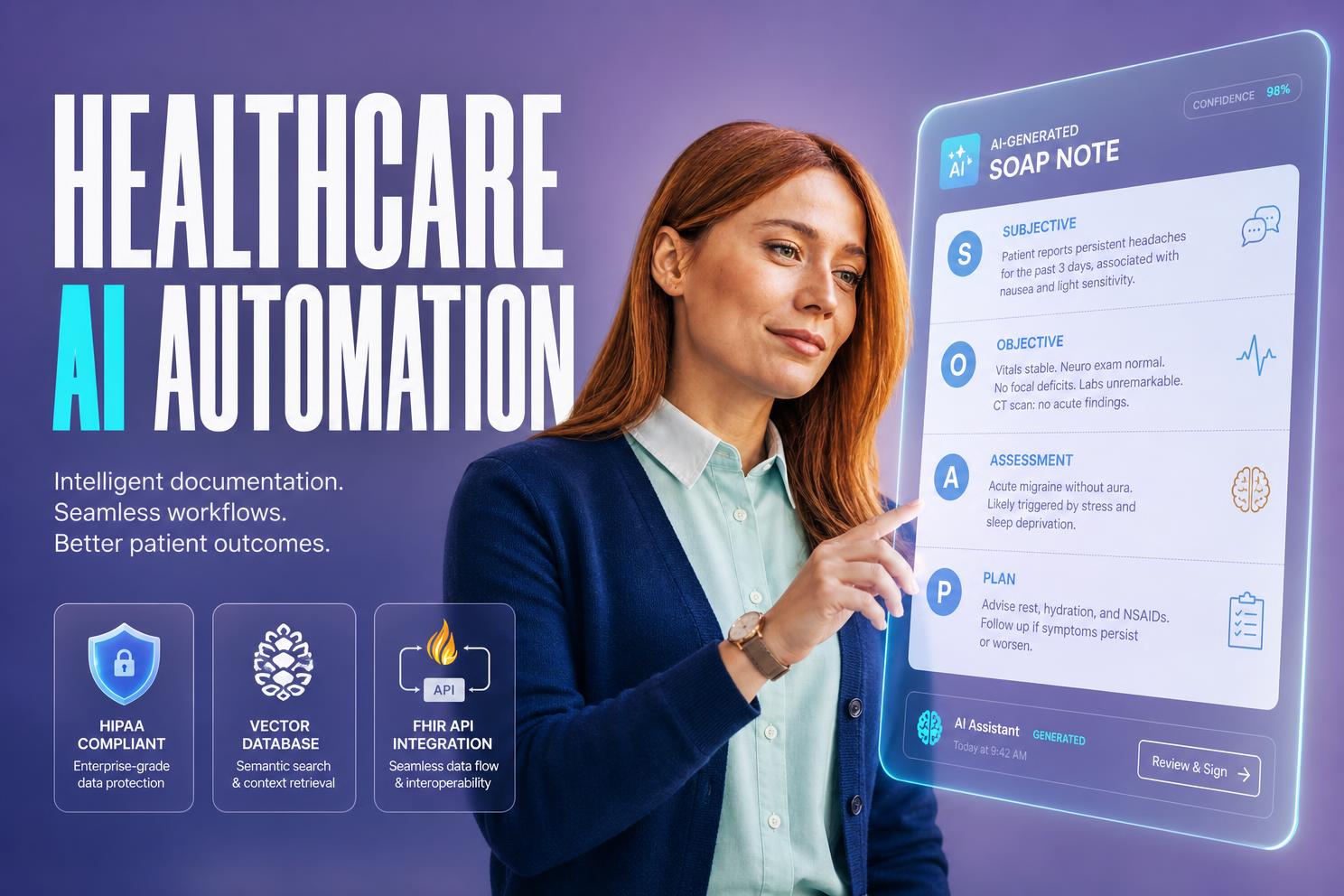
The average physician spends nearly two hours on administrative tasks for every hour of direct patient face time. This is the friction point where modern healthcare stalls. While the industry has digitized records, it has largely failed to automate the cognitive load associated with them—charting, coding, and prior authorization. The opportunity isn't to replace clinical judgment with algorithms, but to build an invisible layer of AI in healthcare software that handles the logistics of care. By offloading documentation, triage, and routine communication to autonomous systems, hospitals can reclaim the physician's most scarce resource: attention.
Industry challenge & market context
Healthcare systems are drowning in data but starving for insights. Legacy Electronic Health Records (EHR) systems were designed as billing repositories, not care enablement tools. They create silos, forcing clinicians to act as data entry clerks. The integration of healthcare AI is no longer optional for efficiency, but the path is fraught with architectural and regulatory complexity.
- Administrative bloat: Providers spend 30-50% of their day on documentation and inbox management, leading to burnout and reduced clinical capacity.
- Siloed data: Patient history, lab results, and imaging are often locked in proprietary formats or monolithic databases, making real-time data retrieval difficult for external automation layers.
- Regulatory friction: Any automation layer must ensure strict compliance with HIPAA, GDPR, and HITECH, requiring robust audit trails and data residency controls that generic SaaS tools often lack.
- Integration latency: Legacy hospital systems often rely on brittle HL7 v2 interfaces or slow REST APIs, making real-time patient support automation technically challenging without a modern middleware layer.
- Risk of hallucination: Unlike a marketing chatbot, a clinical AI assistant cannot afford to invent facts; the architecture must enforce strict grounding in verified medical data.
Technical architecture and how AI in healthcare software works in practice
Implementing safe automation requires a shift from monolithic applications to composable, event-driven architectures. We are not just building a chatbot; we are building an orchestration layer that sits between the user (doctor or patient) and the hospital's systems of record. The core of this architecture relies on Retrieval-Augmented Generation (RAG) to ensure accuracy and agentic workflows to perform multi-step tasks.
A typical deployment involves an API Gateway (Kong or AWS API Gateway) that routes requests to a containerized orchestration layer. This layer, often built with Python or Node.js, uses frameworks like LangChain or LlamaIndex to manage state and context. The system does not rely on the LLM's internal memory; instead, it retrieves relevant context from a Vector Database (Pinecone, Weaviate, or pgvector) which stores embeddings of clinical notes, protocols, and patient history.
For example, consider a medical AI workflow for automated charting. When a doctor concludes a visit, the system receives an audio transcript or raw text. An ingestion service processes this, chunks the data, and generates embeddings. An agent then queries the vector store for similar patient encounters and current treatment guidelines. The LLM synthesizes this into a structured SOAP note, which is then validated by a deterministic rules engine before being pushed back to the EHR via a FHIR API. This ensures the AI suggests rather than decides, maintaining human oversight.
- Ingestion & Embedding Pipeline: Data enters via secure webhooks or SFTP buckets. Services like Kafka or RabbitMQ handle the message queue, ensuring eventual consistency. Text is chunked and embedded using models like OpenAI text-embedding-3 or HuggingFace transformers, then stored in a vector DB for low-latency retrieval.
- Orchestration Layer: This is the brain, built using frameworks like LangChain, AutoGen, or CrewAI. It manages the "tools" available to the AI—functions that allow the LLM to read from the EHR, query a scheduling database, or draft a message. It handles context window management to prevent token limit errors during long patient histories.
- Model Layer & Routing: A router directs prompts to the appropriate model. Simple classification tasks might go to a smaller, faster model (like Llama-3-8B hosted on-prem via vLLM), while complex summarization tasks are routed to a high-parameter model (GPT-4 or Claude 3 Opus). This optimizes for cost and latency.
- Integration & State Management: The system must be stateless where possible but aware of session state for conversational flows. Redis is often used here. Integrations are handled via standard APIs (REST/GraphQL) or HL7/FHIR adapters. Idempotency keys are critical to prevent duplicate prescription orders or appointment bookings if a message is retried.
- Security & Governance: All traffic remains within a VPC or private subnet. Data in transit is encrypted via TLS 1.3; data at rest via AES-256. Access is controlled via OAuth2 and OIDC. A "guardrail" layer (using tools like NeMo Guardrails or custom regex filters) checks outputs to prevent PII leakage or prohibited medical advice before the user sees the response.
The goal isn't a robot doctor; it's a silent resident that handles the noise so the human can handle the signal. We build systems that read, write, and summarize, but never diagnose.
In practice, this architecture supports several high-impact use cases. For patient support automation, a medical voice AI assistant can handle intake calls. It authenticates the patient, checks the schedule in the database, and answers questions about prep instructions by retrieving the specific protocol document from the vector store. If the patient mentions symptoms that suggest urgency, the agent escalates the ticket to a human nurse via a high-priority webhook event.
Business impact & measurable ROI
Deploying AI in healthcare software is not just a technical upgrade; it is a financial lever. Hospitals operate on thin margins, and the cost of labor is the primary driver. By automating the "bottom of the license" work, health systems can increase throughput without hiring more staff.
- Reduction in documentation time: Clinical AI assistants can reduce the time spent on charting by 50-70%. For a hospital system, this translates to seeing 2-3 more patients per day per provider without extending hours, directly increasing top-line revenue.
- Decreased provider burnout: By reducing "pajama time" (after-hours charting), hospitals improve retention. Replacing a departing physician costs roughly 50-200% of their annual salary; automation is a fraction of that cost.
- Operational efficiency: Automated patient triage and scheduling reduce no-show rates by 15-20% through intelligent reminder systems and easier rescheduling workflows. This optimizes expensive capital equipment utilization (like MRI machines).
- Billing accuracy: AI agents that analyze clinical notes to suggest ICD-10 and CPT codes reduce claim denials. A 5-10% reduction in denials represents millions in recovered revenue for large enterprise systems.
- Scalability: Cloud-native infrastructure allows the system to scale elastically. During flu season, the patient support automation layer can spin up additional containers to handle triage volume without human intervention, maintaining a consistent patient experience.
In healthcare AI, latency isn't just a UX metric—it's a clinical safety parameter. If a retrieval pipeline takes 5 seconds, the workflow breaks. We target sub-200ms retrieval times to keep the physician in the flow.
Implementation strategy
Successful deployment requires a disciplined, phased approach. You cannot "boil the ocean" by automating everything at once. The strategy must prioritize high-volume, low-risk workflows to build trust and demonstrate ROI.
- Discovery & Data Audit: Map the current data flows. Identify where the bottlenecks are (e.g., referral processing). Assess the quality of unstructured data—can the existing notes be easily parsed and embedded?
- Pilot Program (The "Lighthouse" Project):strong> Select a specific department, such as Dermatology or General Practice. Implement a single use case, such as automated visit summarization. Use a AI consulting partner to set up the secure cloud environment and the RAG pipeline.
- Integration & Feedback Loop: Connect the pilot to the live EHR in a read-only mode initially. Have physicians review the AI-generated summaries. Use this feedback to fine-tune the prompt engineering and the retrieval algorithms (e.g., adjusting chunk size or similarity scores).
- Security & Compliance Hardening: Before full rollout, undergo a rigorous security audit. Ensure all PII is masked or redacted before being sent to any external LLM APIs. Implement role-based access control (RBAC) so that AI agents only access data relevant to the specific patient context.
- Scale & Expansion: Once the pilot proves safe and effective, expand to other departments. Introduce more complex agents, such as those capable of handling patient chatbot development for complex queries or prior authorization automation.
Common pitfalls to avoid include relying solely on public models without a private data layer (which guarantees hallucinations) and ignoring the user interface. If the AI output isn't embedded directly into the physician's existing EHR workflow, adoption will fail. The technology must be invisible, frictionless, and immediate.
Why Plavno’s approach works
At Plavno, we do not believe in generic AI wrappers. We build enterprise-grade, bespoke AI in healthcare software designed for the rigors of the medical environment. Our engineering-first approach ensures that the solution is not just a prototype, but a scalable, secure, and maintainable product.
We specialize in AI healthcare and medtech software development, understanding that the stack must be resilient. We leverage modern orchestration frameworks like AI agents development tools to create multi-step reasoning systems that can navigate complex hospital protocols. Whether it is building a clinical AI assistant for documentation or a comprehensive digital transformation strategy, we focus on the intersection of clinical utility and engineering excellence.
Our architecture prioritizes data sovereignty. We design systems that can run in a hybrid cloud model—keeping sensitive patient data on-prem or in a private cloud while utilizing secure APIs for model inference. We implement robust observability using tools like Prometheus and Grafana to monitor token usage, latency, and drift, ensuring the system performs reliably under load. By combining deep expertise in custom software development with cutting-edge AI capabilities, Plavno delivers solutions that hospitals can trust.
The future of healthcare is not human versus machine; it is human augmented by machine. By automating the administrative friction, we allow doctors to return to what they do best: caring for patients. The technology is ready. The architecture is proven. The time to implement is now.