Financial institutions are fighting an asymmetric war against sophisticated fraud networks and an increasingly complex regulatory landscape, all while customer expectations for instant, frictionless credit decisions continue to rise. Legacy rule-based systems, which rely on static "if-then" logic, are fundamentally incapable of processing the volume, velocity, and variety of modern financial data. They generate excessive false positives that block legitimate users and miss novel attack patterns that don't match historical signatures. The shift to AI in fintech is no longer a futuristic differentiator; it is a foundational infrastructure requirement for survival, enabling systems that learn, adapt, and reason rather than merely filter.
Industry challenge & market context
The current state of financial technology is defined by data overload and processing bottlenecks. Enterprises are drowning in telemetry—transaction logs, unstructured customer data, and global sanctions lists—but they lack the computational machinery to synthesize this information in real-time. Traditional fraud detection operates on rigid thresholds that fraudsters easily circumvent using techniques like botnets or synthetic identities. Meanwhile, compliance teams spend up to 80% of their time on manual data gathering and review rather than strategic risk assessment. The cost of inaction is high: direct fraud losses are compounded by regulatory fines (GDPR, PSD2, AMLD) and reputational damage that drives customers to more agile competitors. The market demands a move from reactive, human-in-the-loop gating to proactive, automated decision-making pipelines.
- Legacy rule engines create high false-positive rates, often blocking 5-10% of legitimate transactions and requiring expensive manual review.
- Siloed data architectures prevent a holistic view of customer risk, making it impossible to correlate cross-channel behavior patterns.
- Manual compliance processes (KYC/AML) are too slow to support real-time onboarding and instant lending products.
- Rising synthetic identity fraud bypasses static verification checks that do not leverage behavioral biometrics or graph analysis.
- Regulatory scrutiny is increasing, requiring immutable audit trails and explainable AI decisions rather than "black box" outputs.
Technical architecture and how AI in fintech works in practice
Implementing effective fintech AI solutions requires moving beyond simple API calls to OpenAI or Anthropic. You need a robust, event-driven architecture that handles high-throughput data streams while maintaining low latency for critical decision paths. At Plavno, we design systems that decouple ingestion from processing, allowing us to scale inference independently of data capture. A typical deployment involves a Kubernetes-based orchestration layer managing containerized microservices for feature extraction, model inference, and decision gating.
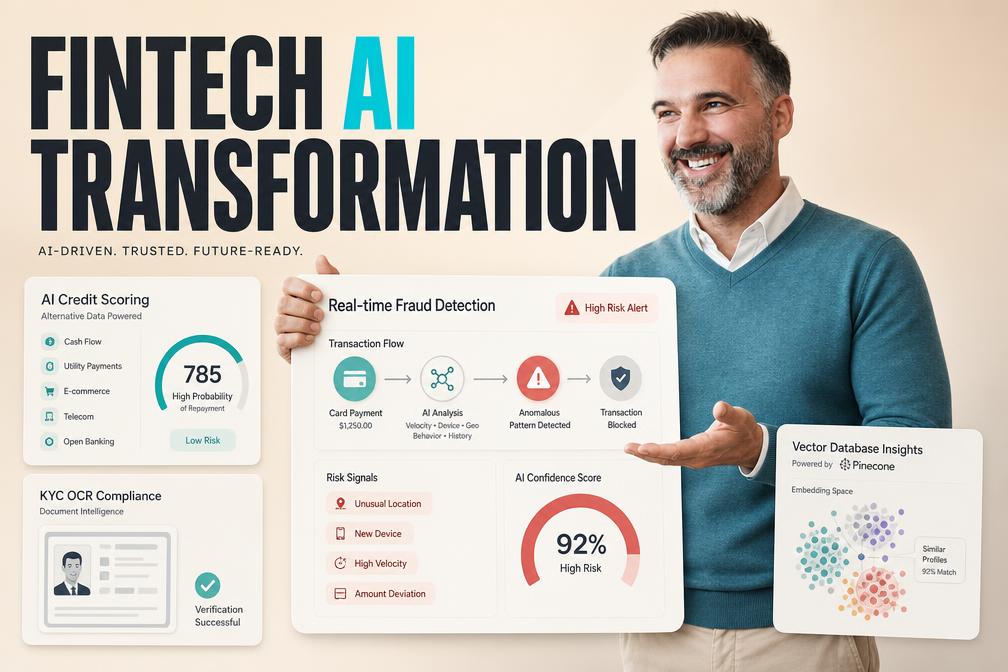
For fraud detection AI, we often employ a hybrid approach: gradient-boosted trees (XGBoost/LightGBM) for low-latency scoring on structured transaction data, paired with Large Language Models (LLMs) for analyzing unstructured metadata like merchant descriptions or geospatial context. The data flow typically moves through a message queue (Apache Kafka or RabbitMQ) to ensure durability and replayability. As a transaction event occurs, the system publishes a message that triggers a feature pipeline to enrich the data with historical user behavior.
This enriched payload is sent to the inference service. If the risk score falls into a "gray area," the system routes the context to an agentic workflow—built with frameworks like LangChain or AutoGen—to perform deeper analysis. This agent might query a vector database (Pinecone or Milvus) containing historical fraud patterns to retrieve semantically similar cases. The agent then synthesizes a recommendation, flagging the transaction or allowing it to proceed. This architecture ensures that the happy path remains fast (sub-100ms), while complex cases get the computational attention they need without blocking the queue.
The most effective fraud architectures are not monolithic models but ensembles of specialized agents that collaborate: one agent checks velocity, another queries graph databases for relationship mapping, and a third synthesizes the narrative for compliance auditors.
In credit scoring AI, the challenge is often alternative data integration. We build pipelines that ingest unstructured data sources—utility payments, rental history, or even mobile device metadata. Using NLP models, we extract and normalize these features into a unified feature store. The scoring model, often a deep neural network or an ensemble, generates a probability of default. Crucially, we implement RAG (Retrieval-Augmented Generation) to provide explainability. When a loan is denied, the system retrieves the specific data points that contributed most to the decision, formatting them into a legally compliant explanation text generated by an LLM, ensuring adherence to "right to explanation" regulations.
For compliance automation, specifically KYC and AML, we utilize computer vision and OCR (Optical Character Recognition) to process identity documents. The architecture here involves an asynchronous workflow: a user uploads a document, a worker service extracts text and biometric data, and another service performs liveness detection. The extracted data is then compared against global watchlists using fuzzy matching algorithms to handle typos and variations in spelling. State is managed in a distributed cache (Redis) to handle rapid retries and idempotency, ensuring that a network glitch doesn't result in duplicate checks or multiple API calls to expensive third-party verification services.
- Ingestion Layer: Apache Kafka or AWS Kinesis for streaming transaction events and document uploads with partitioning strategies to maintain order per customer ID.
- Processing Layer: Kubernetes-orchestrated Python (FastAPI) or Node.js microservices for feature engineering, utilizing libraries like Pandas and NumPy for data manipulation.
- AI/ML Layer: PyTorch or TensorFlow for serving custom models; LangChain or LlamaIndex for orchestrating LLM agents that perform reasoning and retrieval tasks.
- Vector Storage: Pinecone, Weaviate, or pgvector for storing embeddings of historical fraud cases and semantic search of compliance documents.
- API Gateway: Kong or AWS API Gateway handling rate limiting, OAuth2 authentication, and routing requests to the appropriate services.
- Observability: Prometheus and Grafana for metrics, ELK or Loki for logging, and distributed tracing (Jaeger/OpenTelemetry) to track a request from ingress to model inference.
Business impact & measurable ROI
Deploying AI in fintech generates tangible value across the P&L statement, but the gains are most visible in three specific areas: operational efficiency, fraud loss reduction, and revenue uplift from better conversion rates. By automating the review process, institutions can reduce the headcount required for manual KYC reviews by 40-60%, reallocating those resources to complex investigation cases. More importantly, the precision of modern models drastically lowers the false-positive ratio. If a bank processes $10 billion in monthly transactions and currently blocks 1% due to conservative rules, reducing that false-positive rate by half through AI immediately unlocks $50 million in liquidity that would otherwise be stuck in limbo.
A 200-millisecond reduction in latency for credit decisioning can increase conversion rates by 5-10% in digital lending platforms; the ROI of optimizing the inference pipeline often exceeds the cost of the model development itself.
In credit underwriting, credit scoring AI allows lenders to expand their addressable market. By incorporating alternative data, lenders can approve "thin-file" customers who would be rejected by traditional FICO-based models. This drives top-line growth without increasing default rates, provided the model is properly calibrated. Furthermore, the speed of automated underwriting—reducing decision time from days to milliseconds—creates a superior user experience that is a key differentiator in a crowded market. The cost of serving these models, particularly when using serverless inference or spot instances, is often fractional compared to the revenue generated from a single new loan account.
- Fraud Reduction: Decrease in fraud losses by 20-30% within the first six months through the detection of synthetic identities and coordinated bot attacks.
- Operational Savings: 50% reduction in manual review costs for KYC/AML by automating document extraction and watchlist screening.
- Revenue Growth: 15% increase in loan approval rates for subprime or near-prime segments without increasing risk exposure.
- Regulatory Risk: Automated audit trails and explainable decisions reduce the likelihood of fines and the time required to produce reports for regulators.
- Customer Retention: Reduction in friction during onboarding and payments leads to higher Net Promoter Scores (NPS) and lower churn.
Implementation strategy
Successfully integrating fintech AI solutions requires a phased approach that prioritizes data governance and incremental value delivery. You cannot simply "buy" an AI solution and plug it in; the underlying data must be cleaned, normalized, and made accessible. We recommend starting with a pilot program focused on a high-impact, narrow use case—such as transaction monitoring for a specific payment rail—before expanding to a full enterprise rollout. This allows the team to fine-tune models, establish baselines for latency and accuracy, and secure stakeholder buy-in with concrete proof points.
The technical implementation should begin with a data audit. Identify where your data lives, its quality, and the latency of current pipelines. Establish a "Feature Store"—a centralized repository for curated features that ensures data consistency between training and inference environments. For the pilot, use a managed service (like SageMaker or Vertex AI) to reduce operational overhead, but design the model artifacts to be portable so you can bring them to your own Kubernetes cluster later for cost optimization and data residency compliance.
As you scale, focus on the "human-in-the-loop" feedback mechanisms. When the AI flags a transaction or rejects an application, make it easy for human analysts to provide feedback. This data should be fed back into the training pipeline to create a continuous learning cycle (CD/CT for Machine Learning). Be wary of drift; implement monitoring dashboards that track feature distribution and model performance over time, triggering alerts when accuracy degrades beyond a set threshold.
- Data Readiness: Consolidate siloed data sources into a data lakehouse (e.g., Databricks, Snowflake) and establish rigorous data quality checks.
- Pilot Selection: Choose a specific, high-volume pain point (e.g., expense fraud or document verification) to demonstrate quick wins.
- Model Development: Utilize frameworks like PyTorch or Hugging Face for initial training, leveraging pre-trained models to accelerate time-to-value.
- Integration: Deploy models via containerized microservices behind an API gateway, ensuring backward compatibility with existing core banking systems.
- Feedback Loops: Build interfaces for analysts to correct model outputs, and use this data to fine-tune the models periodically.
- Scaling & Governance: Move to a multi-region, auto-scaling infrastructure on Kubernetes; implement role-based access control (RBAC) and full audit logging for model decisions.
Common pitfalls to avoid:
- Ignoring data privacy regulations during the data collection phase, leading to non-compliant models that cannot be deployed.
- Over-engineering the initial architecture; start with a monolithic service for the pilot and decompose into microservices only as scale demands it.
- Neglecting the "cold start" problem where new entities have no history; use graph-based approaches or transfer learning to mitigate this.
- Failing to account for inference costs in the cloud, which can spiral if auto-scaling limits are not set correctly or if large LLMs are used for simple tasks.
Why Plavno’s approach works
At Plavno, we do not treat AI as a magic wand or a standalone product. We treat it as an engineering discipline that requires rigorous integration with your existing infrastructure. Our team of principal engineers and architects specializes in building the heavy-lifting machinery—data pipelines, vector databases, and orchestration layers—that makes AI reliable and scalable. We understand that in FinTech, trust is built on consistency and security. That is why our architectures prioritize idempotency, circuit breakers, and comprehensive observability from day one. Whether you need to build a custom AI development company solution or integrate specific machine learning development services, we focus on shipping production-grade code, not research prototypes.
We have deep experience in delivering fintech solutions that handle real-time financial transactions and sensitive user data. Our approach involves a thorough discovery phase to map your business requirements to technical capabilities, followed by an agile development process that delivers working increments every two weeks. We leverage modern stacks—Python, Go, Kubernetes, and Terraform—to ensure your systems are cloud-agnostic and future-proof. Furthermore, our expertise in AI consulting ensures that we guide you through the strategic decisions, from choosing the right embedding models to designing the optimal human-in-the-loop workflows for your compliance teams.
We build systems that are designed for the real world: messy data, network failures, and evolving fraud tactics. By combining deep domain knowledge in financial services with cutting-edge engineering practices, we deliver AI solutions that actually reduce risk and drive revenue. If you are ready to move beyond the hype and implement robust, scalable AI architectures, we are ready to build.
The integration of AI in fintech is reshaping the competitive landscape, separating the institutions that can process risk in real-time from those buried in manual review. The technology to detect fraud with high precision, score credit based on holistic data, and automate compliance is available today. The challenge lies in the implementation—building the resilient, scalable, and secure architectures that power these intelligent systems. By focusing on data quality, event-driven design, and continuous feedback loops, enterprises can unlock massive ROI and operational efficiency. Plavno provides the engineering rigor and architectural expertise required to turn these possibilities into production reality. If you are looking to architect and deploy these solutions, contact us to discuss your infrastructure.