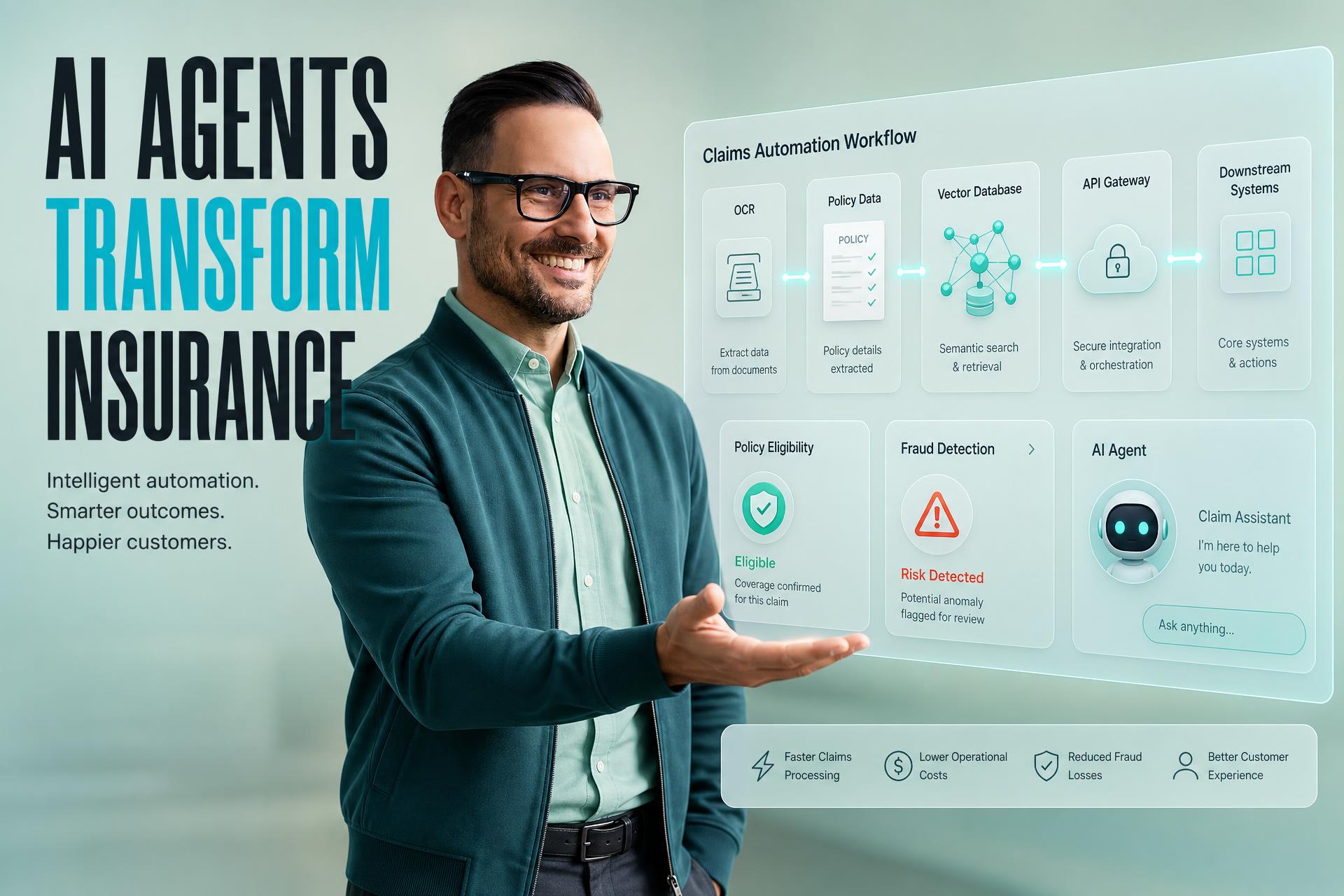
The insurance sector is currently wrestling with a fundamental disconnect: customer expectations for real-time, digital-first service are clashing violently with backend systems built thirty years ago. Legacy policy administration systems, often running on monolithic mainframes or rigid COBOL architectures, cannot support the agility required for modern claims intake or dynamic eligibility verification. The result is a massive operational drag—manual data entry, high latency in claims processing, and a customer experience that feels antiquated. To bridge this gap without a complete "rip and replace" of the core tech stack, forward-thinking carriers are turning to AI agents for insurance. These are not simple chatbots; they are autonomous, goal-oriented systems capable of reasoning, executing API calls, and orchestrating complex workflows across fragmented data landscapes.
Industry challenge & market context
The current state of insurance operations is defined by friction. While digital transformation has been a buzzword for a decade, the reality on the ground for most carriers is a patchwork of disparate systems. When a customer files a claim, the data often enters via a static web form or an email, which then requires human intervention to extract, validate, and input into the system of record. This manual pipeline is the primary driver of the "leaky bucket" problem in insurance operations.
- Legacy integration debt: Core systems often lack modern RESTful APIs, forcing teams to rely on brittle file transfers (FTP/SFTP) or screen scraping, which introduces latency and error rates that autonomous agents must navigate carefully.
- Unstructured data overload: Critical information is locked in PDFs, images of accident scenes, adjuster notes, and free-text email threads; traditional RPA (Robotic Process Automation) fails here because it cannot handle semantic variability.
- Regulatory and compliance friction: Every automated decision regarding eligibility or claims payout must be traceable, explainable, and compliant with regional regulations (GDPR, HIPAA), creating a governance nightmare for ad-hoc AI implementations.
- High operational costs: The "three-moment" model—intake, assessment, payout—is bloated by headcount costs; claims adjusters spend up to 40% of their time on administrative data gathering rather than complex decision-making.
- Fraud detection latency: Traditional rule-based engines catch known patterns but miss novel fraud vectors; they lack the contextual awareness to correlate disparate data points in real-time during the intake process.
Technical architecture and how AI agents for insurance works in practice
Deploying effective AI agents for insurance requires moving beyond simple prompt engineering. You need a robust, event-driven architecture that treats the LLM as a reasoning engine rather than a database. The architecture must support state management, tool use, and strict guardrails to prevent hallucination—especially when dealing with financial payouts and coverage determinations.
In a typical production deployment, we utilize an orchestration framework like LangChain or CrewAI to manage the agent lifecycle. The frontend (web or mobile) connects via GraphQL to an API Gateway (e.g., Kong or AWS API Gateway), which authenticates the user via OAuth2/OIDC and passes the context to the backend services. The core logic resides in a Python or Node.js runtime, often containerized and deployed on Kubernetes. This runtime manages the conversation state, stored in Redis or a similar low-latency data store to handle context window limits and ensure conversation continuity.
The "brain" of the system is the LLM (e.g., GPT-4o, Claude 3.5, or a fine-tuned Llama 3 instance for on-prem deployments), but its power comes from the tools it can access. For claims automation, the agent needs access to specific tools: an OCR service (like AWS Textract or a custom Vision Transformer model) to read damage photos, a SQL connector to query the Policy Administration System (PAS), and a vector database (Pinecone, Milvus, or pgvector) for retrieving relevant policy clauses via RAG (Retrieval-Augmented Generation).
The real engineering challenge isn't the model; it's the orchestration of state and tools. An effective insurance agent must maintain a persistent "belief state" about the claim, updating it as new evidence arrives, while strictly adhering to business logic flows defined in the code, not just the model's imagination.
Consider a scenario for eligibility verification. When a user asks, "Am I covered for a rental car while my vehicle is in the shop?", the agent does not guess. It executes a deterministic pipeline:
- Intent Recognition: The LLM classifies the query as "coverage_verification".
- Entity Extraction: It extracts the user_id and policy_number from the session context.
- Tool Execution: The agent calls a secured internal API (REST) to fetch the active policy details.
- RAG Retrieval: Simultaneously, it queries the vector DB for the specific "rental coverage" clause in the policy document PDF associated with that user.
- Synthesis: The LLM synthesizes the structured data (deductibles, limits) with the unstructured text (exclusions) to generate a precise, legally sound answer.
For AI customer support and claims intake, the architecture becomes asynchronous. A user uploads photos of a car accident. This triggers an event in a message queue (Kafka or RabbitMQ). A worker service picks up the event, processes the images through a computer vision model to detect damage severity and license plates, and updates the claim object in the database. The agent then polls this status or receives a webhook notification to inform the user of the next steps, ensuring the UI remains responsive even if heavy processing takes 10-20 seconds.
- API Gateway & Security: Kong/AWS API Gateway handling rate limiting, JWT validation, and masking PII (Personally Identifiable Information) before it hits the LLM to ensure data residency compliance.
- Orchestration Layer: LangChain or AutoGen managing multi-agent workflows (e.g., a "Research Agent" fetching data and a "Writer Agent" drafting the response).
- Model Layer: A mix of proprietary models (GPT-4 for complex reasoning) and open-source models (Llama 3 for fast, cheap classification tasks) to optimize cost and latency.
- Data Persistence: PostgreSQL for transactional data (claims, policies), Redis for session caching and rate limiting, and a Vector DB for semantic search over policy documents and historical claims.
- Infrastructure: Kubernetes (EKS/GKE) for container orchestration, allowing for auto-scaling of agent pods during peak claim events (e.g., after a storm), utilizing circuit breakers to prevent cascading failures if legacy mainframes slow down.
Business impact & measurable ROI
Implementing insurance AI is not just a technology upgrade; it is a financial lever. The ROI of these agents is measurable in three distinct vectors: operational efficiency, loss ratio improvement, and customer lifetime value (CLV). By automating the intake and triage process, carriers can significantly reduce the "touch time" per claim.
From a technical perspective, the efficiency gains come from the elimination of synchronous blocking. Human agents can only handle one query at a time. AI agents handle thousands concurrently. In practice, we see Straight-Through Processing (STP) rates for simple claims (e.g., windshield repair, minor fender benders) jump from 10-15% to 50-60% within six months of deployment. This directly translates to a reduction in Loss Adjustment Expenses (LAE).
- Reduced claims cycle time: Automated FNOL (First Notice of Loss) processing reduces the time from "accident" to "filed claim" from days to minutes, often improving customer satisfaction scores (NPS) by 15-20 points.
- Lower operational costs: Deflecting 60-70% of Tier 1 support queries (status checks, coverage questions) via AI customer support reduces the need for offshore BPO staffing, lowering cost-per-contact by approximately $0.80 to $1.20 per interaction.
- Fraud mitigation: Agents perform cross-referencing in real-time—checking claimant history against geolocation data and social signals—flagging suspicious claims instantly before payout, which can reduce fraud leakage by 5-10%.
- Improved underwriting accuracy: Data gathered by agents during the intake phase feeds back into the underwriting engine, refining risk models and pricing strategies over time.
The shift from "chatbot" to "agent" changes the unit of economics. You are no longer just deflecting a call; you are completing a business transaction. The metric for success isn't containment rate, it's claims auto-adjudication and policies bound without human intervention.
Implementation strategy
Deploying these systems requires a disciplined approach. A "big bang" rollout is a recipe for failure, specifically due to the risks of hallucination in regulated industries. The correct path is a phased, pilot-driven strategy that prioritizes high-volume, low-complexity use cases first.
- Phase 1: Discovery & Data Audit: Map out the current data flows. Identify which APIs are available for the Policy Admin System and Claims Management System. Assess the quality of unstructured data (PDFs) to determine if a vector store is viable.
- Phase 2: The "Copilot" Pilot: Deploy an internal-facing agent for claims adjusters. The agent assists in summarizing notes and fetching policy details, but a human remains in the loop. This trains the system and builds trust with the operational teams.
- Phase 3: Customer-Facing Intake: Roll out claims automation for low-risk lines (e.g., auto glass). Use strict tool-calling; the agent fills the form, but the system validates the data before submission.
- Phase 4: Full Autonomy: Expand to eligibility verification and complex claims. Implement feedback loops where human corrections are used to fine-tune the underlying models or the prompt templates.
A critical aspect of the strategy is governance. You must implement an "LLMOps" layer that includes observability (using tools like Arize or Weights & Biases) to monitor token usage, latency, and failure rates. You need guardrails that check the agent's output against business rules (e.g., "Never approve a claim over $10,000 automatically") before it reaches the user.
Common pitfalls to avoid:
- Allowing the LLM to generate financial figures directly without grounding them in a calculator tool or database query.
- Neglecting data residency; sending EU customer data to US-based model endpoints without proper compliance frameworks.
- Underestimating the cost of context retrieval; failing to cache embeddings or vector search results can lead to massive latency spikes and cloud bills.
- Building a monolithic agent; a single agent trying to do everything (support + sales + claims) usually performs poorly compared to specialized agents orchestrated by a supervisor.
Why Plavno’s approach works
At Plavno, we do not treat AI as a magic wand. We treat it as another layer in the software engineering stack that requires rigorous architecture, testing, and integration. Our background in custom software development allows us to build the necessary infrastructure around the models—the APIs, the vector databases, and the security layers—that make AI agents for insurance viable in an enterprise setting.
We specialize in building resilient systems that integrate with your existing legacy infrastructure. Whether you need to modernize your insurance software development lifecycle or implement specific AI agents development solutions, our focus is on engineering precision. We leverage frameworks like LangChain and AutoGen not just for demos, but for production-grade systems that handle idempotency, retries, and eventual consistency.
Our approach is collaborative and outcome-focused. We help you identify the highest-ROI use cases—whether it is AI automation for underwriting or AI assistant development for customer support—and build a roadmap that de-risks the adoption process. By combining deep domain expertise in AI consulting with hands-on engineering capabilities, we ensure that your AI initiatives move beyond the pilot phase into tangible business value.
The future of insurance is autonomous, but it must be built on a foundation of solid code. If you are ready to explore how intelligent agents can transform your claims intake and eligibility workflows, we are ready to build.
The transition to AI agents for insurance represents a shift from reactive processing to proactive engagement. By embedding intelligence directly into the workflow, insurers can finally close the gap between customer expectations and operational reality. The technology is here; the challenge is implementation. With the right architecture and a disciplined engineering partner, the ROI is not just possible—it is inevitable.