Introduction
This week, the signal from the startup ecosystem is loud: voice AI is no longer just for customer support bots. A recent wave of coverage highlights a push toward using voice AI to decode human behavior in under 60 seconds, specifically to filter candidates in high-volume hiring scenarios. The technology promises to analyze tone, cadence, and micro‑expressions in the voice to predict cultural fit and soft skills faster than a human recruiter can scan a resume.
Plavno’s Take: What Most Teams Miss
Most engineering teams treat voice AI in hiring as a simple "sentiment analysis" problem, akin to a chatbot evaluating customer satisfaction. This is a fundamental category error. In a hiring context, you are not just detecting if someone is happy or angry; you are attempting to infer complex psychological traits (resilience, empathy, assertiveness) from prosodic features—pitch, rhythm, and spectral characteristics—that are incredibly noisy.
The critical failure mode we see is the lack of explainability in the inference pipeline. When a model rejects a candidate, it often outputs a probability score (e.g., "0.32 likelihood of leadership potential") without grounding that score in specific audio segments. In a production system, this is a ticking time bomb. If a candidate asks why they were rejected, "the computer said so" is not a legally or ethically viable defense. Furthermore, teams underestimate the data preprocessing required. Raw audio from a phone interview is riddled with compression artifacts, background noise, and network jitter. If your AI automation pipeline doesn’t aggressively normalize and denoise input before inference, your model is learning to judge the candidate’s Wi‑Fi connection, not their competence.
What This Means in Real Systems
Architecting a reliable voice‑based screening system requires a move away from simple REST API calls toward a complex, asynchronous streaming pipeline. You cannot simply upload an MP3 and wait for a JSON response if you want real‑time or near‑real‑time feedback.
The Architecture Stack
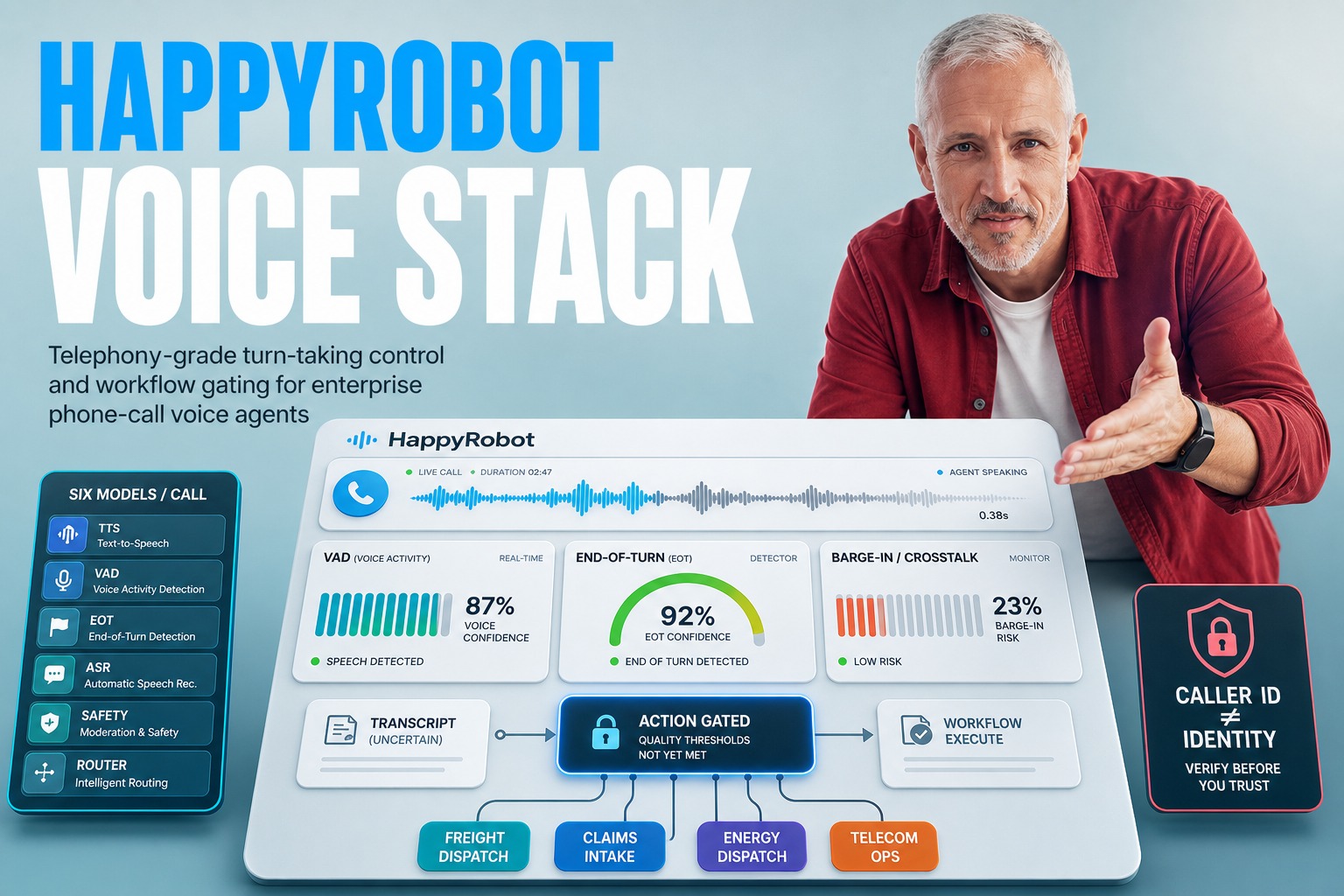
At the infrastructure level, we are looking at WebRTC or WebSocket connections to ingest raw audio streams. This stream must be forked: one path goes to an Automatic Speech Recognition (ASR) engine (like Whisper or a commercial equivalent) to generate the transcript for NLP analysis (keyword spotting, semantic coherence). The second path goes to a dedicated audio processing engine that extracts MFCCs (Mel‑frequency cepstral coefficients) or other spectral features.
Latency Budgets
A conversational interface requires a strict latency budget. If the user speaks for 10 seconds, the system needs to process that audio and return a signal within 500ms to maintain flow. This often necessitates GPU‑backed inference servers that are always hot, driving up cloud costs significantly compared to serverless, event‑driven architectures.
Data Synchronization
One of the hardest technical challenges is aligning the audio features with the text transcript. To provide context, you need to know that the candidate’s voice pitch spiked (indicating stress or excitement) exactly when they answered the question about "conflict resolution." This requires precise timestamping and a buffering strategy that can handle out‑of‑order packets if the network degrades.
Trade‑offs
The primary trade‑off here is between model complexity and operational cost. Massive transformer models that analyze audio and text jointly offer higher accuracy but require expensive GPU instances and have higher latency. Lighter models are cheaper and faster but may miss subtle nuances, leading to higher false‑negative rates in candidate screening.
Why the Market Is Moving This Way
The driver for this technology is not just AI hype; it is a response to a breakdown in traditional scaling mechanisms for recruitment. In the current economic climate, companies are laying off recruiters while simultaneously receiving hundreds of applications for every open role. Manual screening is mathematically impossible at this scale.
Technologically, we have crossed a threshold where ASR error rates have dropped low enough (often below 5% in controlled environments) that we can rely on the transcript for semantic analysis. Simultaneously, the commoditization of "emotional intelligence" APIs means that development teams no longer need to train their own models from scratch. They can fine‑tune existing pre‑trained models on proprietary interview data. This lowers the barrier to entry, allowing startups to ship MVPs in weeks rather than months. However, this ease of access masks the complexity of productionizing these models in a compliant, fair manner.
Business Value
The value proposition of voice AI in hiring is quantifiable, provided the system works as intended. The primary metric is "Time‑to‑Hire." In a typical manual process, a phone screen takes 30 minutes of recruiter time plus scheduling overhead. An AI‑driven voice agent can conduct an initial screen in 5–10 minutes without human intervention.
Cost Modeling
Consider a scenario where a company screens 1,000 candidates for a role. At a fully loaded cost of $100/hour for a recruiter, manual screening costs $50,000 (1,000 candidates * 0.5 hours * $100). An automated system, assuming a cloud compute cost of $0.05 per minute of audio processing, would cost roughly $500 (1,000 candidates * 10 mins * $0.05). Even factoring in development and maintenance amortization, the ROI is compelling.
Quality of Hire
Beyond cost, the potential value lies in consistency. Humans suffer from interview fatigue and bias (the "halo effect"). An AI system applies the same scoring rubric to candidate #1 as it does to candidate #1,000. If the model is properly calibrated, this can theoretically improve the quality of hire by removing the variance of human mood. However, this is entirely dependent on the training data; if the historical data reflects human bias, the AI will simply automate it at scale.
Real‑World Application
High‑Volume Sales Recruitment
A B2B SaaS company needs to hire 50 sales representatives. They implement a voice AI agent that conducts a 5‑minute "role‑play" interview. The system analyzes the candidate for "energy," "resilience to rejection," and "clarity of speech." Candidates scoring above a threshold are automatically calendared for a human manager interview. This filters the top 10% of applicants from a pool of 5,000, allowing the sales director to only speak to qualified leads.
Customer Support Screening
A fintech startup uses voice analysis to screen for "empathy" and "patience." The AI presents a frustrated customer scenario (a prompt) and analyzes the candidate's vocal response. It specifically looks for a decrease in speech rate and a softer pitch, which correlates with empathetic listening. This ensures that only candidates who demonstrate the right behavioral traits are moved to the technical assessment phase.
How We Approach This at Plavno
At Plavno, we do not believe in "black box" hiring tools. When we design HR voice AI assistant solutions, we prioritize auditability and control. We architect systems where every inference is logged with a reference to the specific audio segment and feature weights that triggered the score.
We implement a "Human‑in‑the‑Loop" (HITL) review layer for low‑confidence scores. If the AI returns a probability of 0.45 for a "pass" (essentially a "maybe"), the system routes that application to a human reviewer rather than auto‑rejecting. This hybrid approach maximizes efficiency while mitigating the risk of filtering out high‑potential talent due to model uncertainty. Furthermore, we treat the audio data as highly sensitive PII, enforcing encryption at rest and in transit, and ensuring strict data retention policies where audio is deleted immediately after processing to comply with GDPR and CCPA.
What to Do If You’re Evaluating This Now
- Demand Explainability: Ask your vendor or engineering team: "Can I play back the audio and see exactly which seconds of the recording caused the 'low confidence' flag?" If the answer is no, do not deploy.
- Run a Shadow Mode: Before letting the AI reject candidates, run it in "shadow mode" for 4–6 weeks. Let it analyze interviews and score them, but have humans make the actual decisions. Compare the AI scores against human ratings to calibrate the model and check for adverse impact against protected groups.
- Check the Audio Stack: Ensure your infrastructure supports high‑fidelity audio capture. If you force candidates to use a web interface with poor echo cancellation, your data quality will plummet, and your model accuracy will follow.
Conclusion
Voice AI in hiring is shifting from a novelty to a necessary component of high‑volume recruitment infrastructure. However, the difference between a tool that hires efficiently and one that creates legal risk lies in the engineering rigor. It requires a stack that handles real‑time streaming, synchronizes multi‑modal data (text and audio), and provides granular explainability. At Plavno, we focus on building these robust, transparent pipelines because we know that in hiring, as in code, garbage in leads to garbage out.