The Latency Trap: Why Real-Time Voice AI Breaks Standard Architectures The race to build human-like voice interfaces has hit a critical inflection point. This week, the industry signal is clear: the market is moving aggressively from turn-based chatbots to real-time, interruptible voice agents. This shift is driven by the release of faster, streaming-capable Text-to-Speech (TTS) and Speech-to-Text (STT) models, and the optimization of Large Language Models (LLMs) for low time-to-first-token. However, simply bolting these APIs together creates a fragile user experience. The core risk isn’t the AI’s intelligence; it’s the latency stack. If your voice agent takes 1.5 seconds to respond, it feels broken. If it can’t handle interruption (barge‑in), it feels robotic. We are seeing businesses rush to deploy voice assistants without understanding the unforgiving physics of streaming audio, leading to high abandonment rates and production failures.
Plavno’s Take: What Most Teams Miss
Most engineering teams treat voice AI as a wrapper around a chatbot: record audio → transcribe → process text → synthesize speech. This "bucket brigade" architecture is the single biggest mistake in production voice systems. It guarantees latency accumulation. Every millisecond of STT processing, LLM inference, and TTS generation stacks linearly. When you add network jitter, a simple "hello" turns into a 2‑second pause that kills the illusion of conversation.
The critical oversight is interruptibility and state management. In a human conversation, we interrupt, overlap, and correct course. Standard LLM architectures are designed for completion, not interruption. When a user cuts off the AI, the system must kill the ongoing TTS stream, discard the pending LLM tokens, and instantly feed the new partial transcript into the context window. If your architecture relies on synchronous REST calls or monolithic processing blocks, you cannot handle this. The system breaks, the audio stutters, and the user hangs up. We see teams getting stuck here because they design for the "happy path"—a perfect, uninterrupted Q&A—ignoring that real conversation is messy and asynchronous.
What This Means in Real Systems
Building a production‑grade voice agent requires a fundamental rethinking of the data pipeline. You are no longer managing request‑response cycles; you are managing a continuous stream of audio events.
The Architecture of Streaming:
At the infrastructure level, this means moving away from HTTP/1.1 polling to persistent connections like WebSockets or gRPC streams. The client (mobile or web) establishes a socket and sends raw audio chunks (typically PCM or Opus encoded) in real‑time. On the backend, we need a multi‑stage pipeline running in parallel:
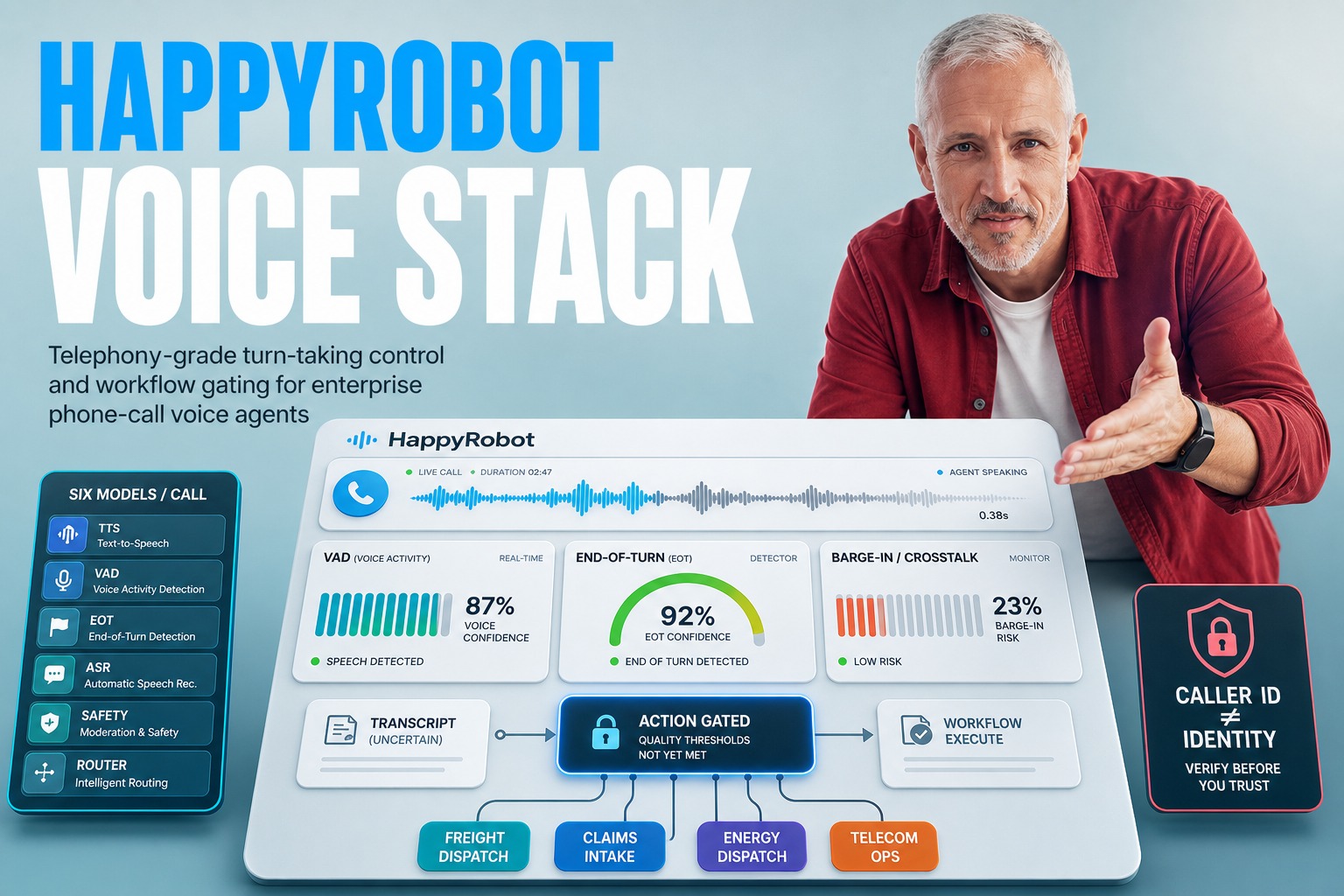
- VAD (Voice Activity Detection): Before the audio even hits the STT, a lightweight VAD model (like Silero or WebRTC VAD) must determine when the user stops speaking. This is non‑trivial. Set the threshold too low, and background noise triggers the agent; too high, and the agent waits awkwardly for silence.
- Streaming STT: We cannot wait for the user to finish speaking to start transcribing. We use streaming STT APIs (e.g., Deepgram, Whisper Turbo) that emit partial transcripts. This allows the LLM to begin reasoning before the sentence is over, shaving off hundreds of milliseconds.
- The Orchestration Layer: This is the brain. It receives partial transcripts, manages the conversation history, and decides when to trigger the LLM. It must handle "endpointing"—deciding definitively that the user has finished. If the system endpointing is too aggressive, it cuts the user off; too passive, and the agent feels slow.
- Streaming LLM & TTS: The LLM must stream tokens, not wait for full generation. As tokens arrive, they are fed into a streaming TTS engine. The TTS should begin playing audio before the LLM finishes the full sentence. This technique, often called "audio streaming" or "chunked playback," masks the inference latency.
Failure Modes:
The complexity lies in the failure modes. What happens if the WebSocket drops mid‑sentence? You need idempotency keys to replay the context. What happens if the user interrupts while the TTS is buffering? You need a "kill switch" signal that propagates instantly to the client to stop audio playback. If you are using AI agents that rely on tool use (e.g., checking a database), the latency of that external API call becomes a bottleneck. You cannot block the audio stream while waiting for a CRM response; you must implement "filler" audio or asynchronous updates.
Why the Market Is Moving This Way
The shift toward voice is driven by user friction with text interfaces. In complex domains like fintech, healthcare, or logistics, typing queries is slow and error‑prone. Voice is the natural interface for high‑stakes, high‑complexity interactions. Technologically, we have crossed a threshold where latency is no longer dictated by hardware but by software architecture. The emergence of "native audio" LLMs (models that can process and output audio directly) is on the horizon, but today's winners are mastering the orchestration of discrete STT, LLM, and TTS components.
Furthermore, the cost of inference has dropped enough to make always‑on voice agents viable for SMBs, not just enterprises. We are seeing a move away from generic "IVR replacements" toward "agentic" voice systems that can perform tasks—booking appointments, updating records, negotiating terms—rather than just retrieving information. This requires a tighter integration between the voice layer and the business logic layer, moving beyond simple API calls to deep, secure database access.
Business Value
The business case for low‑latency voice AI is quantifiable. In call center deflection, a sub‑800ms latency agent can resolve 30‑40% of Tier 1 queries without human intervention. In sales, a voice agent that handles initial qualification with human‑like pacing can increase lead conversion rates by 15‑20% simply by maintaining engagement.
Consider the cost structure. A traditional human agent costs $30–$50 per hour. A well‑architected voice agent, running on optimized infrastructure (e.g., GPU instances for inference, spot instances for audio processing), can operate at a cost of $0.05–$0.15 per minute. For a company handling 10,000 minutes of calls a day, that’s a shift from $8,000+ in daily labor costs to under $1,500 in compute costs. However, these savings evaporate if the architecture is inefficient. Poorly designed pipelines that over‑provision resources or use high‑latency models can balloon costs by 3x. The value isn't just in "using AI"; it's in the engineering efficiency of the stack.
Real‑World Application
1. Fintech Onboarding and Support:
A neobank deployed a voice agent to handle account verification and fraud checks. Instead of a static form, the agent converses with the user, asking for ID details in real‑time. By integrating directly with the core banking API via secure webhooks, the agent can verify identity and approve limits within the call. The result was a 50% reduction in verification drop‑offs, primarily because the voice interface guided users through complex steps more effectively than a web form.
2. Healthcare Triage:
A telehealth provider uses voice AI to intake patient symptoms. The system is designed with high sensitivity to hesitation and distress in the voice (using tone analysis). It routes high‑risk patients to human nurses immediately. The architectural key here is reliability and compliance; the audio stream is encrypted end‑to‑end, and the RAG (Retrieval‑Augmented Generation) system pulls from a vetted medical database to ensure accuracy, avoiding hallucinations that could cause liability.
3. Internal Logistics Coordination:
A supply chain firm built internal voice agents for warehouse managers. Instead of typing into a clunky ERP terminal, managers speak updates ("Shipment X is delayed at dock 4"). The agent parses this, updates the inventory database, and triggers alerts to downstream teams. This use case demands near‑zero latency and high noise cancellation, as it operates in loud environments. It replaces slow manual data entry with real‑time voice commands.
How We Approach This at Plavno
At Plavno, we don't treat voice as a skin for a chatbot. We design dedicated AI automation pipelines where audio is a first‑class citizen. Our architecture prioritizes the "Time‑to‑First‑Audio" metric—the time from the user stopping speaking to the moment the agent starts making a sound. We target sub‑500ms p99 latency.
We achieve this by avoiding the "bucket brigade." We implement an event‑driven architecture using message queues (like Kafka or RabbitMQ) to decouple the audio ingestion from the processing. This allows us to scale the STT and LLM components independently based on load. We also implement aggressive caching for common intents and pre‑compute responses where possible.
Security is paramount. Since voice agents often access sensitive data (PII, financial records), we enforce strict tenant isolation in our custom software deployments. We utilize private endpoints for LLM inference where data residency is a concern, ensuring that audio data never leaves the client's controlled infrastructure. We also build extensive observability into the pipeline, logging every millisecond of latency at each stage—VAD, STT, LLM, TTS, Network—so we can pinpoint bottlenecks instantly.
What to Do If You’re Evaluating This Now
If you are looking to deploy a voice agent, stop testing with text interfaces. A chatbot that feels fast will feel broken in voice.
- Audit Your Latency Budget: Do not accept "fast enough." Measure the round‑trip time. If your stack cannot consistently deliver under 800ms, you will lose user trust. Identify if the delay is in the STT, the LLM (time‑to‑first‑token), or the TTS.
- Test for Interruption: Try to talk over your agent. Does it stop immediately? Does it remember what it was saying and adapt, or does it glitch? If it can't handle barge‑in gracefully, it is not production‑ready.
- Beware of Vendor Lock‑in: Many platforms offer "all‑in‑one" voice solutions. While easy to start, they often lack the flexibility to integrate deeply with your internal APIs or to optimize the latency stack. Consider a modular approach using best‑of‑breed STT, LLM, and TTS, orchestrated via a custom layer.
- Plan for Failure Modes: What happens when the user has a thick accent? What happens when the internet connection is unstable? Your system needs graceful fallbacks—re‑prompting, switching to DTMF (touch‑tone), or escalating to a human.
Conclusion
Real‑time voice AI is the new frontier of user experience, but it exposes the weaknesses of standard software architectures. The winners in this space will not be those with the best model, but those with the best engineering—those who understand that a conversation is a real‑time, fault‑tolerant system, not a database query. If you are building voice interfaces, architect for latency and interruption, or prepare for your users to tune out.